
This week we’re sharing tributes to all of the 2025 Dance Magazine Award honorees. For tickets to the awards ceremony on December 8, visit store.dancemedia.com.
Stephen “tWitch” Boss
Stephen “tWitch” Boss had a gorgeous smile, an easygoing charisma, a theatrical hip-hop style that was all about fun. Ellen DeGeneres, whose talk-show sidekick he became, once challenged him to freestyle moves while she called up seemingly random cuts of music. The man threw himself into it, catching every facet of the tunes, never missing a beat.

Indeed, tWitch—performer, choreographer, actor, DJ, producer—always seemed game, equipped for whatever, and built for mass entertainment and Hollywood stardom. He kept focus on reaching a platform capable of holding all he wanted to express in the world, and he made it.
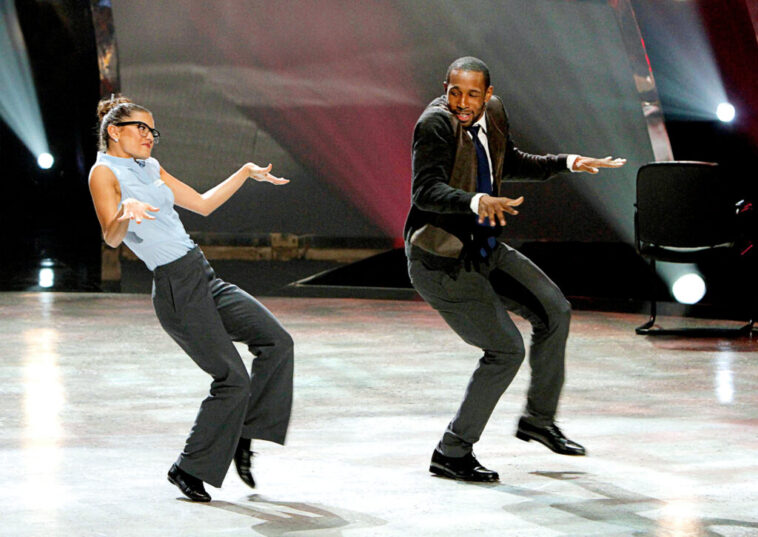
tWitch performing with Hayley Erbert on Season 10 of “So You Think You Can Dance.” Photo by Adam Rose, Courtesy Fox.
Most of that world first met him on “So You Think You Can Dance.” He performed in numerous seasons, judging a few, and gained a Primetime Emmy nomination for his choreography in Season 4. Throughout, tWitch pursued acting roles in film and television. His fame grew through the years as DeGeneres’ resident DJ, occasional host, later co-executive producer, and all-time audience favorite. He raised a young family, too, with fellow “SYTYCD” competitor Allison Holker, and the two became glamorous figures on the Los Angeles scene.
Leading up to his death by suicide in 2022 at age 40, tWitch passed two milestones—the emotional finale of DeGeneres’ long-running show and, just days prior to his death, his ninth wedding anniversary. Family, colleagues, and fans remember tWitch as a man of charm, decency, and endless creativity, who loved sharing everything he loved about dancing.
Lester Horton
Lester Horton’s career in choreography, teaching, and performance spanned eras of promising growth for his adopted city, Los Angeles—and severe threats to the U.S. and its artists, from racial segregation to the Great Depression and McCarthyism. Colleagues and students remember Horton as a man who expected and relished change. He shaped his work for the moment at hand and molded dancers equipped to meet any challenge.
Indiana-born, Horton’s own exposure to movement traditions and techniques was eclectic, including Native American dance; the cross-cultural stylings of Ted Shawn and Ruth St. Denis (which he loved to satirize); and the work of Japanese-born Michio Ito, another new Angeleno, for whom he began performing in 1929. In 1932, he launched his own troupe, a defiantly diverse one. Influential Horton trainees and star performers included Alvin Ailey, Carmen de Lavallade, Bella Lewitzky, Janet Collins, Joyce Trisler, James Truitte, Merce Cunningham, actor James Mitchell, and fashion-and-costume designer Rudi Gernreich.
 Horton in 1953. Photo by Bob Willoughby, From the DM Archives;.
Once described in a Clive Barnes review headline as a “Genius on the Wrong Coast,” Horton actually presented concert dance on both U.S. coasts, as well as nightclub acts and dance sequences in Hollywood films. His dancers found the latter work dispiriting, but Horton kept them employed in tough times. In 1946, along with Lewitzky and two other partners, he established in Los Angeles one of the first American theaters devoted to modern dance.
Horton’s most lasting legacy, though, is the training method he codified. Based on meticulous anatomical studies, not set in any one aesthetic, it aimed to build strength, flexibility, and overall adaptability in bodies of any physical form or movement background. After Horton’s death in 1953, Alvin Ailey carried this method from Los Angeles to New York City, where it became a foundation for his own works of genius. We lost both of these men way too soon, but we deeply honor Horton’s memory whenever we celebrate the Ailey company and its many generations of finely trained performers.
Janet Collins
Janet Collins’ storied life brings to mind the words of poet Dinos Christianopoulos: “They tried to bury us, but they didn’t know we were seeds.” During Collins’ childhood in early 1930s Los Angeles, one sure test of the city’s steely racial divide was for a talented Black youth to show up in search of the best ballet training and opportunities. Repeatedly, Collins found herself shut out by white schools and companies fearful of ruining their reputations. But she proved to be a pioneer and seed who inspires dancers to this day.
The teenaged Collins quickly declined an invitation to join the internationally renowned Ballet Russe de Monte Carlo. Accepting would have come with the condition that she only perform in skin-lightening makeup. Collins chose, instead, to move not only with grace but integrity.
 Collins backstage with ballet master Zachary Solov. Photo by Sedge LeBlang, From the DM Archives.
Los Angeles connections proved fortunate for Collins. She studied and worked with Katherine Dunham and Lester Horton in the city; both nurtured rich diversity within her performing and, later, choreographic style. But the East Coast awaited with unimagined triumphs: a well-received 1949 New York debut at the 92nd Street Y and a Broadway debut in the 1950 Cole Porter musical Out of This World. In 1949, recommended by Merce Cunningham, she joined the School of American Ballet’s faculty, becoming its first Black instructor. Among her many students were Robert Joffrey, Louis Johnson, and Arthur Mitchell. In 1951, Collins broke another color barrier when Metropolitan Opera director Rudolf Bing, defying his board’s resistance, wrote her a full-time prima ballerina contract.
Today’s ballet world has come to better recognize skill and radiance across color and ethnicity, largely thanks to dancers like Janet Collins who never gave up or compromised on their dreams.
Michael Peters
Michael Jackson’s music videos blasted MTV wide open for generations of Black artists, previously a rare sight on the channel. And Jackson’s performances virtually owned MTV thanks to the innovative choreography of Michael Peters.
 Photo by Ed Fortson, From the DM Archives.
Brooklyn-born Peters was the man for the job, keenly attuned to pop music as a living force. Or maybe not always quite so living, for it was Peters, with Jackson, who set in motion the sly, electrifying werewolf of “Thriller” and released the undead zombie “funk of 40,000 years.” Peters was also the choreographic vision behind Jackson’s “Beat It” video, and even portrayed the gang leader dressed in immaculate white and sunglasses.
Peters’ career included numerous achievements in television, theater, and film, and many honors, including a 1982 Tony (Dreamgirls), two Primetime Emmys, and the 1994 American Choreography Award for guiding Angela Bassett’s sensational Tina Turner moves in What’s Love Got to Do with It. Peters also choreographed and directed videos and acts for Donna Summer (“Love to Love You Baby”), Lionel Richie (“Hello”), Pat Benatar (“Love is a Battlefield”), and other top-flight artists.
In 1994, we lost Peters to AIDS at 46. In her New York Times obituary, critic Jennifer Dunning credited him with “helping to raise the production values” of music videos, as well as respect for the genre as “serious works of popular culture.”
Peters’ work, embraced by a world of young music fans, heightened the visibility and appeal of creative dance, influencing arena shows and dance-competition shows for years to come. A strong advocate for choreographers in Hollywood film, he’s also remembered for pushing for an annual Academy Award for the field, a worthy goal yet to be achieved.
The post 2025 Posthumous Dance Magazine Awards appeared first on Dance Magazine.




GIPHY App Key not set. Please check settings