
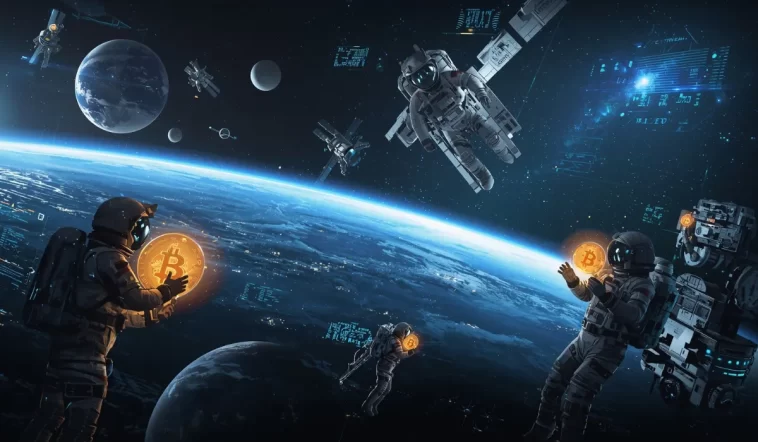
Two tech scientists have published a paper exploring the feasibility of deploying Bitcoin as an interplanetary monetary standard for financial transactions between Earth and Mars. Apparently, BTC can be transferred in as little as three minutes using existing technologies, but only needs a human or machine to receive it on the red planet.
International space agencies are busy working on plans to terraform Mars, and usually bring up the subject of water, radiation, and agriculture; however, this groundbreaking research speculates currency as a frontier that may be just as essential as the others.

Late last month, Jose E. Puente and Carlos Puente released a whitepaper titled “Bitcoin as an interplanetary Monetary Standard with Proof-of-Transit Timestamping,” suggesting that the apex cryptocurrency’s scarcity, decentralized verification model, and predictable issuance make it a “natural” candidate for a universal monetary standard.
Proof-of-Transit Timestamping to Send BTC Between Earth and Mars by Relying on Ground Stations and Satellites
The main challenge here is the 3 to 22-minute radio transmission delay between Earth and Mars, which makes it impossible to conduct synchronized Bitcoin mining activities on both planets. This level of latency would also make real-time proof-of-work (PoW) consensus impractical and even simple payment unreliable.
The proposed Proof-of-Transit Timestamping (PoTT) model aims to solve this bottleneck as it suggests that if a Bitcoin user wants to send a payment to someone on Mars in the future, then that transaction would be delivered through different stations, such as ground antennas, satellites, or even via a relay around the moon.
PoTT introduces a proof-of-concept cryptographic, tamper-evident audit system where the transaction is signed and timestamped at each relay station before continuing the journey until it reaches the recipient’s destination. If a block or transaction is delayed, the consensus algorithm tells exactly where the transmission delay occurred.
The researchers noted that PoTT serves as a receipt layer on the Bitcoin and Lightning Network while leveraging optical links built by NASA, Elon Musk’s Starlink, or other satellite providers. According to them, the technology is “essentially ready” and Bitcoin could become the first currency to operate across planets as soon as a stable link is established between Earth and Mars.
Once up and running, BTC Lightning transactions could reach Mars in as little as three minutes, or as long as 22 minutes under a worst-case scenario.
Jose and Carlos Puente assured that the consensus mechanism does not alter Bitcoin’s layer-1 economics or its monetary policy; instead, it adds a responsibility layer that allows Mars to process BTC transactions, Lightning payments, and sidechains locally, while still back-pegging against the Layer-1 on Earth for settlement.
Technically, Bitcoin mining won’t take place on Mars, but the planet could have a local economy based on BTC pegged to the supply available on Earth. Consumer payments would be made instantly over Lightning channels, while bulk transactions would be settled asynchronously between both planets.
On addressing the issue with the two-week blackout period on Mars that occurs every 26 months, their solution is to deliberately route transactions around the Sun using relay satellites to avoid the blackout. Jose Puente explained that PoTT functions like any ordinary Bitcoin timestamping technology except that it can extend into outer space.
Bitcoin is Planet-Agnostic and has Already Made it to Space
The concept builds on top of Blockstream’s satellite service from 2018, when the blockchain development firm leased five satellites to broadcast the Bitcoin network over Africa, Europe, South and North America, and the Asia Pacific, providing internet-free transactions and information sharing to crypto users across the five continents. The company also released an API that enabled the satellites to transmit encrypted messages, while allowing users to pay for the service using micropayments on the Lightning Network.
In August 2020, SpaceChain partnered with the European Space Agency (ESA) to complete the first Bitcoin transaction from the International Space Station (ISS). This was made possible by transmitting encrypted data from a ground station to the ISS, where a hardware wallet containing the private key signed off on the transaction. The space-as-a-service focused blockchain startup delivered the multi-sig hardware wallet technology to the space station via a SpaceX Falcon 9 rocket that was launched at the end of 2019.
However, the biggest caveat is that for a Bitcoin transaction to occur on Mars, a human or an AI would need to be present, which hasn’t happened yet. Currently, only rovers, landers, and orbiters from NASA and other space agencies have explored the planet’s surface.
Amazon founder Jeff Bezos’s Blue Origin has started accepting cryptocurrencies, including BTC, Ether (ETH), Solana (SOL), USDT, and USDC, but so far the company’s shuttles have only reached about 100 kilometers above Earth.
Musk’s SpaceX is aiming to reach Mars by the end of 2026, and plans to build a self-sustaining settlement there. Like Jose Puente, the Tesla and X owner also argued that a standardized form of money is needed to transact between Earth and Mars, but expressed concerns over Bitcoin’s 10-minute block time.
Also Read: Top 3 Crypto Price Predictions today: Pi Coin, AVAX, and XRP
PoTT Ready for Early Prototyping as Space Agencies Race to Send Humans to Mars
Puente argued that Lightning Network addresses this issue, as PoTT and Lightning combine to provide local speed with global settlement that works across planets.
While making his case for Bitcoin being the most appropriate form of interplanetary currency, the tech entrepreneur said that if humanity is serious about becoming a multi-planet civilization, then it needs an open, neutral monetary base that is not dependent on any single company, government, or ground station.
He also noted that PoTT is designed to be planet-agnostic across a star’s habitable zone, meaning that the travel receipts it generates could have come from transactions sent to the moon or any other planet.
Currently, the research is focused on Earth and Mars because it is the cleanest near-term case study. The authors reiterated that the proposal for Bitcoin as a shared monetary standard between the neighboring planets is already concrete enough for early prototyping.
At the time of writing, Bitcoin (BTC) is trading at $113,966, up 1.46% in the last 24 hours.




GIPHY App Key not set. Please check settings