
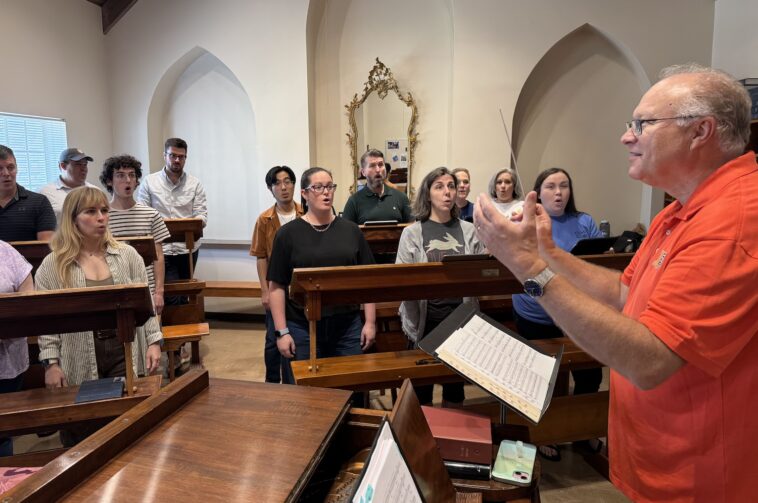
Dr. Stanley Roberts leads a Coro Vocati rehearsal. (Photos courtesy of Coro Vocati)
The Atlanta choral ensemble’s new artistic director talks about a new season, which begins October 18.

When I last spoke to Mercer University associate dean and professor of choral conducting Dr. Stanley Roberts, he was preparing to appear as guest conductor at Coro Vocati’s May performance of Two Rivers: A Journey Through Life’s Contrasts. At the time, he was one of a rotating slate of guest conductors following the retirement of Founding Conductor John Dixon. Fortune has smiled on Roberts in the months since, and he will now take the stage as the choir’s newly confirmed artistic director and conductor.
“I was thrilled to have the opportunity to come in and put that concert together for them,” he says of the concert that marked 15 years of the chamber choir’s operation. In hindsight, he views the audition aspect of the concert as an afterthought. “Obviously, they were looking for someone, but it was never presented to me as an audition. The board met over the summer, called and said ‘What’s the possibility that you’d be the artistic director?’”
Dr. Stanley Roberts.
Now ensconced in his new position, Roberts looks forward to kicking off Coro Vocati’s upcoming 2025-26 season, which will follow the ensemble’s usual set of three concerts — one each for fall, winter and spring. As is customary for Coro Vocati, the programs aim to offer conceptual frameworks that transcend mere choral performances. The season opens with An American Landscape: The Joys of Our Spirit, with performances on October 18 and October 19.
“We’re picking up on Walt Whitman poems from Leaves of Grass,” explains Roberts. To that end, the program emphasizes relatively contemporary American composers with works by modern masters Aaron Copland and Samuel Barber standing alongside those by the still active Eric Whitacre and René Clausen.
“There’s a little bit of Americana flavor to it,” says Roberts of the show’s folksy undercurrents.
Given that one of Coro Vocati’s most outstanding claims to fame is that it premiered Craig Hella Johnson’s Considering Matthew Shepard, a meditation on the murder of gay 21-year-old Matthew Shepard. I’m curious to know if the “Americana” theme of the upcoming show was similarly socially conscious.
“The programming is not so much set to make some type of political statement,” Roberts replies. “For this concert especially, I look at it as the musical elements that bind us. Some of these musical gems have been a part of the fabric of the American choral life over the years. It’s a way of us coming together more so than just making a political statement.”
Nevertheless, that coming together at a time when the country remains so bitterly divided carries a political weight all its own, and Roberts is quick to concur. “You will find in any ensemble you conduct, whether it’s a university ensemble or a church choir or a professional choir, that you oftentimes will have the entire spectrum of thought sitting in front of you,” he says of the diverse array of mind-sets and walks of life that come together in a given choir. “It’s this wonderful opportunity we have as conductors to work within that framework of finding that which is common: our common humanity, our common goodness.”
On December 13 and December 14, the choir will be performing Christmas With Coro Vocati: Songs of Wonder, Hope and Joy. “That concert will be very accessible for anyone in the family,” says Roberts. The concert will run the gamut from contemporary, jazzy contemporary numbers to vintage Christmas material. Most notable will be works by Giovanni Pierluigi da Palestrina in honor of the composer’s 500th birthday. “Palestrina is widely considered to be the height of the Renaissance choir.”
Coro Vocati returns to the bucolic May 2 and May 3 for its third and final program of the season, Dirt Roads and Footpaths. For Roberts, the pastoral imagery was rooted in his origins as a south Georgia farmboy and how the long winding dirt roads of his youth became a metaphor for the journeys we take in life.

Some 40 years after that upbringing, Roberts was in England to attend the Three Choirs Festival in Gloucester. In that time, he found himself spending free time wandering down the many footpaths in England’s Lake District. Those meditative walks formed the basis for Dirt Roads and Footpaths. Central to the concert will be John Corigliano’s setting of Dylan Thomas’ poem Fern Hill.
I can’t help but think the Dirt Roads and Footpaths concept carries more of that socially conscious undercurrent. Roberts is quick to concur. “Some days you’re on the path and enjoying the adventure, and sometimes you’re called to help maintain the path for those that are coming behind you,” he affirms.
Despite the conceptual framework that sets Coro Vocati apart from its peers, Roberts is first and foremost enthusiastic about the ensemble he’ll be working with. “It’s a great opportunity for me as a conductor,” he beams. “To work with this level of musician who has an incredible eagerness to dig deeper into their choral art … there’s nothing they can’t do. This choir can sing anything.”
::

Jordan Owen began writing about music professionally at the age of 16 in Oxford, Mississippi. A 2006 graduate of the Berklee College of Music, he is a professional guitarist, bandleader and composer. He is currently the lead guitarist for the jazz group Other Strangers, the power metal band Axis of Empires and the melodic death/thrash metal band Century Spawn.




GIPHY App Key not set. Please check settings