
NEED TO KNOW
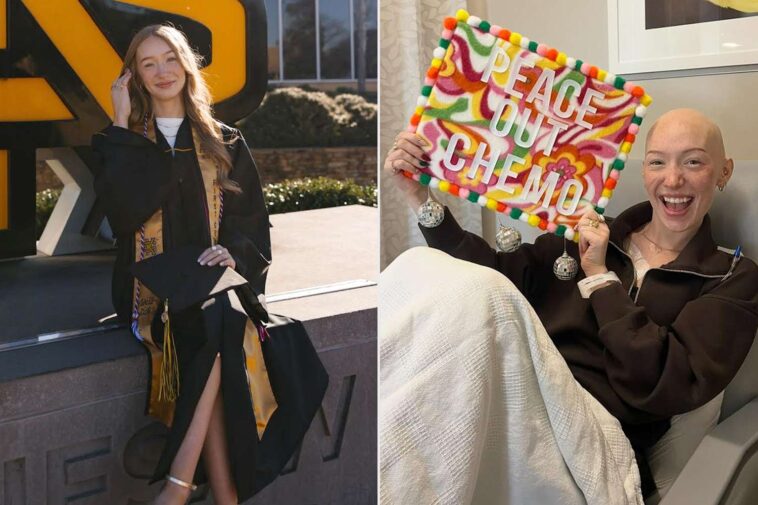
Months after graduating college, Allie Reece experienced shoulder painEventually, at 23, she was diagnosed with Hodgkin’s lymphomaSince then, she’s shared her cancer journey on TikTok, where she has built a supportive community of thousands of followers
When Allie Reece first noticed shoulder pain, she didn’t think much of it. A recent graduate of Kennesaw State University, Reece, then 22, had moved back home to Canton, Ga., in December 2024, and was juggling part-time work, social obligations and the stress of transitioning into adulthood.

Part of living at home meant sleeping in her childhood twin-size bed, and the mild ache in her collarbone and shoulder seemed easily explained.
“It was the kind of annoying pain you get when you sleep wrong,” Allie tells PEOPLE exclusively. “It wasn’t sharp or constant, and it usually went away by the next day.”
Over the next several months, the shoulder pain came and went — sometimes after golfing, other times after long walks — but it never lingered long enough to raise concern.
Allie Reece in April 2025.
Allie Reece
Then, in April 2025, her worry spiked. Two weeks after a day on the golf course, she woke with a sharp, stabbing pain in her shoulder blade, unlike anything she had felt before. Alarmed, she went to the emergency room.
Initially, doctors suspected a blood clot. But a CT scan revealed something far more serious: a mass in her chest, roughly the size of an orange. Physicians suspected lymphoma, though confirmation would take time.
“I’ll never forget that first moment — it was disbelief,” Reece says. “You hear the word ‘mass,’ and your mind immediately goes to the worst-case scenario. Even knowing it could be treatable, the fear is overwhelming.”
Allie Reece in the hospital.
Allie Reece
The following day, Reece met with an oncologist, a meeting she recalls as emotionally overwhelming. “I was a wreck,” she says. “Anytime someone would talk to me, I would just start crying. I’m not normally a crier, but for about two weeks, I was completely unstable.”
Her oncologist explained that the first step would be a fine needle biopsy, which extracts a small sample from the mass for testing. When the results came back benign, Reece’s anxiety only deepened.
“I ended up having three surgeries because everything kept coming back benign,” she says.
Determined to find answers, Reece sought a specialist at Piedmont Hospital in Atlanta. She underwent a cervical mediastinoscopy — a delicate surgery around her heart and lungs — to biopsy three lymph nodes. Yet once again, the results came back benign, prolonging the uncertainty and fear.
It wasn’t until a PET scan was finally approved that clarity arrived. The images revealed both the mass and an affected lymph node, confirming the presence of cancer cells. Relief mingled with dread — at least now they knew the problem, but the road ahead remained daunting.
“The next step was a robotic thymectomy,” Reece recalls. “They went in through small incisions under my armpits and along my chest. They deflated my lung to reach the mass, which was wrapped around my heart and lungs. The plan was just a biopsy, but they were able to remove the entire mass.”
Allie Reece during chemotherapy.
Allie Reece
After a week and a half of agonizing waiting, in August 2025, her oncologist delivered the long-awaited confirmation: Hodgkin’s lymphoma.
“They were very reassuring about the survival rate,” she says. “It’s very common in people our age. She told me, ‘You’re going to be fine. It’s going to be tough for a while, but you should live.’ ”
Even with that reassurance, fear lingered. “Until you hear the final pathology results, it’s terrifying,” she says. “You feel like you’re walking on a tightrope every day.” But having a clear path to treatment offered a fragile sense of hope after months of uncertainty.
Right away, Reece, now 23, began an eight-round regimen called ABVD, a standard treatment for Hodgkin’s lymphoma. The side effects were immediate: fatigue, nausea and hair loss.
Determined to normalize the experience for others, Reece turned to TikToksharing candid moments from chemotherapy appointments and the emotional journey of shaving her head — a story that reached over five million people.
“I’m 23, dating and suddenly I had to face the fact that I was going to be bald. I wasn’t happy about it at all,” she says. To prepare, she experimented with wigs, ordering several and posting about them online to help other girls facing the same challenge.
When the time came, she cut her long hair into a lob, thinking shorter hair would be easier to lose — a decision she calls one of her best ideas. As her hair thinned, she collected it in a bag she named Lola, a ritual that gave her a sense of control over something that felt completely uncontrollable.
“I wanted to show that it’s scary, but it’s doable,” she says. “You don’t have to be crying or miserable. If I can do it, anyone can.”
Reece also chose to freeze her eggs through IVF, a process she found intimidating because there weren’t many relatable resources online. “I wanted to make content that could help other girls going through the same thing — it’s scary, but doable. If I can do it, anyone can,” she says.
Her openness resonated. Messages poured in from people expressing gratitude, sharing their own experiences, or simply saying, “Thank you for sharing — it helps me feel less alone.”
Allie Reece in the hospital.
Allie Reece
Throughout her treatment, she says her family and friends became her backbone.
Her mother accompanied her to appointments, managing logistics and providing emotional support. Her brother shaved his head alongside her, while friends organized care packages, drove her to sessions and offered constant encouragement.
“I couldn’t have done it without them,” Reece says. “They reminded me every day that I wasn’t in it alone.”
However, not every day was brave. Reece says some nights, after chemotherapy, she’d lay awake scared and exhausted, overwhelmed by uncertainty. Yet amid the fear, she found moments of resilience and gratitude, especially through her community of over 100,000 followers.
“There were days I thought, ‘I can’t do this,’ and other days I’d think, ‘I’ve got this,’” she says. “Cancer forces you to slow down and reflect on what matters most.”
Allie Reece with her family.
Allie Reece
After completing chemotherapy in December 2025, Reece marked the milestone by ringing the bell at the infusion center — a symbolic end to treatment. Surrounded by family, doctors and nurses, she reflected on the journey: the fear, the pain, the uncertainty and the unexpected joy of perseverance.
“That moment was surreal,” she says. “It was a mix of happiness, relief and gratitude. You don’t get to that point without the people around you, cheering you on.”
Now cancer-free, Reece focuses on wellness, fitness and sharing her story to inspire others. She continues to post updates on social media, offering a glimpse into life after chemotherapy — including challenges, triumphs and the small, everyday moments that feel monumental after what she’s endured.
“If my story can make someone feel seen, heard or understood, then it’s worth sharing,” she says. “Cancer changes you, but it doesn’t define you. It’s about what you do after, how you live and who you lift up along the way.”
“Even when symptoms seem minor, don’t ignore them,” she says. “It’s better to check and be safe. Early detection can make all the difference.”



GIPHY App Key not set. Please check settings