
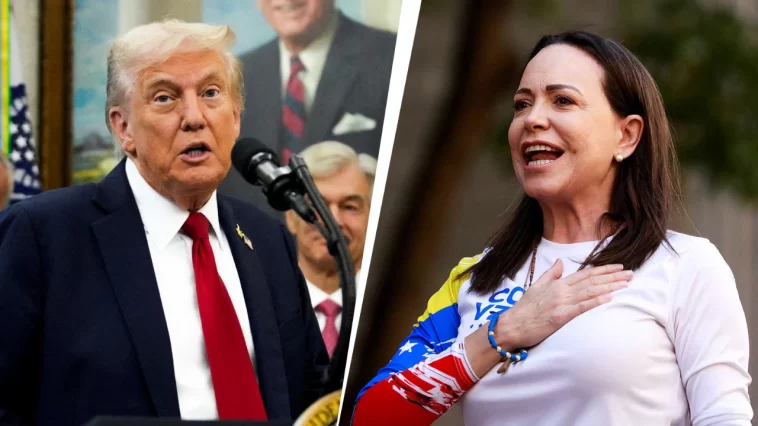
Key Points
A planned Trump–Machado meeting spotlights a basic question: who can actually run Venezuela tomorrow.
Maduro’s removal did not hand power to the opposition; the state is still held by insiders and security chiefs.
The outcome matters abroad because it will shape sanctions, oil supply expectations, and migration pressure across the region.
María Corina Machado is expected to walk into the White House on Thursday, January 15, for a meeting with President Donald Trump. On paper, it looks like a straightforward show of support for Venezuela’s best-known opposition leader.

In reality, it is a test of something far more practical: whether Washington believes legitimacy is enough when the machinery of power sits elsewhere.
Trump has already hinted at the problem. He recently questioned whether Machado has sufficient backing inside Venezuela to lead the country.
 Machado Heads To The White House As Trump Bets On Regime Insider. (Photo Internet reproduction)
That skepticism hardened after a U.S. operation in Caracas ended with Nicolás Maduro in U.S. custody to face narco-terrorism charges, with his wife Cilia Flores also detained, according to international reporting.
Venezuela’s power shift tests U.S. leverage
If Maduro’s removal was the climax, the next scene was the twist. Delcy Rodríguez, a senior figure from the same governing structure Venezuelans have blamed for collapse and repression, was sworn in as interim leader.
Reports describe a classified CIA assessment arguing that a transition anchored in parts of the existing state would be more stable in the first weeks than one led by an opposition movement without control of the armed forces, intelligence services, or key ministries.
That logic explains why names like Diosdado Cabello at the Interior Ministry, Defense Minister Vladimir Padrino, and National Assembly leader Jorge Rodríguez still matter.
They sit atop the institutions that issue orders, manage budgets, and decide who gets arrested and who gets protected.
It is also why the United States has long offered large rewards for information leading to the capture of senior figures tied to alleged trafficking networks: $25 million for Cabello and $15 million for Padrino.
Machado’s meeting with Trump is, in that sense, a bid to bridge a dangerous gap: moral authority versus operational control. A White House photo can strengthen her standing with allies and donors. It cannot, by itself, command checkpoints, ports, or payrolls.
Why this is meaningful abroad is simple. Venezuela’s political outcome will influence sanctions policy, the pace of any oil-sector reopening, regional security spillovers, and the flow of migrants into neighboring countries.
For Brazil and the hemisphere, a clean transition could ease pressure. A cosmetic one could freeze the crisis in place.




GIPHY App Key not set. Please check settings