
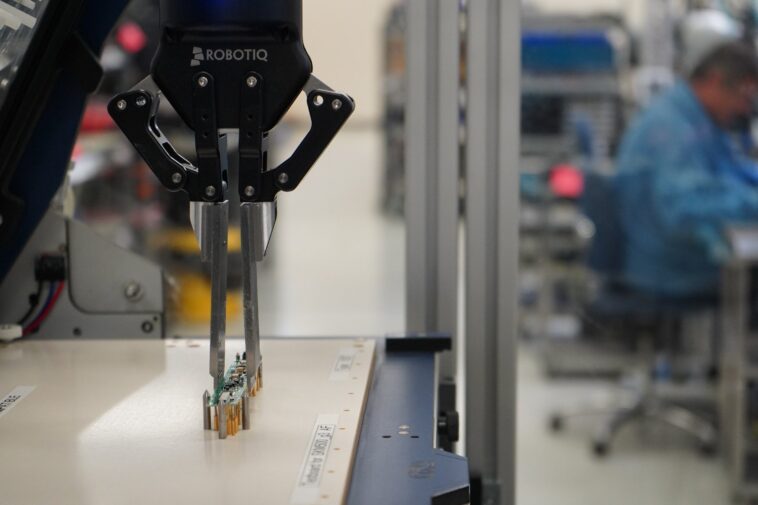
At Sennheiser Manufacturing USA in Albuquerque, precision is non-negotiable.
Every week, the facility assembles 30,000 printed circuit boards (PCBs) that power 1,500 professional audio devices for the Americas and Asia. With 115 different PCB variants running through production, automation is essential to maintain throughput and quality.

But one critical step remained manual: 100% PCB testing.
As production increased, testing became a bottleneck.
Here’s how Sennheiser removed that bottleneck and increased the number of PCBs tested by 33% in one year.
Results at a glance
33% increase in PCBs tested within one year
115 PCB variants handled with one adaptive gripper
100% PCB test coverage maintained
Real-time cobot KPI monitoring implemented
Second cobot justified using production data
Keep reading for the full story…
The challenge: manual PCB testing became a bottleneck
“At Sennheiser, we test everything 100%,” explains Manufacturing Manager Steven Nery.
The process was simple but repetitive:
An operator places a PCB into the tester
Closes the fixture
Waits for the test cycle
Removes the board
Loads the next one
Repeat for eight hours.
With 115 PCB types and rising production demand, manual handling limited scalability. The team needed a solution that could:
Handle frequent part changeovers
Adapt to different PCB sizes and form factors
Maintain consistent quality
Integrate quickly without disrupting production
The solution: flexible gripping and collaborative automation
Test Engineer Roger Case began exploring automation options. The breakthrough came with Robotiq’s 2F-85 Adaptive Gripper.
“Robotiq had a unique solution: a reliable gripper that can manage part changeovers quickly, which was important for our high-mix, high-volume production. Plus, its wide stroke fit the form factor of the PCBs we were looking at.”
Within weeks, the team deployed a Universal Robots UR5 cobot equipped with the 2F-85.
The automated workflow:
The robot picks up a PCB with the gripper
Moves it to a scanner to validate part ID
Loads it into the tester
The tester signals start
After testing, the system sends a pass/fail message
The robot sorts the PCB into the appropriate bin
The result was a repeatable, consistent testing cycle — without manual intervention.
Measuring performance with Robotiq Insights
From the beginning, Sennheiser treated their cobot like a new team member. They even named it ART (Automated Robotic Team member).
But performance needed to be measurable.
“Since we always evaluate how new employees are performing, I told our managers we should do the same for ART,” says Case.
To track KPIs, the team connected the robot to Robotiq Insights, a web-based monitoring application.
Insights quickly became a shop floor control tool used by multiple groups:
Managers use dashboards to visualize production performance
Engineers receive daily reports and stop alerts
Operators receive notifications when trays need reloading
“I use Insights to communicate information to non-engineering people, because I can just point to the dashboard and explain what’s going on,” says Nery.
When the robot stops, the team knows immediately — and can react quickly. That visibility transformed automation from a black box into a controllable, optimizable process.
33% more PCBs tested with higher consistency
After one year, the numbers were clear.
“With ART1, we saw an increase of around 33% in the number of PCBs tested over a year,” says Case. “And the quality was higher because the handling was more consistent.”
The production data collected through Insights helped justify the purchase of a second cobot.
Today, ART2 (a UR5e) operates alongside ART1, and the factory is aiming to double PCB testing capacity.
The first deployment removed a bottleneck. The second scaled a proven system.
A new role on the shop floor
Automation didn’t eliminate jobs; it elevated them.
Marcella Segovia previously performed the repetitive manual testing process. Today, she runs the robot testing operation.
She:
Prepares trays
Prioritizes job orders
Changes robot programs for different PCB types
Monitors production
Insights sends her a text message when trays are empty so she knows when to reload.
“I was a little scared of the robots at first, but I really wanted to learn how to run them,” she says. “They’re fast, but I can keep up — and it’s great how much we’ve increased our numbers.”
Repetitive manual testing became a higher-value technical role at the center of production.
The bigger picture: scaling with data, not assumptions
Sennheiser didn’t automate everything at once.
They:
Identified a clear bottleneck
Deployed a flexible cobot cell
Measured performance
Used real production data to justify scaling
That’s Lean Robotics in action.
By combining a flexible adaptive gripper, a collaborative robot, and real-time performance monitoring, Sennheiser turned testing into a competitive advantage — and built a clear path for future expansion.
If PCB testing is limiting your throughput, the opportunity may not be in adding labor — but in removing the bottleneck with flexible automation and measurable performance.




GIPHY App Key not set. Please check settings