
Hardware and infrastructure stocks have been some of the biggest winners of the AI boom. Is Micron another winner in the making or is it overhyped?
Some of the biggest winners of the artificial intelligence (AI) trend have been the hardware and infrastructure companies supporting it, not the software companies developing AI programs.

Nvidia is probably the best example. AI’s demand for its graphics processing units (GPUs) propelled it into the trillion-dollar club a couple of years ago and into becoming the world’s most valuable company today with a market cap of $4.6 trillion.
So, it seems one of the best ways to play AI is by investing in the infrastructure supporting it. And one of the most attractive values in the AI infrastructure space right now is Micron Technology (MU 0.56%).
You may have heard about it in connection with memory hardware for AI, but is the Micron opportunity real or is it just hype? Keep reading and I’ll tell you.
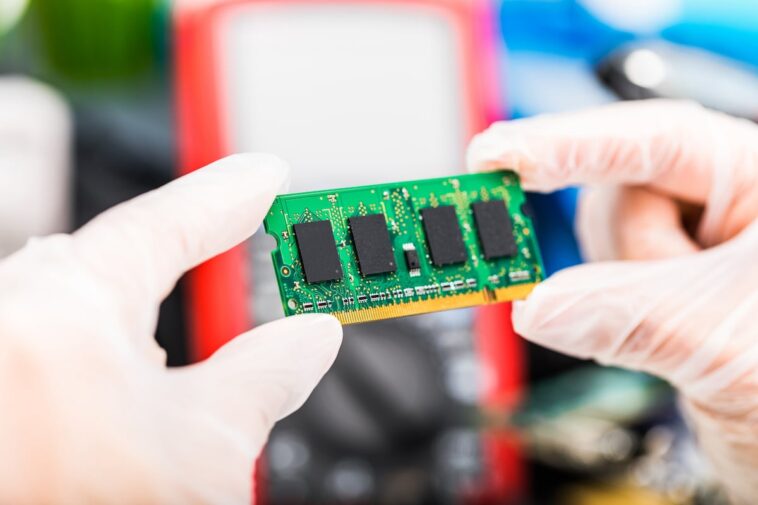
Image source: Getty Images.
Random Access Memories
For your computer to store and access data in the short term, it needs a component called random access memory (RAM). For AI programs to make inferences from data it has been trained on, it needs a lot of RAM or dynamic random access memory (DRAM) a sub-type of memory hardware preferred for AI.
Micron is one of three companies that make up roughly the whole of the memory hardware market. The other two are Samsung and SK Hynix. But the demand AI has put on those three companies has created a shortage in memory hardware.
RAM prices are expected to increase 50% in the first quarter of 2026 alone. Intel CEO Lip-Bu Tan has stated that the memory shortage is unlikely to end until at least 2028.
Micron’s business is simple; it designs and produces memory hardware, both RAM and DRAM, for computers. But so great is the opportunity presented by AI’s memory needs that Micron actually exited the consumer PC market late last year to focus on AI.
Just last month, Micron, which is based in Boise, Idaho, broke ground on a $100 billion semiconductor factory in upstate New York. The factory is slated to employ over 9,000 people and will be the largest semiconductor factory in the United States once it’s completed.
So, Micron is positioning itself to be the dominant provider of memory hardware to the American market.

Today’s Change
(-0.56%) $-2.31
Current Price
$411.66
Key Data Points
Market Cap
$463B
Day’s Range
$392.71 – $420.88
52wk Range
$61.54 – $455.50
Volume
34M
Avg Vol
33M
Gross Margin
45.53%
Dividend Yield
0.11%
Memory at a bargain price
While Samsung is a larger company than Micron, Micron is the growth opportunity between the two. Micron’s revenue for Q1 of its fiscal 2026 (ended Nov. 30, 2025) was up 57% year over year to $13.6 billion. DRAM made up 79% of that number, which shows that most of Micron’s growth is coming from AI.
But the revenue wasn’t the only highlight. Micron is also incredibly profitable with a gross margin of 56.8%, while its operating margin was 32.5%, and its net margin was 28.15%.
Micron is also trading at an incredible valuation right now. It trades at a forward price-to-earnings (P/E) ratio of 10.57, which is higher than Samsung’s 8.5.
However, when we factor in growth for the price-to-earnings-to-growth (PEG) ratio, Micron is at 1.12 to Samsung’s 3.31, making it an attractive buy at current prices even after its 330% bull run in the past 12 months.
Believe the hype; Micron is emerging as a serious player in the AI hardware market. So give it a look.




GIPHY App Key not set. Please check settings