
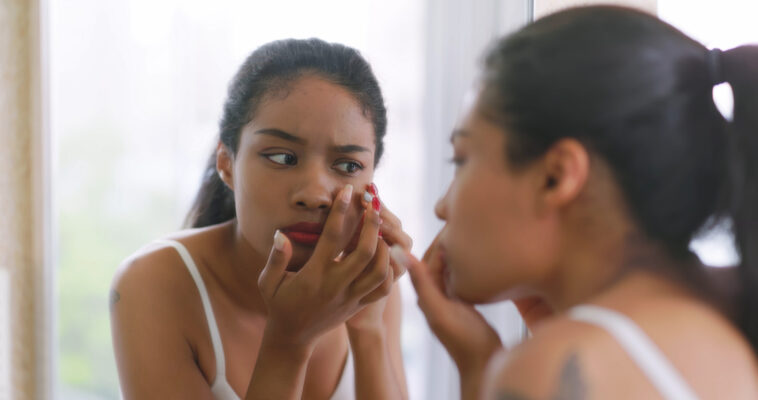
We’ve all been there: The morning before a big performance, a huge zit—or a whole breakout—decides to show up. Ugh. Time to cover up with concealer, put on a full face of stage makeup, and sweat under the lights for hours. Surely, that just makes it worse, right?
First and foremost, don’t worry. Breakouts are entirely normal, and they shouldn’t get in the way of performance. Luckily, there are steps dancers can take to manage breakouts and keep their skin as healthy as possible, even during the busiest of competition or performance seasons.

What Is Acne?
Amanda Fredette. Photo courtesy Fredette.
According to Amanda Fredettea certified physician assistant at Rhode Island’s Aspire Dermatology, acne results when oil or other substances clog pores and hair follicles. “It’s a condition that we see every day in the dermatology practice,” she says. Most often, acne appears as whiteheads, blackheads, or cysts, and it can have a variety of causes.
For tweens, teenagers, and young adults, hormone fluctuations are often the culprit. Fredette explains that hormone changes often produce excess oil, which clogs pores. Breakouts can also occur when the skin isn’t properly cleaned or hydrated, or because of excess friction. And while makeup, stress, and diet may exacerbate underlying issues, Fredette clarifies that they don’t produce acne on their own. (Some underlying medical conditions, like polycystic ovarian syndrome, can also cause or worsen acne. In these cases, consult a medical professional.)
Glamming Up
As a teen, commercial dancer and choreographer Mel Charlot dealt with plenty of breakouts. Charlot, who now judges on the TV shows “Révolution” and “Danse avec les Stars” (France’s “Dancing with the Stars”), dealt with hormonal acne caused by PCOS. “It was difficult,” she recalls. “Back then, at competitions, my dance team used the same kind of makeup so we’d all look the same. I felt like my skin couldn’t breathe.”
The thing about stage makeup, says Charlot, is that more is more. “It was always a full-beat look,” she says. “The type of makeup we had was very heavy, because you wanted to make sure it could be seen from afar and would stay after sweating.” Fredette explains that for dancers with sensitive skin, heavy makeup can break down the skin barrier and make them more acne-prone. “It’s important to look at the ingredients in your makeup,” she says. “Many contain pore-clogging ingredients like oils, waxes, and silicones.” Noncomedogenic products are ideal, and dancers who are prone to breakouts can try a foundation that contains salicylic acid. “It’s almost like an acne medication in the makeup,” she says. “You can layer it knowing it won’t clog your pores.”
 Mel Charlot on Dancing With The Stars. Photo by Pixeline Photographie, courtesy Charlot.
Charlot warns that applying more makeup to cover up pimples can sometimes emphasize them instead. She recommends using a color-corrector to reduce redness. (Resist the urge to over-apply!) Dancers can also put makeup on top of pimple patches, so long as the adhesive doesn’t irritate their skin. For spot treatment, Fredette suggests over-the-counter acne medication, like benzoyl peroxide or salicylic acid, applied to a clean face.
Seeking Solutions
While it may take time to find the right products and regimen, Fredette encourages dancers not to give up. High-quality skin care doesn’t have to be expensive; pay attention to ingredients, and once you find what works for you, stick with it. When in doubt, seek professional advice.
For Charlot, seeing a dermatologist, which helped her establish her best skin-care routine, was the most important step for her skin health. “We would figure it out together, which was beautiful, because I felt like somebody was accompanying me during my journey,” she says. “It can feel embarrassing and humbling to talk about your acne, but it’s super-important to be honest. That’s the only way you can find what works for you.”
 Mel Charlot (center) on Dancing With The Stars. Photo by Pixeline Photographie, courtesy Charlot.
At the end of the day, she adds, breakouts shouldn’t affect your confidence or dancing. “You might have some bumps. But who doesn’t? Nobody is walking around looking like a photoshopped magazine cover.” Don’t let acne steal your spotlight—focus on dancing your best, and remember that confidence starts on the inside.
Quick Tips
Take it off: Always remove makeup at the end of the day. Fredette recommends a double wash, starting with an oil-based cleanser to break down stage makeup, then a water-based cleanser to wash away any remaining oil, bacteria, or sweat. (For exfoliants, avoid cleansers with beads, which can damage the skin; gel or cream options with salicylic acid are safer.) Then, apply moisturizer to seal the skin barrier overnight.
Don’t forget: Charlot reminds dancers to cleanse the nooks and crannies around the nose, as well as the edges of the face and jawline, during the double cleanse. Gel or hairspray can also leak down around the hairline. “Especially for Black women, we’ll gel down the baby hairs, so it’s important not to forget to wash that,” she says.
Practice good hygiene: Clean makeup brushes and sponges regularly, and don’t share applicators or products. If you’re applying makeup with your hands, says Fredette, wash them first. And no matter what, don’t pick or pop pimples. “You’ll risk infection and make it even harder to heal,” she explains. Use a warm compress to help painful cysts or whiteheads work their way out.
Try a primer: Primer helps the makeup to sit more smoothly, and it also protects the skin. Fredette suggests applying a noncomedogenic primer or hypochlorous acid spray as a base layer. (The spray can also be used on top to set makeup, or as a freshener throughout the day.) “It has antimicrobial properties, and it helps calm the skin and reduce redness,” she says.
“De-influence” yourself: Fredette warns dancers not to copy what they see on social media: “Everyone’s skin is different, so what works for one person might not work for another.” Keeping things simple is best—there’s no need for a 10-step skin-care routine. And while it can be validating to see others relate to your own acne experience, says Charlot, avoid the urge to take their word as gospel: “Do your research before you start spending a bunch of money.”




GIPHY App Key not set. Please check settings