
Key Points
— President Daniel Noboa said he will govern Ecuador from Guayaquil for several weeks, addressing crime, housing, and education — days after police arrested the city’s opposition mayor in a dawn raid on money laundering charges

— Mayor Aquiles Álvarez, 41, a fierce Noboa critic and potential presidential candidate, was detained along with 10 others including the president of Barcelona SC football club — his supporters call it political persecution
— Guayaquil, a city of 3 million and Ecuador’s largest port, has become a global epicenter of narco-violence — the country recorded a homicide every hour in early 2025, and projections estimate ~9,100 killings for the year, a rate near 50 per 100,000
Five years ago, Ecuador had a homicide rate of 6.7 per 100,000 — one of the lowest in Latin America. Projections for 2025 estimate roughly 9,100 killings, a rate near 50 per 100,000, making it South America’s most violent country. Guayaquil, the largest city and main Pacific port, sits at the center of this collapse. Its port is a primary transit point for Colombian and Peruvian cocaine bound for the United States and Europe, and the gangs fighting over those routes have turned neighborhoods into war zones.
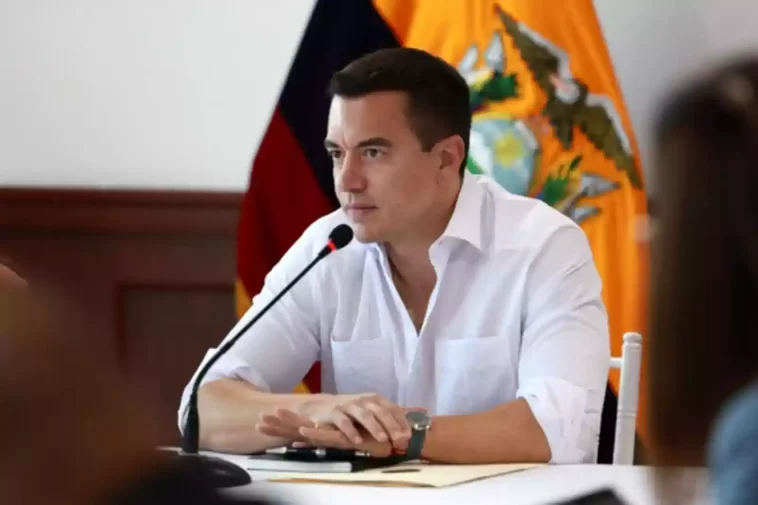
 Noboa Moves Government to Ecuador’s Most Violent City. (Photo Internet reproduction)
It is into this city that President Daniel Noboa announced he will move his government for several weeks. The timing, though, has less to do with security than politics. On February 10, heavily armed police arrested Mayor Aquiles Álvarez in a dawn raid. Prosecutors charged him with money laundering and tax fraud. His two brothers — including Antonio Álvarez, president of Barcelona SC, the country’s most popular football club — were among 10 others detained.
Rival or criminal?
Álvarez, 41, is no ordinary mayor. Elected in 2023 through an alliance with former President Rafael Correa’s Citizens’ Revolution party, he broke decades of right-wing control over Ecuador‘s economic capital. He emerged as one of Noboa’s most vocal critics, publicly accusing the government of failing to confront narcotrafficking and not ruling out a presidential run. His supporters — including the Citizens’ Revolution party — call the arrest political persecution, timed to the same week the National Assembly debated the status of a Noboa ally newly installed atop the Judicial Council.
Guayaquil is now led by 25-year-old Deputy Mayor Tatiana Coronel, an Álvarez ally. Legal analysts say Noboa has no formal authority over the municipal government, and any attempt to marginalize Coronel would mean open war with the city council. The feud is personal: last March, the municipality shut down a cardboard factory owned by the Noboa family conglomerate — one day after a federal food regulator closed two restaurants belonging to the Álvarez family. Noboa’s move to Guayaquil may look like crisis management. But this is his hometown, his political rival is in prison, and the city’s government is in the hands of a 25-year-old. The crisis was always there. The opportunity is new.




GIPHY App Key not set. Please check settings