
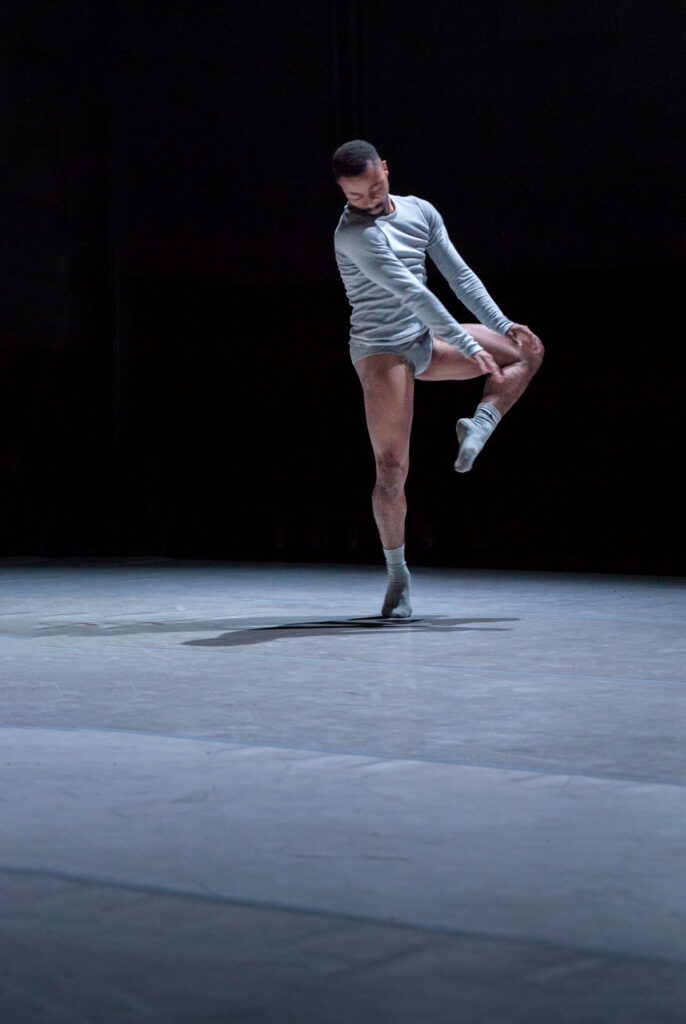
According to Roderick George, his riveting 2024 work Venom ended up onstage “by accident.” New York City Center’s artistic director for dance, Stanford Makishi, happened to attend an APAP performance of the work-in-progress, which sprang from George’s DoublePlus residency at Gibney, and programmed the piece for the theater’s beloved Fall for Dance festival. In the room for Fall for Dance was the curator of France’s “Born to be a live” festival, who invited the choreographer to expand the work, with its themes of the HIV/AIDS epidemic and ongoing erasure of LGBTQ+ communities, into a full evening. The result, The Grave’s Tears, premiered last year with new music and “a different identity,” George says. It makes its North American debut at New York Live Arts February 12–14.
George is no stranger to the dance scenes in Europe or New York City: After stints performing with such troupes as Cedar LakeContemporary Ballet and The Forsythe Company, he started his own company, kNoname Artist, in Berlin in 2015. He returned to the U.S. in 2020 and has since earned many accolades, among them the inaugural Jacob’s Pillow Men Dancers Award in 2024 and a 2025 Princess Grace Fellowship.

What was your research process like for this work?
The research process was rooted in archival viewing, interviews, and physical response. I engaged deeply with films and plays, including We Were Here by David Weissman, The Normal Heart by Larry Kramer, How to Survive a Plague by David France, and For the Love of Friends by Cara Consilvio. These works shaped my understanding of grief, activism, intimacy, and survival during the AIDS epidemic. Rather than translating them literally, I used improvisation to process what I absorbed emotionally and somatically—images of falling bodies, brittle bones, lifelessness, and spiritual rupture—allowing history to move through the body as lived memory.
What enlarged in the process of expanding Venom into The Grave’s Tears?
The disco scene expanded. In Venom we had just one track, now it’s a whole full disco scene. I wanted to create club culture, the glamour, the spirit. I also wanted to bring forth Berlin, that dark, gritty essence, to give that emotional charge, as if to say “I still exist and I am here.” That’s what the whole piece is about, ultimately: Even if I am not here anymore, the spirit of remembering is still present.
Jace Clayton’s score creates a haunting sonic landscape, deftly manipulating iconic songs from the disco era.
There’s definitely a ghost inside of this work. The songs are repurposed. I want people to rethink how we hear and think about these songs. During the show, I sing Prince’s “Sometimes It Snows in April.” It’s important for my voice to be onstage.
Can you discuss the scenic design of the piece? It looks like dirt falling from the sky.
It’s actually black ash. I considered snow, but it’s too pretty. I wanted it to look as if we are getting buried in unmarked graves.
Roderick George in his DUST. Photo by Jubal Battisti, courtesy George.
Your movement style is generous, in that I can see so many forms at work.
I don’t want to be pigeonholed. I reject that every day. I want a gumbo of movement, Martha Graham, postmodern, improvisation, and ballet.
Ballet vocabulary explodes through in The Grave’s Tears. Where does ballet live in your body and in your work?
I studied at the Houston Ballet Academy. It was a driving force for me. I just created a new work for the New Jersey Ballet. I love ballet. It didn’t love me back. I’m 5′ 3″—I will never be the prince. I was so lucky to have a mentor in William Forsythe. He told me, “You will always be the prince, you are six feet tall, you are amazing.”
You are still dancing in your work!
Yes, I have to, partly because that’s what people want. I am in my 40s. I want to show these young bucks that if I can do it, they can too. It is getting difficult to wear so many hats. I still want to get a chance to dance in Houston, my hometown.
You have made seven works for the students at your alma mater in Houston, Kinder High School for the Performing and Visual Arts. How do you make time to keep coming back to Houston?
I have to. I can’t thank HSPVA enough for opening up my mind. The dance director at the time, LuAnne Carter, cultivated a culture that helped me see the world, for me to own my power.
What kind of dancers are you drawn to?
I am looking for caring people who are involved with the world, who want to grow and be part of the culture that I have created. I bring in artists who I am inspired by, who enhance me and someone else in the room. In the end, it’s the luck of the draw, and I always get lucky.
The post Roderick George on Researching the AIDS Epidemic and Ongoing Erasure of Queer Communities for His Latest Work appeared first on Dance Magazine.




GIPHY App Key not set. Please check settings