
3 Key Points
—Latin America’s largest steelmaker posted FY2025 adjusted EBITDA of $1.54 billion on $15.6 billion in net sales, sustaining a 10% margin despite a 13% revenue decline — anchored by a $250 million cost-reduction program that offset a 10% drop in realized steel prices and a 14% collapse in Mexican flat-steel demand.

—Ternium invested $2.5 billion in capex — the peak of its current cycle — with the bulk funding the Pesquería mega-project in northern Mexico, where downstream capacity is now operational and a new slab plant targets late-2026 startup, backed by a $1.25 billion green loan.
—The board proposed an annual dividend of $2.70 per ADS (~6% yield), matching FY2024’s payout, while management guides for sequentially higher EBITDA and shipments in Q1 2026 — supported by Mexico’s new 35% steel tariff on non-FTA imports and Brazil’s fresh antidumping duties on Chinese steel.
01What Happened
Ternium delivered FY2025 net sales of $15.6 billion, down 13% from $17.6 billion in 2024, as realized steel prices fell 10% across all major markets and total steel shipments declined 4% to 15.1 million tons. Adjusted EBITDA came in at $1.54 billion with a 9.9% margin, compared to $2.04 billion and 11.5% in 2024. The margin compression was real but contained — a testament to the $250 million cost-reduction program management executed during the year.
Q4 2025 adjusted EBITDA was $395 million (10.5% margin), slightly below Q3’s $420 million but sharply above the year-ago $270 million (7.0% margin). Net income for the quarter was $171 million, including a $94 million deferred tax gain from Mexican peso appreciation. Equity holders’ earnings were $0.62 per ADS, missing analyst consensus of $0.77–0.97.
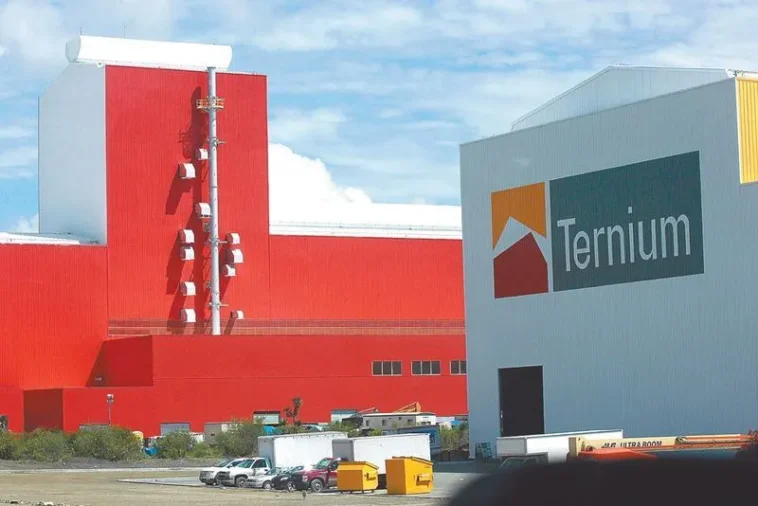
 Ternium’s $250M Cost Push Shields 10% Margin. (Photo Internet reproduction)
The full-year net income figure of $303 million was heavily distorted by two Usiminas-related charges: a $405 million write-down of deferred tax assets (Q3) and a $117 million provision update for ongoing acquisition litigation. Stripping these out, underlying earnings power was substantially higher. Operating cash flow reached $2.3 billion for the year, financing the bulk of the $2.5 billion capex program alongside $530 million in shareholder dividends.
02Key Drivers
Mexican Demand Collapse & Market Share Gains
Mexico’s apparent steel consumption fell 10% in 2025, with flat products — Ternium’s core market — down 14%. CEO Máximo Vedoya called this decline unprecedented for Mexico, driven by sluggish construction activity, uncertainty around USMCA trade negotiations, and a destocking cycle across the entire steel value chain. Despite this, Ternium’s Mexican shipment decline was smaller than the market because the company gained share in flat products, partly aided by Mexico’s decision to raise import tariffs to 35% for non-FTA countries.
Mexico still imports nearly 9 million tons of finished steel products annually. With higher tariff barriers now in place, management sees a structural opportunity to substitute imports with domestic production — particularly once the Pesquería slab plant comes online and reduces Ternium’s dependence on purchased slabs from third parties.
Cost & Efficiency Program
The $250 million competitiveness plan was the single most important factor in protecting margins. Savings came from blast furnace stability improvements, renegotiated service contracts, optimized iron ore sourcing, and logistics efficiencies. Combined with lower raw material and purchased slab costs, these initiatives allowed Ternium to hold a 10% EBITDA margin in a year when revenue per ton dropped 10%. Management expects further margin improvement in 2026, targeting a return to the 15% level by year-end through continued cost discipline and higher revenue per ton.
Regional Divergence
The Southern Region (Argentina) was a bright spot: shipments increased year-on-year as steel demand recovered from depressed 2024 levels, driven by agricultural, mining, and energy sectors under Milei’s economic reforms. Brazil was a mixed story — domestic consumption grew, but Chinese flat-steel imports surged under unfair trade conditions, keeping Ternium’s Brazilian shipments flat. The government responded with antidumping duties on cold-rolled coils and galvanized steel, adding to earlier tariffs on nine other products. In Other Markets, U.S. shipments declined, partly reflecting Section 232 dynamics.
03Financial Detail
Steel Segment
Steel segment net sales fell 13% to $15.0 billion, with cash operating income of $1.36 billion and a 9.0% margin (vs. 10.3% in 2024). Cash operating income per ton was $90, down from $114. Q4 steel cash operating income was $342 million (9.4% margin), up from $197 million (5.2%) a year earlier but below Q3’s $391 million (10.3%), reflecting the sequential pressure from lower realized prices partially offset by lower input costs and efficiency gains. Total steel shipments for Q4 were 3.73 million tons.
Mining Segment
Mining net sales rose to $1.14 billion from $1.06 billion in 2024, driven by higher iron ore shipments (13.0 million tons, up from 11.4 million) despite lower realized prices. Mining cash operating income was $197 million (17.3% margin), down from $252 million (23.8%) as unit costs increased. A $19 million impairment was recorded on Las Encinas mining assets in Q4, alongside a $23 million deferred tax write-down.
Capital Allocation
Capex of $2.5 billion represented the peak investment year for the Pesquería expansion. Management guided capex declining to approximately $2 billion in 2026, $1.2 billion in 2027, and $800 million in 2028 — which CEO Vedoya described as “regular capex” including Usiminas. Net cash stood at $712 million at year-end (down from $1.6 billion at end-2024), with $1.5 billion in cash, $1.6 billion in other investments, and $2.4 billion in borrowings. The proposed $2.70/ADS annual dividend ($530 million total) includes the $0.90 interim already paid in Q4 2025, with the remaining $1.80 payable May 15, 2026.
Management Signals
CEO Vedoya framed 2025 as a year of “adapting rapidly and acting proactively to protect profitability” — defensive language that nonetheless carries conviction about the strategic positioning. The $250 million cost program was presented not as emergency austerity but as a structural improvement that will carry forward. The message is clear: even if steel prices don’t recover, Ternium can protect margins through operational discipline.
The Pesquería investment narrative is shifting from cost to catalyst. Downstream capacity (cold rolling, galvanizing, pickling, finishing) is now operational and ramping. The upstream slab plant remains on track for late-2026 startup, backed by a $1.25 billion green loan. Once running, Pesquería will reduce Ternium’s reliance on purchased slabs — a significant cost headwind in recent years — and position the company as a fully integrated producer in Mexico’s most strategically important steel market.
On Usiminas, the February 2026 switch to USD functional currency is strategically meaningful: it reduces future deferred tax volatility from BRL/USD movements and aligns Usiminas’ reporting with the economic reality of its dollar-denominated commodity operations. Ternium also completed the acquisition of Nippon Steel’s remaining participation in Usiminas’ control group in February 2026, consolidating its governance position.
04What to Watch Next
USMCA renegotiation is the dominant wildcard. Vedoya noted a July target for renewal but said management’s 2026 projections do not assume a positive outcome, placing more impact in 2027. Any agreement that strengthens North American steel trade rules would be a meaningful tailwind; a breakdown would create significant uncertainty for Ternium’s Mexican operations. Mexico’s 35% tariff on non-FTA steel imports provides near-term protection regardless of USMCA timing.
Pesquería slab plant commissioning (targeted late 2026) will be the single most watched operational milestone. Success would transform Ternium’s Mexican cost structure by eliminating or sharply reducing purchased slab costs. Delays would extend the current margin compression from external slab sourcing. Industry group CANACERO estimates Mexico’s steel market could grow 4% in 2026, providing a demand recovery tailwind.
Capex deceleration will improve free cash flow visibility. At $2 billion guided for 2026 (vs. $2.5 billion in 2025) and declining further to $800 million by 2028, Ternium will transition from peak investment to harvest phase. CFO Brizzio acknowledged the company will move to a modest net debt position in 2026 but described the levels as “very low.” The dividend commitment of $530 million annually signals confidence in underlying cash generation even through the investment cycle.
Key Figures
Metric
FY2025
FY2024
Change
Net Sales
$15.6B
$17.6B
−12%
Adjusted EBITDA
$1,541M
$2,038M
−24%
EBITDA Margin
9.9%
11.5%
−160 bps
Net Income
$303M
$174M
+74%
Equity Holders’ EPS (per ADS)
$2.17
($0.27)
n/m
Steel Shipments
15.1M tons
15.6M tons
−4%
Operating Cash Flow
$2,314M
$1,906M
+21%
Capex
$2,501M
$1,865M
+34%
Net Cash
$712M
$1,644M
−$932M
Dividend (per ADS)
$2.70
$2.70
Flat / ~6% yield
Quarterly Trend
Metric
Q4 2025
Q3 2025
Q4 2024
Net Sales
$3,775M
$3,955M
$3,876M
Adjusted EBITDA
$395M
$420M
$270M
EBITDA Margin
10.5%
10.6%
7.0%
Net Income
$171M
($270M)
$333M
EPS (per ADS)
$0.62
$0.10
$1.43
Steel Shipments
3,727K tons
3,757K tons
3,764K tons
Capex
$463M
$711M
$561M
05Risk Factors
Trade policy remains Ternium’s most consequential external risk. The USMCA renewal timeline is uncertain, and any adverse outcome — higher tariffs on Mexico-origin steel entering the U.S., stricter rules of origin, or failure to extend the agreement — could reshape regional steel flows. Separately, Section 232 tariff dynamics continue to affect Ternium‘s U.S.-bound exports.
Usiminas-related volatility is structural until the litigation provision is resolved. The $528 million provision (balance sheet value at December 2025) for the acquisition dispute will continue to create earnings noise through interest accruals and BRL/USD movements. The deferred tax write-down is behind them, but the $1.25 billion Pesquería green loan adds leverage at a time when net cash is declining — management expects to enter net debt in 2026, though at low levels.
Safety remains a material concern. Management disclosed fatal accidents at Ternium Mexico, Ternium Brazil, and Usiminas in 2025, describing these outcomes as “unacceptable” and announcing enhanced critical-risk prevention programs. For a company investing $2.5 billion in new capacity, operational safety at scale is both a human imperative and a risk management priority that investors should monitor.
Sector Context
Ternium is the largest steel producer in the Americas by revenue, headquartered in Luxembourg but operationally anchored in Mexico (its dominant market), Argentina (through the Techint Group), and Brazil (through its controlling stake in Usiminas). The Pesquería industrial center in Nuevo León is the company’s crown jewel — a multi-billion-dollar integrated steelmaking complex that, once the slab plant is commissioned, will be among the most modern flat-steel facilities in the Western Hemisphere.
The stock trades at approximately $43.25 per ADS on the NYSE (52-week range: $24.00–$45.57), with a market cap of around $8.6 billion. The P/E of approximately 14.5x on reported earnings and an enterprise value that reflects the Pesquería investment suggest the market is pricing in the transition from peak capex to margin recovery. Analyst consensus is mixed — UBS has a $39 neutral target, Wells Fargo an underweight at $34, while others see upside once USMCA clarity emerges and Pesquería delivers on its cost-reduction promise.
The broader Latin American steel landscape is being reshaped by three forces: Chinese overcapacity driving unfair trade concerns across the region, nearshoring creating structural demand for industrial steel in Mexico, and government trade actions (Mexico’s 35% tariff, Brazil’s antidumping duties, the Argentina-U.S. trade agreement) that are collectively building a more protected regional market. Ternium, with operations spanning all three countries, is uniquely positioned to benefit from this regionalization trend — provided it can navigate the USMCA uncertainty that sits at its center.




GIPHY App Key not set. Please check settings