
It was a starry night in the City of Angels on Monday, as dance-world luminaries gathered at the Debbie Allen Dance Academy for the Dance Magazine Awards. Though the annual ceremony is always a festive affair, this year—its first ever in Los Angeles—it had a special Hollywood sparkle. The evening (sponsored by Backhausdance, Bennington College, Howard University, Tiger Friday, Tremaine, and the Westside School of Ballet) honored dance leaders of the West Coast, artists who have helped shape this innovative but often undersung corner of the dance world. Guests buzzed happily as they snapped photographs on the red carpet, excited to be celebrating the best of the West.
After opening remarks from Dance Media president Joanna Harp—cheers erupted when she mentioned that this was the awards’ first visit to Los Angeles—the performance began with a video tribute for the first honoree, director and choreographer Kenny Ortega. However impressive the clips (including snippets from the Olympic games, the High School Musical and Descendants series, Dirty Dancing, and Ferris Bueller’s Day Off), as presenter Paul Becker noted, they were only “a little speck of what he’s accomplished in his life—like a trailer to a trailer.” Becker, one of Ortega’s long-time creative collaborators, described the icon’s legacy of inspiring, discovering, and helping fellow artists. “He teaches us that movement needs to have a story, needs to have purpose, and every chance we get to tell a story is a chance to change a life,” Becker said. “He finds the promise in people.”

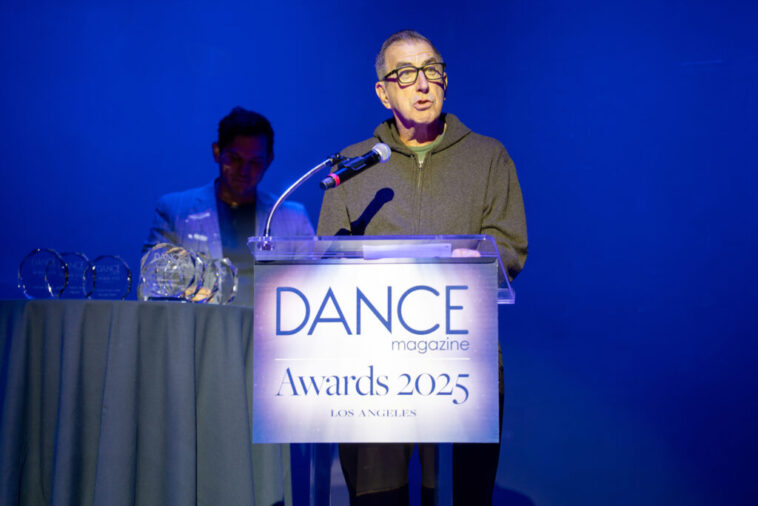
Kenny Ortega, with Paul Becker in background. Photo by Joe Toreno.
In his acceptance speech, Ortega responded reciprocally, thanking the friends and colleagues who’d seen the promise in him. “As recently as this evening, I was asked why I thought dance was important,” Ortega said. “I believe it is an integral part of the fabric of being human, of being alive. It has expanded my life, and introduced me to a world I would’ve otherwise never known existed.”
Next came a rare treat: a performance by an awardee, the impossibly elegant San Francisco Ballet principal Frances Chung. She gave a crystalline rendition of the grand pas de deux from The Nutcracker, partnered by Joseph Walsh. Presenter Dwight Rhoden, the co-founding artistic director of Complexions Contemporary Ballet, described being captivated by Chung’s “impeccable technique, breathtaking articulation, and profound emotional clarity.” Rhoden, who has worked with Chung on multiple ballets at SFB, emphasized what a joy she is in the studio. (William Forsythe, he said, is also a big Fran fan.)
 Frances Chung and Joseph Walsh in an excerpt from The Nutcracker. Photo by Joe Toreno.
Chung accepted her award in her tutu, rising on pointe to reach the microphone. “Dance has seen me through everything,” she said. “I’ve felt all the feelings—in dance, through dance, because of dance. I have felt proud, have felt insecure, I have felt pure joy, I have felt disappointment, I have felt strong. I think more and more lately, though, I’ve just been feeling so grateful.” Now in her 24th season with SFB, she dedicated her award to everyone who’s been on the journey with her—including her two children, who “have given me so much freedom in dance,” she said.
 Frances Chung. Photo by Joe Toreno.
Dance Magazine editor in chief Caitlin Sims pinch-hit for Harkness Foundation executive director Joan Finkelstein (unable to attend due to a family emergency) to present the Harkness Promise Awards. Given since 2018 to innovative artists in the first decade of their choreographic careers, the Promise Awards went this year to Annie Rigney and Micaela Taylor. Reading Finkelstein’s words, Sims lauded Rigney’s “deeply visceral, grounded, fluidly holistic approach to movement,” and Taylor’s “deft choreographic use of quirky gestures, exaggerated facial expressions, and dramatic theatricality to produce an unexpected gut punch.”
 Caitlin Sims presenting to (left) Annie Rigney and (right) Micaela Taylor. Photos by Joe Toreno.
Honoree Lula Washington next offered a piece of her own writing and choreography, “Respect,” danced by Ongelle Johnson—who immediately got our attention. “Heeeey!” Johnson called as she walked onstage. “Wake up! There is a felon married to an immigrant trying to tell us that the problem is felons and immigrants!” The audience laughed and applauded as Johnson held an extended développé à la seconde, then blew us a kiss before strutting offstage. That mixture of artistic daring and advocacy, said presenter Tamica Washington-Miller—Washington’s daughter, and director of programs for the Lula Washington Dance Theatre and school—forms the heart of Washington’s choreography. “Your works have become a lens through which audiences confront truths,” Washington-Miller said. “You taught us that art is activism, that dance can be a healer, that courage is a practice.” Washington-Miller also paid tribute to her father, Erwin Washington—the co-founder of LWDT, who helped build it into a resilient, internationally recognized institution. “My folks saw a void, and they built a refuge,” she said. “They stood in a gap, literally saved lives, and made history.”
 Lula Washington taking her “long walk.” Photo by Joe Toreno.
Washington didn’t head directly to the podium. “I have to take the long walk,” she said, making a circuit around the stage as Washington-Miller stomped and clapped along. After arriving, Washington called out the many artists who helped pave her way, a list that included Joan Myers Brown, Cleo Parker Robinson, Bella Lewitzky, Rudy Perez, Donald McKayle, Arthur Mitchell, Alvin Ailey, Pearl Primus, Martha Graham, the Nicholas Brothers, and Gus Solomons jr. “I dance because it gives me strength and courage,” she said. “It gives me a voice and a light that must never stop shining. What I do is keep hope alive.” She asked to bring the house lights up and, singing, implored us to “reach out and touch somebody’s hand.” (We did.) “We’ve got to keep our art going strong,” she said. “We have to continue to fortify ourselves, because there’s so much negativity in the world.” And she gave a final exhortation: “Vote!”
 Birdy Adler and Serene Wong in an excerpt from Donald Byrd’s Octavia. Photo by Joe Toreno.
Then came an excerpt from honoree Donald Byrd’s Octavia, a stoic yet fervent duet danced by Birdy Adler and Serene Wong. Presenter Theresa Ruth Howard, founder and curator of MoBBallet (Memoirs of Blacks in Ballet), highlighted the “many chapters and artistic seasons” of Byrd’s life. His early choreography combined “Cunningham ballet legs, the modern torso, Ailey’s technique, Balanchine’s speed, the attack and urgency of Black dance,” she said. “It was unlike anything else: challenging, sexy, and just a little bit scary.” Working with him as a dancer “was the first time my intellect was not only welcome but required in the studio,” Howard said. And Byrd has always been a provocateur, blending art and politics in a way that proved to be ahead of its time. After he became the leader of Seattle’s Spectrum Dance Theater in 2002, the world started to catch up: “Works once deemed polarizing and disturbing were now seen as socially urgent,” Howard said. Today, she added, Byrd’s career “functions not only as a blueprint but as a permit” for artists like Rhoden, Kyle Abraham, and Camille A. Brown.
 Donald Byrd, with Theresa Ruth Howard in background. Photo by Joe Toreno.
Byrd, as eloquent in words as in movement, emphasized his personal connection to Los Angeles—where his choreographic career began. “Los Angeles isn’t just a place in my history; it is the beginning of everything,” he said. “It was here that who I am as an artist came into focus. And in the spirit of Los Angeles mythology, I dreamed boldly—maybe recklessly, but I dreamed big.” He expressed gratitude for the dancers and supporters who believed in his talent from the beginning. “This award carries the weight of my history,” he said, “and it touches me deeply.”
 Lydia Murray. Photo by Joe Toreno.
Lydia Murray, a member of the Awards selection committee and the marketing and communications manager at Baryshnikov Arts, took a moment to honor Charlie Reinhart—a titan of dance administration and a fellow selection committee member, who passed away over the summer—before presenting tributes to this year’s four posthumous awardees. Beloved commercial-dance star Stephen “tWitch” Boss “built bridges between dance genres, art forms, and communities,” Murray said. “His kindness and warm personality left an indelible mark on dance, pop culture, and those who knew him.” She described how Lester Horton, a founding father of modern dance and a mentor to many other luminaries, shaped the course of dance history. Murray quoted one of his students, Alvin Ailey: “ ‘Lester taught us to justify movement—not just do a step, but to feel something about the step.’ ” She talked about trailblazing Black ballerina Janet Collins, who refused a contract with the Ballet Russe de Monte Carlo when they asked her to use light-colored makeup. Collins “would become a star while remaining true to herself,” Murray said, tracing Collins’ successful career at the Metropolitan Opera and beyond. And Murray extolled entertainment-world choreographer Michael Peters’ influential work for stars including Michael Jackson. “We’re familiar with the term ‘household name,’ ” she said, but Peters’ work “might be described as ‘household movement.’ ”
The evening continued with the presentation for Brenda Way and Kimi Okada, jointly honored for their work leading ODC. After two dancers performed a spiritual, ethereal duet excerpted from Way’s A Brief History of Up and Down, BroadStage artistic and executive director Rob Bailis came to the podium to describe how Way and Okada built ODC into “an unmatched resource for dance,” a haven and a launching pad for five generations of San Francisco dance artists. “All this comes from an inherent generosity, an inherent creativity, and an inherent entrepreneurial drive,” Bailis said.
 (From left) Brenda Way and Kimi Okada. Photos by Joe Toreno.
Way began the acceptance speeches by reflecting on the collective’s early days, when she was “inspired by the raw and stimulating imagination and intellect” of her students to imagine a new kind of organization. ODC was designed to “allow us to be master of our own fate,” she said, an “artistic ecosystem” supportive of women’s creative visions and voices. Okada, one of the founding members of the group and now its school director and associate choreographer, emphasized that the values that have always animated ODC—accessibility, inclusion, excellence—remain its driving forces. “We provide a place where anybody who wants to move can dance,” Okada said. “We are a world of dance, not just a dance company.”
 Mandy Moore’s “Moments of Pleasure.” Photo by Joe Toreno.
Though honoree Mandy Moore was unable to attend the ceremony in person—ever busy, she was in London working on “Strictly Come Dancing”—she created a piece just for the occasion. “Moments of Pleasure,” performed by a star-studded cast of artists dear to her (including Alan Bersten, Jenna Johnson, Jillian Meyers, Robert Roldan, and Britt Stewart), was classic Moore: deeply musical and deeply felt. Meyers, presenting Moore’s award just before taking the stage, said it felt nearly impossible to sum up Moore’s wide-ranging choreographic career. “Her creative spirit is immense, and fills up not only her work but the people who work with her,” she said. Meyers described Moore’s love of the nitty-gritty aspects of creation, her interest in process as much as product. “Her fascination and relentless pursuit of quality in the choreographic process is why I believe whatever she makes is not only wonderful but personal, full of integrity and care,” Meyers said.
In a filmed acceptance speech, Moore said she felt both grateful and lucky. “It’s weird to be honored for something that you’d do for free and you’d do if nobody was watching,” she said, with a chuckle. “I get to spend my days expressing myself through my body, through my ideas, and through my perspective on life. I basically get to play all day every day. And I don’t take that lightly.”
 Dancers from the Debbie Allen Dance Academy in an excerpt from Fame. Photo by Joe Toreno.
Finally, young dancers from the Debbie Allen Dance Academy brought down the house with their infectious performance of an excerpt from Fame, performed in honor of Chairman’s Award winner Debbie Allen. Presenter JaQuel Knight joked that it was a hard act to follow. “Miss Allen, you’ve got those kids working!” the choreographer and director teased. “They’re on the press tour, baby!” Knight took the microphone to the middle of the floor to deliver his rousing tribute to Allen, one of his mentors, in the house that she built. “We need some better words than ‘icon,’ than ‘trailblazer,’ than ‘door-opener,’ ” he said. “You don’t just inspire dancers. You have shaped mankind.”
 Debbie Allen. Photo by Joe Toreno.
A visibly moved Allen reflected on her beginnings as a dancer, and the unwavering support of her mother, who found ways for Allen to train even when dance studios turned her away because she was Black. “She made me believe that I was a student of the universe, and that I could go anywhere—that this was a little glitch, but change was the nature of the universe, and this would change,” Allen said. She urged the audience to focus on creating opportunities for the next generation of dancers, as her mother had for her—and as she had for her own daughter, Vivian Nixon, whose negative experience at a prestigious ballet school inspired Allen to found DADA. “I am just grateful to God for the real purpose in my life,” Allen said. “Let’s do everything we can to keep dance and hope alive.”
The post Inside the 2025 Dance Magazine Awards appeared first on Dance Magazine.




GIPHY App Key not set. Please check settings