
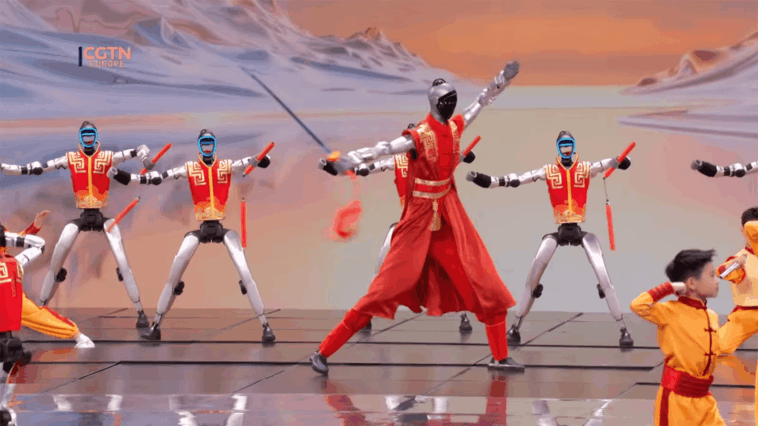
Red lanterns, drums, dancers – and suddenly humanoid robots march onto the stage. What sounds like a scene from a science fiction film was actually part of real New Year’s productions in China. At the most important festival of the year, the country shows not only tradition but also technological strength. And that’s exactly what makes the robot performances so exciting: they are entertainment – and at the same time a message to the world.
Those: CGTN Europe

The big New Year’s gala on the state broadcaster China Central Television – CCTV for short – reaches hundreds of millions of viewers every year. In recent years, robots have repeatedly appeared there: as dancers, as stage characters or as technical attractions between classic program items.
International tech media such as TechCrunch or the German specialist portal heise online regularly report on China’s rapid progress in humanoid robots. Companies like Unitree Robotics are particularly in focus. Their two-legged models can now walk, jump and perform choreographed movements in a stable manner.
Such performances are not spontaneous shows. They are carefully planned demonstrations of what is already technically possible.
What is technically behind it?
Humanoid robots are machines that are modeled on the human body. They have legs, arms and often a “head” with cameras. But what’s important is what’s inside:
Degrees of Freedom: Each movable joint counts as its own degree of freedom. Modern humanoids often have over 20 of them. Actuators: These are the motors in the joints. You have to be strong, fast and precise at the same time. Sensors: Gyroscopes and acceleration sensors constantly measure balance. AI software: It calculates in real time how the robot has to move to avoid falling.
According to analyzes at The Decoder, the combination of classic control technology and machine learning is particularly crucial. Robots often initially train movement sequences in simulations. Only when everything is running smoothly is the choreography transferred to the real machine.
The goal: movements that are as fluid and “natural” as possible.
A robot on a New Year’s stage is more than entertainment. He is also a symbol.
China has been pursuing a clear industrial strategy for years to become a leader in key technologies. Robotics plays a central role in this. Humanoid robots are considered particularly sophisticated – those who master them demonstrate technological maturity.
Specialist media classify this soberly: While US companies like Boston Dynamics are developing spectacular motion robots and companies like Tesla are working on their own humanoids, Chinese manufacturers are pushing into the market at high speed. Series production and cost reduction are a strong focus.
A TV gala offers the perfect stage for this: millions of people see live what is possible. This creates enthusiasm – and confidence in your own innovative strength.
Why dancing is so difficult
Maybe you’re thinking, “Dancing? It’s just a show!”
In fact, dancing is one of the most difficult tasks for a robot.
Why?
Because every movement must be perfectly balanced. If a humanoid robot missteps even slightly, it loses its balance. Unlike a human, he has no natural feeling for his body – only sensor values and calculations.
Modern systems calculate hundreds of times per second:
Where is my focus? How fast am I moving? How should I place my feet?
This all happens in real time. That’s exactly why such performances are considered technological demonstrations – not just stage stunts.
A look into the future
What starts as a show today can become everyday life tomorrow. In the future, humanoid robots could:
Working in factories Carrying heavy loads Helping in disaster areas Supporting care facilities
They are still expensive and complex. But every public demonstration shows that developments are progressing quickly. Maybe in a few years we won’t just see individual robots in parades – but entire teams of autonomous machines in everyday life.
Conclusion
The robot appearances at Chinese New Year are much more than futuristic show effects. They combine tradition with high-tech and send a clear message: robotics is a central area of the future.
What this means for you is that the world of machines is changing rapidly. What seems spectacular today could be completely normal tomorrow. And maybe it will be you who will program such robots one day.
FuxFun – Did you know that…?
…a humanoid robot constantly calculates where its center of gravity is while walking? Even a millimeter deviation can make the difference between balance and fall!
For professionals
You can find more in-depth classifications at:
heise online – reports on Chinese humanoids and industrial policy The Decoder – analyzes on AI-supported robotics TechCrunch – market analyzes and international comparisons
Suchbegriffe: „China humanoid robot gala“, „Unitree humanoid development“, „China robotics industry strategy“.
Sources
heise online: Reporting on the development of humanoid robots in China (2023-2025) TechCrunch: Analyzes on Chinese robotics startups The Decoder: Background reports on AI and humanoid robotics
Book recommendation
If you would like to delve deeper into the world of robots, I recommend the book “Robots & AI” from the SchlauFUX series by Kosmos Verlag:
👉 https://www.kosmos.de/de/kosmos-schlaufux-roboter-und-ki_1182437_9783440182437 There you will learn clearly and understandably how robots work – and why they will change our future
I like it:
Like Loading…
Similar posts




GIPHY App Key not set. Please check settings