
Read in Indonesian here
Classrooms Are Beginning to Adjust
On a regular afternoon at Pondok Pesantren Cipasung in Tasikmalaya Regency, the classroom looks much like any other school day. Students sit at their desks, Qurans in hand, waiting their turn to recite verses before their teacher. At the front of the room, Hasan Basri listens carefully, correcting pronunciations one by one, ensuring every letter is spoken with precision.

Each recitation takes no small amount of time. Hasan must pay close attention to identify where corrections are needed, and in a single session, this can repeat dozens of times — demanding a high level of focus so nothing slips through the cracks.
Lately, though, he’s had a little help. By incorporating the Reading Progress feature within Microsoft Teams Learning Accelerators, Hasan now has access to deeper analysis that supports his assessment of pronunciation, tajwid accuracy, and reading structure. Technology hasn’t replaced the way he teaches — it’s sharpened the precision of how he evaluates.
A dedicated educator since 2016, Hasan has taught Arabic Language and Information & Communication Technology (ICT) at both the pesantren and university levels. Over the years, he has witnessed firsthand how teaching methods evolve — from fully traditional approaches to the gradual integration of technology, including learning animations as early as 2018.
His awareness of artificial intelligence grew through national-level training programs and discussions that pushed for digital transformation among educators. As both the government and the broader education ecosystem began paying closer attention to AI in learning, what once felt distant from the pesantren (Islamic boarding school) classrooms started to feel relevant and within reach.
That curiosity eventually led him to AI Teaching Power — a training program jointly developed by Microsoft Elevate and NUCare Global by LAZISNU — designed to equip teachers with practical AI skills rooted in values-based learning. For Hasan, it was a turning point. AI stopped being an abstract concept and became something genuinely applicable to his everyday teaching.
From Admin Work to Nurturing Character
One of Hasan’s biggest challenges over the years has never been about teaching itself — it’s been about time. His responsibilities extend well beyond the classroom: preparing lesson plans, developing syllabi, creating learning materials, and manually grading student work.
At the same time, he wanted to make sure every student received enough individual attention — particularly in language and recitation-based subjects that require detailed, personal evaluation. The heavy administrative load often ate into time that could have been spent accompanying students through their learning more deeply.
That changed when he began using Microsoft Copilot in his day-to-day teaching. With Copilot as his teaching ‘assistant’, administrative work can now be completed far more efficiently. He uses it to develop materials, design assessments, and build a more systematic structure for Arabic language learning.
That efficiency has given him more room to focus on nurturing his students’ character. Time that was once consumed by paperwork can now be redirected toward more meaningful, personal interaction with his santri.
“Before, so much time went into administration. Now I can focus more on guiding the moral development of my students,” he said.
The shift has also changed how he delivers lessons. Religious subjects that previously relied heavily on verbal instruction can now be enriched with more varied learning media, making students more actively engaged in the learning process.
A Wider Practice Space, A More Flexible Way to Learn
This shift in teaching approach has had a direct impact on how students experience learning.
Through the AI Conversation Practice feature in Copilot, students can independently simulate Arabic conversations from simple introductions to subject-matter discussions. Practice that was once limited to class hours can now happen anytime.
AI tools have also extended into Quran recitation and other core pesantren texts. Using Reading Progress and Speaking Progress, Hasan can comprehensively monitor each student’s reading ability — covering pronunciation, tajwid rules, punctuation, and language structure.
In practice, students access these tools through their own devices. Some use personal laptops, while others make use of shared computers available on campus. This flexibility ensures that all students can continue practicing reading and speaking optimally, whether in class or studying independently.
The implementation of distance learning carried out by Hasan Basri leverages Microsoft Teams and Learning Accelerators, enabling students to continue participating in reading and speaking exercises from their respective locations. Through this system, teachers can monitor progress, assess reading accuracy, and provide feedback even without being in the same physical classroom.
 Through the Reading Progress feature in Microsoft Teams Learning Accelerators, Hasan Basri can provide more in-depth feedback on students’ recitation — from tajwid accuracy and reading structure to punctuation. The system highlights areas that need improvement with visual markers, making the evaluation of Quran recitation and Arabic reading more structured and measurable.
As the holy month of Ramadan approaches — when Quran study intensifies across pesantren — this approach becomes even more relevant. Students can practice independently outside of class hours, while Hasan continues to monitor their progress.
When in-person learning isn’t possible — whether because students or teachers are away — learning doesn’t have to stop. Reading and speaking practice can happen remotely, while deeper material discussions continue through online sessions. Learning is no longer bound by location or schedule.
From the Classroom to a Broader Movement
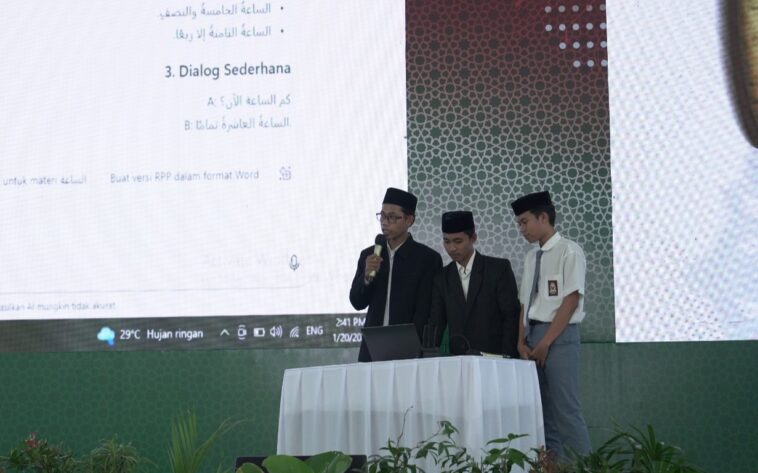
 Mr. Hasan is presenting the use of Microsoft Copilot at Pondok Pesantren Cipasung, highlighting how AI can be integrated into teaching and learning activities within the pesantren environment.
What Hasan has experienced is part of a larger initiative through AI Teaching Power, a collaboration between Microsoft Elevate and NU Care Global that brings practical and human-centered AI training to educators in both formal and non-formal settings under the Ministry of Religious Affairs.
The program equips teachers with modules such as AI for Educators, Build Agent AI, and 21st Century Learning Design. Beyond technical skills, it also integrates Spiritual Intelligence, emphasizing purpose, empathy, and humility in the use of technology.
This approach makes AI feel naturally aligned with pesantren education, because technology is never separated from the values and ethics that form the foundation of learning.
Closing the Gap, Opening Access
What’s happening in Hasan’s classroom reflects a broader shift in Indonesian education. AI-driven digital transformation is increasingly part of the effort to strengthen learning quality and prepare the next generation for the future.
Through Microsoft Elevate, Microsoft is committed to continuing to partner with civil society organizations, educational institutions, and local communities to expand inclusive AI skills access for educators. Initiatives like AI Teaching Power are designed not just to introduce technology, but to ensure that teachers have the right support, guidance, and ecosystem to apply it meaningfully within their own learning contexts.
By strengthening educator capacity, Microsoft and its partners hope that digital transformation in education won’t remain exclusive, but can be accessed more equitably, including in faith-based learning environments like pesantren.
“AI isn’t just about advanced technology, it’s about opening up broader and more equitable access to learning. When educators are equipped with the right skills and understanding, they can deliver learning experiences that are more relevant, inclusive, and impactful for the next generation,” said Arief Suseno, AI Skills Director, Microsoft Indonesia.
Ultimately, the use of AI in education isn’t simply about adopting new technology, it’s about creating learning spaces that are wider, more adaptive, and more human for everyone.
It’s time for pesantren to step boldly into an inclusive digital era. Sign up now at pendidik.elevaite.id and be part of the transformation in pesantren education.
###
Hasan Basri, a teacher at Pondok Pesantren Cipasung, Tasikmalaya Regency, presenting the use of Microsoft Copilot as a learning tool within the Islamic boarding school environment, alongside one of his students (photo: Hasan Basri)




GIPHY App Key not set. Please check settings