
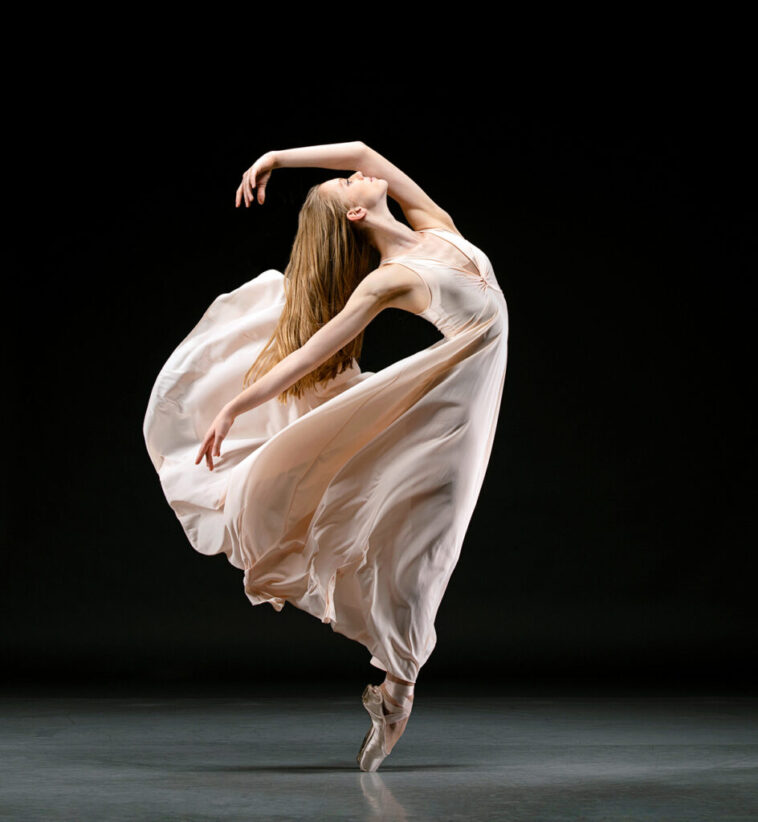
By the time dance photographer Gene Schiavone retired in 2020, he had hundreds of thousands of images sitting on his hard drives, gathering virtual dust. He’d been American Ballet Theatre’s staff photographer for 20 years, and captured photos of ballet students and stars all over the world. As many photographers do, he thought about creating a book. But rather than putting out a generic coffee-table tome, he wanted to tell the stories of the dancers.
Enter writer and former professional ballet dancer Gavin Larsen, who’d recently written her own moving autobiography, Being a Ballerina. Together she and Schiavone shaped Infinite Steps, a look at 33 ballet dancers’ journeys through Schiavone’s portraits and Larsen’s mini biographies.

There are frank insights from international stars Maria Kochetkova and Roberto Bolle, and behind-the-scenes accounts of less well-known dancers, including a future scientist who performed with Ballet Arizona for just one year and a New York City Ballet apprentice at the beginning of her career. “We both agreed right away that it should not be just all big names,” Larsen says. “We wanted to show the hard and the light, the success and the non-success, and pull back the curtain on why people make the choices they make.”
Schiavone started the project by picking out the most compelling photos of the dancers whose stories he felt would resonate the most with readers. Then Larsen interviewed each one. She’d start off their conversation by sharing a photo or two of Schiavone’s and asking what the images brought up for them. From there, she let the dancer guide the conversation to whatever aspects of their life in ballet felt most meaningful.
 Photo by Gene Schiavone. Courtesy the University of Florida Press.
Larsen was often humbled by the dancers’ candor. At times, she found it overwhelming to be trusted with their stories—particularly the more sensitive ones, like the anonymous dancer who quit ballet to heal from bulimia. But Larsen was excited by the challenge of making Schiavone’s photos “speak” through sharing the human experiences behind the moments he captured. “When someone’s holding this book in their hands, I want them to feel like the dancer in that photo is actually talking to them,” she says.
As all the profiles came together, one theme stuck out to Larsen: the powerful drive that keeps dancers going. “It’s not a life of joy all the time—it’s colored by light and dark and ups and downs,” Larsen says. “But dancers dance because they have this sense of purpose. They know deep down that this is what they’re meant to do.”
Annalisse Veldhuyzen VanZanten:
Seeing the Finish Line From the Starting Line
Gavin Larsen calls Annalisse Veldhuyzen VanZanten’s career “short, but hot.” The dancer began ballet at age 14, and, like many late starters, she struggled. Then she got a chance to model for Schiavone, who captured lines she didn’t know she had. “The photo shoot was a lightbulb moment,” Larsen says. “She saw herself in a way that she hadn’t in the mirror.”
After high school, Veldhuyzen VanZanten decided to defer college for just two years to dance professionally; any longer and she’d lose her scholarships. Although the COVID-19 pandemic delayed her plans, she ended up jumping into Ballet Arizona’s corps de ballet for Swan Lake, then joined its studio company for one season.
“She could see the finish line when she was at the starting line,” Larsen says. “She knew she was going to dance for a year and that was going to be it, so she went in 1,000 percent.” Veldhuyzen VanZanten was asked to return for another season, but she stuck with her plan, and left ballet to earn a degree in biochemistry.
Annalisse Veldhuyzen VanZanten. Photo by Gene Schiavone.
Cory Stearns: The Reality of Hierarchy
 Cory Stearns. Photo by Gene Schiavone.
Cory Stearns admitted to Larsen that when he joined American Ballet Theatre as an apprentice in 2005, he did not feel welcomed. “Without prompting, he ended up talking a lot about the sense of competition and the hierarchy,” Larsen says. “When he entered the company, it was, frankly, a very cold and scary atmosphere. And he said to himself that he would try to change it if he was ever in the position to do so.”
Fortunately, by the time Stearns was a senior principal, the culture had evolved to become more welcoming to all dancers, with less separation between the ranks. Stearns, who will be retiring from ABT in June, is part of a new generation that treats other dancers with respect and encouragement, no matter their casting. “To me, that was a great point to make quite prominent—the fact that the backstabbing can be real, but overwhelmingly it is not,” Larsen says.
 Cory Stearns. Photo by Gene Schiavone.
Paloma Herrera: No Regrets
The only dancer featured in the book that Larsen knew personally beforehand was former ABT star Paloma Herrera—the two had been in the same class at the School of American Ballet. While reconnecting for Infinite Steps, Larsen says, she was struck by Herrera’s unfailing positivity.
“When I asked her how it was to be retired, she said it wasn’t hard at all because she was so in love with every single moment, and now she’s in a new part of her life,” Larsen says. Herrera told her that seeing Schiavone’s photos again was like looking back at a scrapbook of yourself as a kid. “You see yourself laughing and having fun, having these great times, but you don’t wish to be doing that again,” Larsen recounts. “She said, ‘I remember the joy. I remember the exhilaration of that performance. I remember the difficulty of that role. But I don’t want it again. That was then, and now is now.’ ”
 Paloma Herrera at her American Ballet Theatre farewell performance in 2015. Photo by Gene Schiavone.
Jennifer Alexander: The Honor of the Corps
In 2007, on the way back home from watching her husband in a Pennsylvania production of The Nutcracker, American Ballet Theatre corps member Jennifer Alexander was struck by a car and died at the age of 35. “Gene said Jennifer was so respected in that company that her death was beyond shocking—it was like an earthquake,” Larsen says. To draw out what made the senior corps member so beloved, she interviewed Alexander’s half-sister Andrea, her cousin Lisa, and her close ABT friend Anne Milewski Cary. They explained that the 13-year corps de ballet member carried herself like a ballerina and treated every role with the dedication of a principal—an attitude that was contagious among fellow company members.
“She could have had feelings of bitterness, but her sense of purpose won out,” Larsen says. “She felt, ‘This is what I’m meant to be doing: showing other people how being a dancer is an honorable thing, no matter where you’re standing onstage.’ ”
 Jennifer Alexander rehearsing with Kevin McKenzie in 2007. Photo by Gene Schiavone.
Marja Quaqua:
Overcoming Burnout and Doubts
One of Larsen’s favorite profiles to write was that of Marja’ Quaqua. As a young prodigy, Quaqua took home top finishes at ballet competitions—early successes that paradoxically ended up shaking her confidence. The pressure that came with winning, she told Larsen, made her feel like she had to focus on being the best, rather than simply dancing because she loved the way it let her express herself.
Burned out and feeling alone as the only Black dancer at her studio, Quaqua contemplated quitting. But a turning point was getting a Ballet in the City scholarship, a funding effort co-founded by Misty Copeland. That recognition, Larsen says, encouraged Quaqua to embrace her own unique qualities as a dancer rather than try to fit the mold of other competition winners.
Today, Quaqua dances with Carolina Ballet Theatre. “As a teenager, she dealt with burnout and doubt, and feeling marginalized,” Larsen says. “Now she’s thriving.”
 Marja’ Quaqua. Photo by Gene Schiavone.
The post Infinite Steps, a New Ballet-Photo Book by Gene Schiavone and Gavin Larsen, Shares the Stories of 33 Dancers appeared first on Dance Magazine.




GIPHY App Key not set. Please check settings