
After more than two decades immersed in the world of experimental performance, Leslie Cuyjet is sharing her voice on larger and larger stages. The 2025 Guggenheim Fellow returns to New York City to present her tour de force solo For All Your Life at Brooklyn Academy of Music’s Next Wave Festival December 3–7. Blending live performance with a film made in collaboration with Daniele Sarti, For All Your Life probes the history of the life insurance industry—and questions the value of the artist’s own life—as Cuyjet pitches herself in various guises to prospective audience-investors. The work, which she recently brought to Boston and Urbana, Illinois, and will continue to tour next year, is part of her ongoing investigations into artist sustainability.
For All Your Life revolves around connections between the life insurance industry and the slave trade. What led you to this topic?

I came across this fact that slaves were insured and used as expendable collateral on insurance claims a few different ways. I don’t quite remember what came first, but I had stumbled on this New York Times article about New York Life’s connection to the transatlantic slave trade. I’m also a customer—I get annual statements for an annuity account—so I started asking, “What is New York Life?” Around the same time, I was approaching a milestone birthday, entering middle age, and my career was dissolving (as the rest of the performing arts did during COVID), so I was thinking about retirement, savings, and investments—how I can preserve myself and have some kind of financial safety net.
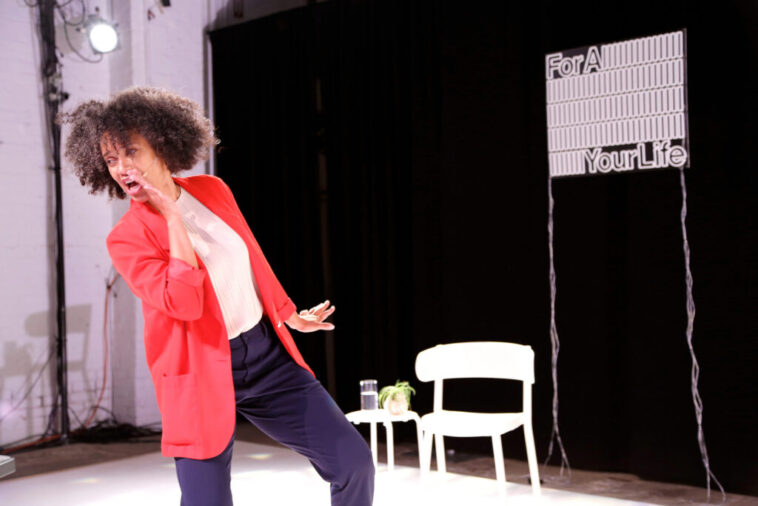
Leslie Cuyjet in her For All Your Life. Photo by Brian Rogers, courtesy Cuyjet.
How did this research process converse with your personal experiences as a Black artist?
In the summer of 2020, after the deaths of George Floyd and Breonna Taylor, I felt very alone in this feeling of uncertainty around the authenticity of solidarities with Black Lives Matter—I even got a few Venmos from well-intentioned friends on Juneteenth. This coincided with an uptick in attention to my work, and I couldn’t tell if that was a result of all these things. I was like, “How do I ask this question?” I couldn’t really reconcile with it, so I said, “I’m going to ask you (the audience) to reconcile with it.” That’s how it spun into this conceptual framework, where you can support me, but you have to accept that you’re going to benefit from my death.
A large part of For All Your Life takes shape on film. How do you approach multimedia elements with your collaborators?
When I had this idea for a film, I thought I was gonna borrow my partner’s camera, set up a tripod, and do it in a week. But very quickly my co-director, Sean Donovan, was like, “Well, you could, but let’s expand our thinking on how we can bring other people in.” I’m such a collaborator by nature that once the conversation started going with Daniele (Sarti), we realized we were on the same page. I didn’t even know what a storyboard looked like, and I was shocked when Daniele said, “Yeah, I can totally see it. I get it.” I couldn’t believe he could understand the chaos of my brain that I tried to put into a PDF.
Much of your work has been built for very particular, often nontraditional, performance spaces, yet touring is a central element in For All Your Life. How do you adapt the work to new spaces?
I love working with the limitations of space. Sometimes it holds these great little escape routes to new ideas. The space always dictates how the dance is framed—it’s a marriage of dance and architecture. There’s no way I’d just say, “Here’s the piece” and fit it in like a Lego, especially when there’s so much that’s built into the environment of what I’m calling “corporate theater”—the high heels and the refreshments and the white marley in this bright, airy space. Whether or not the audience knows it when they’re walking in, they’re being coded by this environment, and I think that adds to the feeling of what you see. I’ve never restaged a piece this many times, so I think it’s going to be a great challenge to take it into new spaces and keep it fresh.
The post How Leslie Cuyjet Brings Together Personal and Social Histories in For All Your Life appeared first on Dance Magazine.




GIPHY App Key not set. Please check settings