
Tell Me Where It Comes From, Emily Coates’ new commission for Works & Process, was sparked by the discovery of an archival box housed at the Wadsworth Atheneum Museum of Art in Hartford, Connecticut, chronicling George Balanchine’s brief touchdown there in 1933. Coates—a former member of New York City Ballet who’s gone on to an illustrious career as a dancer, choreographer, writer, and professor at Yale University—has spent the past two years mining archives in New England for material on Balanchine’s early years stateside. Together with a group of collaborators, including director Ain Gordon and actor Derek Lucci, Coates’ findings will come to life at Works & Process in New York City on November 23, followed by a regional tour.
What did Balanchine’s time in Hartford look like, and why did it come to an end?

It was very brief. In October 1933, Lincoln Kirstein patched together funding from a number of individuals, including the support of the Wadsworth, to bring Balanchine to the U.S. They took him to Hartford, where he basically lasted one night. He could not envision his ballet school set up in the insurance capital of the world. Up until that point he’d spent his career in major cultural centers, so for Balanchine, it was New York or bust.
What in the archival box at the Wadsworth excited you?
It just sparked my imagination. New York didn’t think much of Balanchine’s time in Hartford. They don’t mention it in the historical narratives on the NYCB or School of American Ballet websites. But I could see in the materials that it was incredibly meaningful to the museum’s identity that they’d participated in bringing Balanchine to America. The impetus for Tell Me Where It Comes From was to draw this regional history back into the story of Balanchine’s legacy.
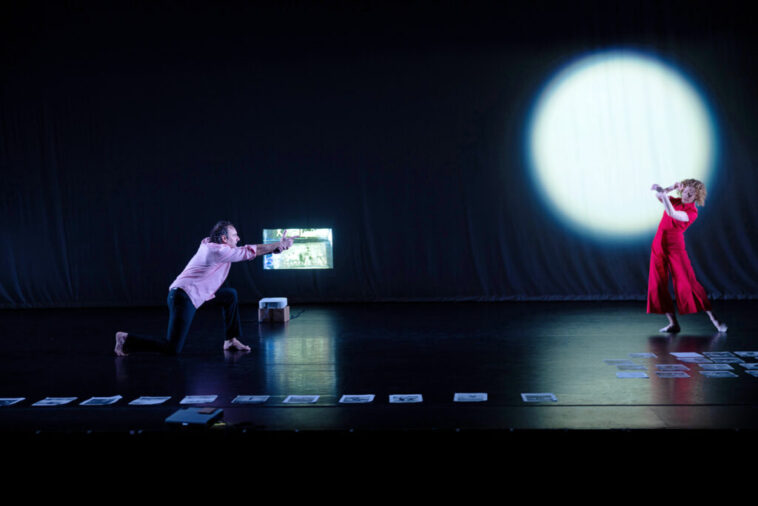
Derek Lucci and Emily Coates in Tell Me Where It Comes From. Photo by Chris Randall, courtesy Works & Process.
Using that box as your jumping-off point, what came next?
I went to Harvard’s Houghton Library, which has Balanchine’s papers. I looked in my own hometown at the Beinecke Rare Books and Manuscripts Library at Yale. I had a residency at Jacob’s Pillow and did research in their archives. I visited the NYCB archive when it was still housed in Lyndhurst, New Jersey. And I went to the NYCB production warehouse. So much of this mapping, as I call it, was a keen interest in where things have landed. Balanchine was a choreographer who didn’t believe in the afterlife of his own work. What these archives really hold are traces, marginalia. But what I didn’t anticipate was how squarely it would point me to Balanchine’s early years. I became captivated by photographs from the 1930s, and what you can see in this proto-, emerging neoclassical style that he would ultimately become known for. There was no single vision then. The works are eclectic.
Given the breadth of your research, what will Tell Me Where It Comes Fromlook like?
I’m very interested in archives and performance and how they seem to contradict each other. Archives try to fix an event; performance is about liveness and copresence in time and space. That contradiction is, to me, creatively generative. The performance blends movement, text, music, and projected images, all sourced from my archival research, into collages of how Balanchine chose to represent the afterlife in his work, and we create a portrait of his choreographic afterlife. Our goal has been to point to the original impulse of Balanchine’s body of work, which lies somewhere between his relationship to his dancers and his own spirituality. The work will not look like what Balanchine himself would have made. But if my fantastic team of collaborators and I have done something right, its core essence will be honored.
The post Emily Coates Maps Balanchine’s Early History in America in Tell Me Where It Comes From appeared first on Dance Magazine.




GIPHY App Key not set. Please check settings