
The Robot Report Podcast · Ed Mehr on Transforming Manufacturing at Machina Labs
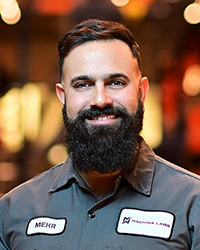
Episode 235 of The Robot Report Podcast features Ed Mehr, co-founder and CEO of Machina Labs. In addition, Eugene Demaitre, editorial director for The Robot Report, is back from a weeklong trip to Seoul.

Gene shares some takeaways from Automation World, or AW 2026and discusses what he learned from the international companies exhibiting in South Korea.
Mehr joins the show to discuss how his company is changing hardware production through flexible, robotic-powered factories that switch products at the click of a button. He offers insights on software-defined factories, advanced automation, and strategic partnerships shaping the future of hardware production.
Ed Mehr, co-founder and CEO, Machina Labs
Mehr is an entrepreneur and engineer specializing in advanced manufacturing, robotics, and artificial intelligence. At Machina Labs, he leads efforts to integrate AI-driven robotics into flexible, on-demand production systems.
Under his leadership, the company is reshaping how industries such as aerospace, defense, and automotive approach metal forming and modern manufacturing. Before founding Machina Labs, Ed held key roles at several leading technology companies.
At Relativity Space, he helped develop the world’s largest metal 3D printer, supporting the company’s mission to transform rocket manufacturing and enable long-term space exploration.
Prior to that, he served as chief technology officer and was a founding member of Averon, a cybersecurity firm that created fully automated internet authentication technology. Ed’s career also includes engineering positions at SpaceX, Google, and Microsoft, where he worked on aerospace, software, and automation projects.
Show timeline
0:30 – Eugene Demaitre recaps AW 2026
9:43 – News of the week
26:27 – Ed Mehr, co-founder and CEO of Machina Labs
News of the week
Teradyne Robotics sues Chinese cobot maker over UR software
Teradyne Robotics, the Odense-based parent company of Universal Robots and Mobile Industrial Robots, has escalated a copyright infringement dispute against the German subsidiary of Chinese cobot maker Elite Robots by filing a lawsuit in German courts.
Teradyne transitioned to legal action following a cease-and-desist letter it alleged was ignored. The company also urged European policymakers to more aggressively defend their intellectual property against non-European rivals.
This legal battle unfolded as European manufacturers increasingly prioritize robotics for 2030, even as the VDMA warned that Germany is losing ground to low-cost Asian competition. Furthermore, the litigation highlights a tightening market for UR, which faces mounting competitive pressure.
Zoox begins testing purpose-built robotaxis in Phoenix and Dallas
Zoox is expanding its robotaxi operations to Dallas, Texas, and Phoenix, Arizona, where it plans to open new depots alongside a Fusion Center in Scottsdale and launch a new partnership with Uber. These two cities join an existing testing footprint that includes the San Francisco Bay Area, Las Vegas, Seattle, Austin, Miami, Los Angeles, Atlanta, and Washington, D.C., bringing the company’s presence to 10 distinct markets.
Following its standard protocol, Zoox plans to initially deploy a small fleet of retrofitted SUVs in central neighborhoods to focus on manual mapping. It will then transition to autonomous testing with a safety driver present to manage AI disengagements.
Once these preliminary steps are complete, the company intends to deploy its purpose-built robotaxis for further testing in these new markets.
OpenAI robotics head resigns over Pentagon deal
Caitlin Kalinowski, the head of OpenAI’s hardware and robotics team, resigned last weekend due to governance concerns regarding the company’s recent agreement to make generative AI systems available within U.S. Department of War computing systems.
Kalinowski, who joined OpenAI in November 2024 after leading Meta’s augmented reality glasses team, stated on social media that the announcement was rushed without defined guardrails or sufficient deliberation on issues like surveillance and lethal autonomy.
While expressing deep respect for Sam Altman and pride in scaling the robotics group, she said that her resignation was a matter of principle. Kalinowski argued that such high-stakes national security deals require greater judicial oversight and human authorization than the current agreement provided.
Humanoid developer Agility Robotics rebrands
Agility Robotics has rebranded to “Agility,” dropping the “Robotics” suffix to create space for growth as the company explores new use cases, services, and industries beyond its current deployments. Accompanied by a refreshed logo and verbal identity signifying motion, innovation, and reliability, this brand reboot is intended to match the maturity of the company’s technology and its commercial momentum in leading humanoid adoption.
Despite the name change, Agility remains on track to deliver the first cooperatively safe humanoid in 2026, with Chief Business Officer Daniel Diez noting that the new identity signals a readiness to scale into real operations across diverse sectors.
Agility Chief Technology Officer Pras Velagapudi will be a featured panelist on the “State of Humanoids” keynote session on May 27 at the Robotics Summit & Expo in Boston. Podcast co-host Mike Oitzman will moderate this panel with Alberto Rodriguez, director of robot behavior for Atlas at Boston Dynamics, and Aaron Prather, the director of robotics and autonomous systems programs at ASTM International.

The post Ed Mehr on transforming manufacturing at Machina Labs; AW26 Recap appeared first on The Robot Report.



GIPHY App Key not set. Please check settings