

T-Mobile Director Srikant Datar, Dean of the Harvard Business School recently took some of his Magenta-colored T-Mobile marbles and went home. By that, we mean that Datar sold 1,000 shares of T-Mobile stock on March 10 at a price of $218.25 resulting in gross proceeds of $218,250. Insider sales and purchases of stock are often tracked by traders as a sign that someone with connections at a company might know some non-public information. As a result, this person’s buy or sell decision could indicate that something big is coming that will impact the shares.
T-Mobile insiders, including Mike Sievert, are dumping their company shares
For example, Datar’s sale might be seen as a sign that T-Mobile’s stock is about to decline. Of course, the decision to sell the shares might have been due to other reasons that have nothing to do with Datar’s knowledge of what is happening inside the carrier. Perhaps the Dean is looking to expand the size of his home, or plans on purchasing 90 iPhone Fold units with 1TB of storage (priced at $2,399 according to a new leak we wrote about today).
Further digging shows that Datar actually sold more shares this month. On March 4, he sold 3,291 shares of T-Mobile at a price of $221.10 for gross proceeds of $727,640.10. So for the month, he sold 4,291 shares of the carrier for gross proceeds of $945,890. A sale like this could be used for the down payment on a new home, or for 394 1TB iPhone Fold units.

Over the last 90 days, nearly $151 million in T-Mobile shares have been sold by insiders
Since February, sales of T-Mobile shares by insiders swamped buys by a tally of 11-0. Keep in mind that some of these sales could be for tax or estate planning and some shares are awarded to some insiders as part of their contract. Nonetheless, insiders have been dumping T-Mobile’s shares even as the wireless provider’s transition to a digital carrier moves ahead. In the 90 days before Friday, T-Mobile insiders sold 694,134 shares of T-Mobile valued at approximately $150.8 million
Other insiders selling large amounts of T-Mobile stock include former CEO Mike Sievert who is still a member of T-Mobile’s Board of Directors. Sievert unloaded 80,000 T-Mobile shares generating $17.2 million in gross proceeds. Director Raul Marcelo Claure sold 550,000 shares worth a cool $119.6 million. Sievert and Marcelo Claure’s sales came right near T-Mobile’s 52-week high. Claure, you might recall, was once the CEO of Sprint.
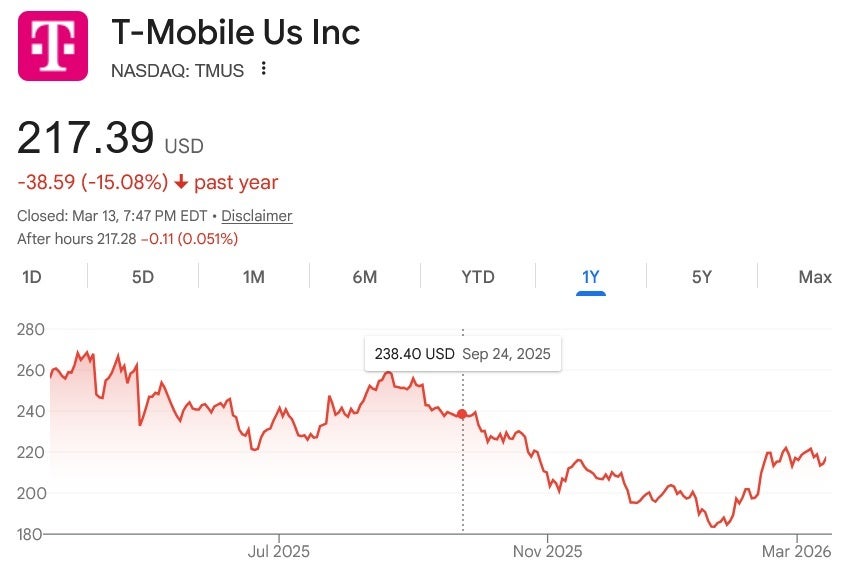
T-Mobile shares have been falling as insiders dump the stock over the last year. | Image by Google
One analysis of the situation states that the insider sales right near T-Mobile’s 52-week high is an indication that insiders were diversifying their holdings or taking advantage of the rallying stock to sell at a high price. As a result, the T-Mobile insiders were probably not selling because they knew some material non-public information that would take the stock down and wanted to exit the stock before the public started selling.
However, there is a time when insiders can sell when they know material non-public information and that is if they dispose of their shares under automatic sell rules. That allows the insider to sell shares under a Rule 10b5-1 trading plan. This means that the seller has agreed to sell his holdings at pre-arranged times even if he comes into possession of material non-public information. At the time this plan is created the insider must not know about anything inside the company that could move the stock. Most of Mike Sievert’s sales took place inside a Rule 10b5-1 trading plan.
Do T-Mobile insiders know that the transition is going to fail?
Over the last 12 months, T-Mobile insiders made 34 buys totaling 709,089. They made 137 sells getting rid of 7,593,886. Obviously the majority of insiders were selling T-Mobile shares over the last year. During that time period, T-Mobile shares fell $38.59 or 15.08%
The big question is whether T-Mobile insiders know something about the carrier’s shift to a digital carrier that the public doesn’t know about. A few days ago we wondered whether T-Mobile’s decision to stop reporting postpaid net phone ads each quarter, an important metric that analysts use to compare T-Mobile with Verizon and AT&T, was done for a dark reason. Perhaps the company knows that this move to reduce stores, reps, and push all transactions through T-Life is bound to result in a mass exodus of subscribers.
Add to this the large imbalance in insider sales and the future of T-Mobile might not be as rosy as once thought.
Read the latest from Alan Friedman




GIPHY App Key not set. Please check settings