
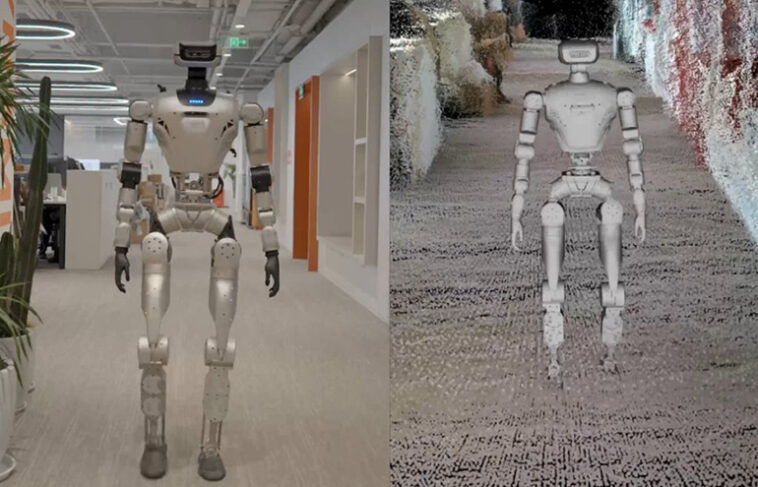
LimX demonstrates safe navigation with RealSense cameras and NVDIA CuVSLAM. Source: RealSense
As robots including humanoids move from novelty to everyday reality, perception is no longer just about performance; it’s about safety, according to RealSense. At NVIDIA GTC this week, the company is demonstrating humanoid navigation with LimX Dynamics.

“Humanoids operate in three dimensions, alongside people, in environments that are constantly changing,” stated Nadav Orbach, CEO of RealSense. “If robots are going to work safely beside humans, perception carries responsibility beyond raw sensors. It must function as the robot’s visual cortex, enabling accurate localization, collision avoidance, terrain understanding, and stable, predictable motion in unstructured environments.”
Spun out from Intel Corp. last year, RealSense delivers depth cameras and vision systems for autonomous mobile robots (AMRs) and humanoids, as well as industrial automation, healthcare, access control, and more. The Cupertino, Calif.-based company said its perception systems enable machines and physical AI to reliably and intelligently navigate and interact with the human world.
RealSense offers ‘visual cortex’ for humanoid robots
“The cameras, advanced perception and reasoning software that enable robots to see are more than tools for navigation or task execution; they are the visual cortex for humanoids, allowing them to move, work and act in human settings,” said RealSense.
The company claimed that its demonstration of autonomous humanoid navigation at GTC in San Jose, Calif., is the first of its kind. LimX Dynamics plans to demonstrate how dense 3D depth perception enables legged robots to localize, map, and navigate autonomously, safely and predictably.
Its system will use RealSense depth cameras and vSLAM (visual simultaneous localization and mapping) and be integrated with odometry from NVIDIA CuVSLAM. NVIDIA Isaac Lab accelerated the development of this stack and served as a high-fidelity digital proving ground for reinforcement learning and policy training.
Shenzhen, China-based LimX Dynamics said this simulation-first approach helped it bridge the “sim-to-real” gap, enabling its humanoid to master complex 3D maneuvers with validated, predictable safety before its physical debut at NVIDIA GTC.
Humanoids need navigation for 3D spaces
Wheeled robots move on a relatively predictable plane, delivering speed and efficiency on flat ground, said RealSense, which cited robotic vacuums as an example.
However, humanoids and quadrupeds are far more complex, it noted. They move through full 3D space, which means shifting contact points and non-linear motion, requiring stable foot placement and awareness of their environment.
“Encoder-only odometry and 2D lidar used for wheeled robots lack the full 3D awareness needed for stable, safe motion,” asserted RealSense. “Until now, that gap has constrained deployment, forcing many legged robots to rely on teleoperation, supervision, or tightly controlled environments.”
Editor’s note: Mike Nielsen, CMO at RealSense, will participate in a keynote panel on “The State of Humanoids” at the 2026 Robotics Summit & Expo.

LimX Dynamics to demonstrate a safer path for robotics
The partners said they will show how RealSense’s dense depth perception fused with NVIDIA visual odometry and cuVSLAM provides scene understanding, localization, mapping, and navigation, enabling LimX’s humanoid to operate safely in 3D space.
In practical terms, they said safer robotics means:
Accurate localization and mapping, so the robot always knows where it is and what’s around it
Collision avoidance with people and moving objects
Fall prevention and stable locomotion through 3D awareness of terrain, edges and height changes
Predictable, human-readable motion, with fewer sudden stops or erratic corrections
“Dense 3D perception also unlocks new behaviors that have historically been difficult to execute safely, including stair navigation, curb and elevation detection, uneven terrain traversal and dynamic obstacle avoidance in shared spaces,” explained RealSense. “Advanced path planning allows robots to adapt to changing conditions, such as moving carts, shifting pallets, or people entering their path.”
RealSense said the LimX Dynamics demo spotlights its expanding role in the broader robotics ecosystem. The company said its decade of depth innovation includes active stereo optimized for close- and mid-range sensing and a mature software developer kit (SDK) ecosystem.
In addition, RealSense said that it has helped robotics teams prototype and scale more efficiently and that it is accelerating the development of safe autonomy for humanoid systems.
The post RealSense unveils autonomous humanoid navigation at GTC 2026 appeared first on The Robot Report.




GIPHY App Key not set. Please check settings