
To move from a celebrity-studded film about a marriage of monsters to a Philip Glass opera about Gandhi’s nonviolent resistance may seem quite a leap. For Bobbi Jene Smith and Or Schraiber, who are among the most highly sought-after choreographers working today, it’s all in a day’s work. Between finishing up with Maggie Gyllenhaal’s The Bride! two years ago and the Paris Opéra’s Satyagraha this year, the seemingly fearless couple have also premiered an evening-length work for the National Ballet of Canada, and conceived and directed Seven Scenes, a collaboration with experimental-music duo Ringdown. Now, their seemingly disparate film and opera projects will come to fruition in short succession, with The Bride! arriving in U.S. theaters March 6 and Satyagraha opening in Paris April 10.
Moving from your work on The Bride! to thinking about Satyagraha seems like quite the transition.

Bobbi Jene Smith: I feel like Satyagraha has been traveling with us through many different processes. It’s like one part of you keeps working all the time on different pieces. We were working with the National Ballet of Canada, and it was giving me information somehow for Satyagraha.
Or Schraiber: Every process is different. And it’s our first time making an opera. We had to study the subject matter of Satyagraha, and Martin Luther King (Jr.), and Gandhi, and everything that comes with this concept of nonviolent resistance. It is extremely relevant for today. It took us two years to really build the knowledge to come to this point.
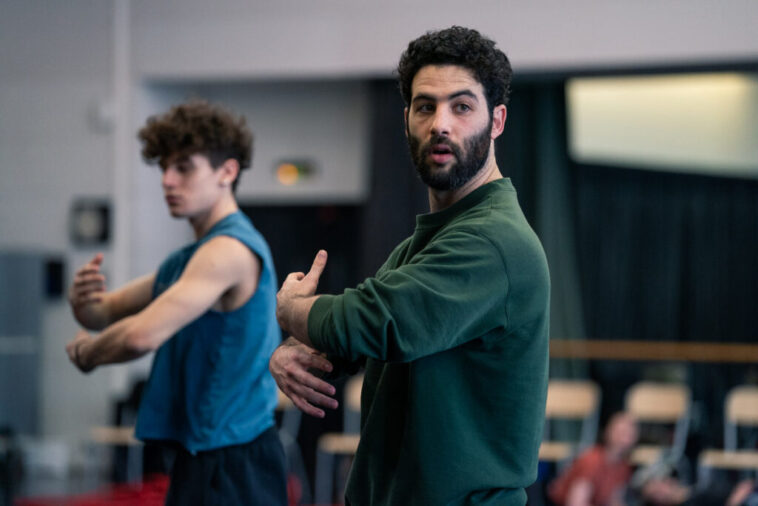
Or Schraiber in rehearsal with Paris Opéra Ballet. Photo by Yonathan Kellerman, courtesy POB.
Not only are you working with singers, you’re directing as well as choreographing. That requires you to bring a different part of yourselves to the project, right?
Smith: Yeah. It also feels inseparable, you know? I think especially for this piece, I would love if the choreographic decisions and the dramaturgical decisions and everything feel like one language. So I feel lucky that we’re able to put on those different hats. And that we’ve been given trust to really go for our vision of this.
As with Satyagraha, The Bride! involved principal performers who are not trained as dancers. Can you talk about how you approachedthat?
Schraiber: We were, to say the least, extremely fortunate to work with Christian Bale and Jessie Buckley. They were so inspiring, and game to do anything. At least to try. With Jessie, it felt like generating material with a trained dancer. Her physical decisions were how a dancer would approach different physicalities. And Christian is so wild in his incredible ideas. His mind palace is just so vast.
Smith: We love to work with what is already there. Jessie and Christian are such physical actors. So it was more just trying to reveal, and craft something to support what’s already there. And also asking them: You’ve been living with these characters. What would Frank do? What would the Bride do?
How did the two of you and tap virtuoso Michelle Dorrance come to work together on The Bride!?
Smith: I’d been trying to meet Michelle for many years, and we’d never quite crossed paths. She was a part of the project way before us. It was Maggie’s idea to have it be a collaboration between two types of dance—the vernacular tap dancing and authentic movement from the 1930s, and then what if it was in collaboration with something more modern? How could these two things collide? So once they had signed off on us, Michelle just immediately got on a plane. We were doing a project in Copenhagen, and Michelle showed up and said, “Let’s get to work.” Immediately there was this kind of bond between the three of us.
Schraiber: When we got into the studio, right away it was so apparent that she’s a musician in a jam session, in that manner of just “Let’s start throwing ideas and see what comes out of it.“
Smith: It was a very productive day and a half of work. It was right before casting. I had just broken a toe and I couldn’t put weight on one foot. Michelle’s like, “Let’s make the audition phrase.” We were thinking, It’s okay that it’s not the most polished thing, it will just be for the audition. And then that phrase ended up being in the film. It shows up in the big ballroom monster-mash scene.
How did your collaboration work?
Smith: It moved me so much, this meeting with Michelle and trying to find a common language between two art forms. And how collaboration really can change you. I loved the feeling in the room of tap dancers—you would kind of spill out an idea, and they’d be like, “Okay, yeah, but how about let’s try this?” We add on to each other. It’s like this healthy camaraderie over constantly building the idea—to be bigger than our own ideas.
You sound very open—like you aren’t too precious about your material.
Smith: The piece is the magical thing that you are all taking care of. You have to let go of whose idea is better, because the best idea has to serve the piece. It becomes very clear if it’s just taking care of one person, or you get stubborn, or you get in your own way.
Maybe it’s not always so clear what is really serving the piece. How do you resolve those kinds of questions?
Smith: I think by getting in the dirt, getting in the room. That’s something that we really connected on with Michelle: Let’s get back to work, let’s get to the dancing. Because usually the dancing is going to solve it.
Schraiber: I think also it’s important not to romanticize this idea. It’s hard.
Smith: Collaboration is hard. (Laughs, mimes choking him.)
Schraiber: We’re doing it for a living, and it’s the hardest thing. But it’s also the most rewarding.
Smith: Your play muscle can get stronger. So that when it gets so hard and you say, “I can’t,” the play muscle takes over. And the love wins. Always.
The post Bobbi Jene Smith and Or Schraiber on Choreographing for Hollywood Monster Flick The Bride! and Paris Opéra’s Satyagraha appeared first on Dance Magazine.




GIPHY App Key not set. Please check settings