
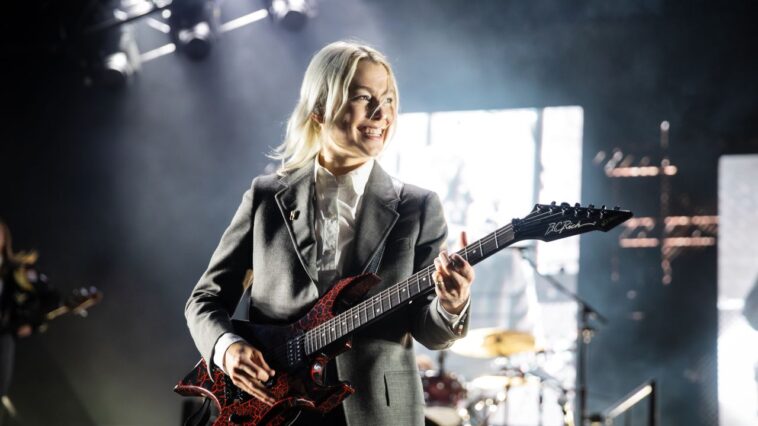
“This song is about the past,” said Phoebe Bridgers before diving into one of the eight unreleased tracks she played for a rapt sold-out crowd at her pop-up Madison Square Garden show on Thursday night. “But that’s every song.” Since her spectral breakout single “Smoke Signals” in 2017, the Los Angeles songwriter, Boygenius member, and soon-to-be actress has become a preeminent chronicler of the ghosts we accumulate over time: past selves, old hauntslost loves. In her songs, collective and personal history are both alive and instructive—a pathway to understanding who you are, and who it is you’d like to become.
Fittingly, Bridgers’ MSG show, which followed a series of month-long surprise performances across the country, pulled off something uncannily akin to time travel. Recording devices were banned and all phones were locked away in Yondr pouches, while pens and paper were strictly verboten for press. (Bridgers will continue the no-phones policy on her just-announced Lost Tour this fall.) After handing over our devices, we received printed tickets with our seat number scribbled in silver ink, lest someone lose their way returning from the merch stand or custom photo booth.

Before Bridgers took the stage, the cyclical nature of history was already evident. Less than 24 hours earlier, New York Knicks fans had swarmed the Garden for a watch party to witness their team beat the San Antonio Spurs in Game One of the NBA Finals—the same team they faced the last time they made it this far, in 1999. Unsurprisingly, this synchronicity seemed to fall on a solid percentage of deaf ears. “Ugh, hurry up!” I heard one flock of teenagers in flowy boho skirts and archival Bridgers’ tees complain as they waited for the digital Knicks marquee outside the arena to shift back to a poster for the show. That said, I spoke with another fan who had donned a Knicks jersey for the occasion, noting that securing Phoebe tickets the night before such a consequential game felt “like destiny.”
Photo by Alex Suskind
Nods to yesteryear also came in the form of the small, round stage Bridgers used, which had all the trappings of a 1970s suburban dad’s basement, from the kitschy chevron throw tossed over a couch to slime-green lava lamps and blacklight posters. Accompanying her were Nick White on keys and Christian Lee Hutson on guitar, foot drum, and harmonica, imbuing every song with a campfire warmth conducive to the setting, as if tens of thousands of us just stumbled across an impromptu jam session.
Perhaps due to the anticipation of new material, a hush blanketed the crowd when Bridgers, sporting a Black Sabbath tee and her usual curtain of ice-blonde hair, opened with “Motion Sickness.” But a sense of surprise reverberated when fans recognized the opening strains of “Waiting Room,” a 2014 ballad about teenage heartache that unfurls into steely determination, and one of the first solo songs she ever released.
After the requisite run of fan favorites “Kyoto” and “Moon Song,” it was time for the new shit. Although the dissemination of lyrics was not permitted, the eight songs she performed—including one with a nod to a major New York landmark—reaffirmed her status as one of the finest singer-songwriters working today. Channeling Soundgarden and the Chicks (yes, she has a country song coming) as deftly as Neil Young and Paul Simon, Bridgers introduced bigger belts, more elastic vocal runs, and thornier topics into her oeuvre of quiet devastation. But she continues to render small moments and passing thoughts as exquisitely as big philosophies about fame, death, and the weaponized neglect of the American government. Every ticket, from the floor to the nosebleeds, was also priced between $1 and $20, with proceeds supporting the Community Justice Exchange’s Immigration Bond Freedom Fund. (If that benefit wasn’t clear enough, Bridgers didn’t mince words before performing one of her more overtly political new songs: “I fucking hate ICE agents.”)




GIPHY App Key not set. Please check settings