

SpaceX’s (SPCX +0.00%) long-awaited initial public offering (IPO) has ignited investor excitement unlike anything seen in years. Last week, news broke that the company set a fixed offering price of $135 per share. For an everyday investor armed with some capital, this price tag appears accessible — opening the door to a stake in Elon Musk’s space exploration and AI empire.
Smart investors understand that IPO stocks come with far more sobering realities, however. Let’s explore the harsh mechanics of IPO stocks before retail investors pile into SpaceX’s upcoming offering.
Image source: Getty Images.
How much does a $10,000 investment buy in the SpaceX IPO?
Let’s start with the cold math. A $10,000 initial investment at the $135 offering price will buy you roughly 74 shares. Here’s the catch: IPO shares are not allocated on a first-come, first-served basis.
Brokerage firms receive a limited pool of shares from the IPO underwriters. This means that retail investors are competing against demand from institutional companies and high-net-worth clients. In other words, a $10,000 deposit doesn’t guarantee 74 shares. While SpaceX’s offering price is fixed, your actual execution price boils down to how brokerages rotate their allotments.
What brokerage firms have access to the SpaceX IPO?
Participating in an IPO requires having an account with one of the major brokerages that have secured access to the SpaceX offering. These platforms include Charles Schwab, Fidelity, Robinhood Markets, and SoFi Technologies.
These platforms offer online applications that take just a few minutes to complete. For the SpaceX IPO in particular, account minimums are zero for Robinhood and SoFi. Charles Schwab requires investors to have a minimum balance of $100,000, while Fidelity lowered its threshold to just $2,000.
Eligibility for IPO investing can be stricter than simply having available cash. Brokerages generally check your account tenure and trading history, and they may assess your total assets (or available liquidity).
Are IPOs smart opportunities for retail investors?
The overwhelming likelihood for a $10,000 order is a partial fill or, more commonly, no fill at all. When SpaceX stock actually lists on the Nasdaq on Friday, the shares that retail investors missed at the $135 offering price will trade in the open market.
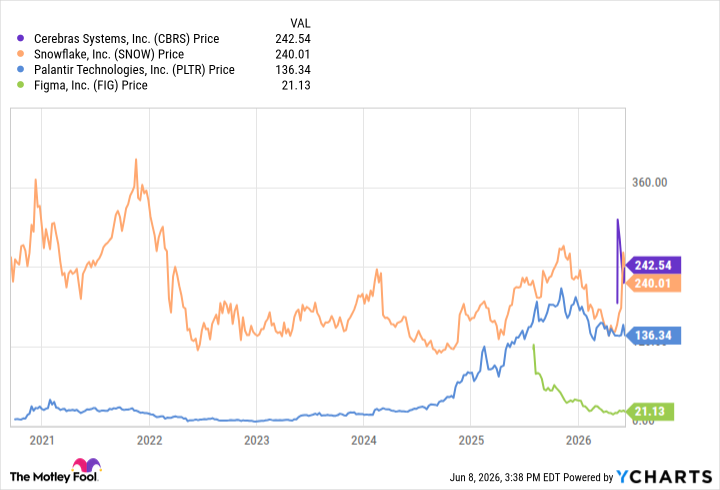
Stock market history is filled with examples of newly public high-profile companies that pop on the first day of trading, fueled by pent-up demand. These dynamics were on full display during the Cerebras Systems IPO, and in offerings from Figma, Snowflake, and Palantir Technologies in recent years.
Data by YCharts.
Suddenly, the offering price climbs much higher in an otherwise short window. More often than not, chasing the premium after missing the offering price turns disciplined investments into emotional gambles. Moreover, if the stock later corrects — which is common for hot IPOs — investors who paid frothy prices end up holding the bag.
At the end of the day, a $10,000 investment in the SpaceX IPO will likely deliver far less ownership and far more frustration than headlines currently suggest. While straightforward math promises 74 shares at a $135 cost basis, the underlying process comes with a high degree of uncertainty and slim odds of an allocation. For most retail investors, the more prudent path to investing in SpaceX is to watch from the sidelines rather than following the crowd for now.




GIPHY App Key not set. Please check settings