
Share

Tweet
Share
Share
Waterfire Arts Center, Providence, RI.
April 16, 2026.
The feeling of taking flight, transcending gravitational inevitability if for just a moment; the power in a reach, energy traveling from the soul out past bone and muscle; the emotional truth of quieter moments, a hand to a shoulder or tenderly supporting another’s head….within the art form of dance is a unique kind of freedom.
Newport Contemporary Ballet Artistic and Executive Director Danielle Genest noted “freedom” as a key theme in Shakespeare’s The Tempest – and also, naturally, storminess. In a program so named, two of her works and then a ballet adaptation of the play thoughtfully investigated these themes – thus, all considered, connecting works across time and medium. The open possibility within creative generativity burned bright.
Genest’s poignant Fugitive Ground opened the program. I reviewed the work when it premiered in 2018, yet it was interesting to experience it again with the themes of freedom and storminess in mind – those themes Genest discussed, in her curtain speech, as guiding the program.
Dancers crossed and uncrossed wrists, thereby gradually moving arms through space: sometimes with a turbulent speed and movement quality. At other points, they pressed wrists forward as if against an imaginary wall: again, sometimes with a frenetic quality, desperate to push against that obstruction. Perhaps there was freedom in pushing forward against various obstacles, moving forward bit by bit – freedom in the fact of persistence.
Partnering offered a feeling of flight, of gravity defied with the support of another. At one point, ensemble member Grace Byars even took on the shape of wings in flight while lifted: a bird freely soaring on the wind of those helping to carry her. To end, dancers walked off into an offstage light. I thought about, wondered about, how much of finding freedom is a choice – the choice to walk into light. Regardless, these personas walked towards that light in community – together – and that felt important.
The next work, Outcry, was a premiere from Genest: exciting, mysterious, thought-provoking. In the theme of storminess, the dancers (Nadia Bradfield, Mia Nolte, Lauren Difede and Jenna Torgeson) moved with power and muscularity from the very start. They stood ground in held poses and reached, their energy extending far past themselves.
That reaching, and subsequently movement out into space, went into all possible directions – creating a sense of insatiable exploration. Yet they also kept returning to the group, together in the search. They had the freedom to do both, in ways that they could shape.
Costumes toned in greys (designed by Alana Frutkoff and Genest) and the polyrhythmic, pulsing score (by Ben Frost and Daniel Bjarnason) enhanced the sense of storminess at hand. With the safe harbor of the group to which they could return, the group seemed fully unafraid to search through the storm. The score did shift to something calmer and more reflective, bringing that shift into the movement as well. Yet mystery still hung in the air, an uneasy restlessness.
The energy rose again: dancers running, reaching, and leaping every which way, any conceivable avenue to eating up space. Through it all, Genest’s typical thoughtfulness and rigor was clear; every gaze, count, and gesture felt highly intentional. The dancers delivered the committed artistry necessary to bring that richness to life – and I felt invested in their searching, their hunger to discover.
To close the piece, the dancers clasped hands and faced out into space, away from each other – very much still craving exploration, yet always exploration grounded in each other. For me, that seemed to be the key.
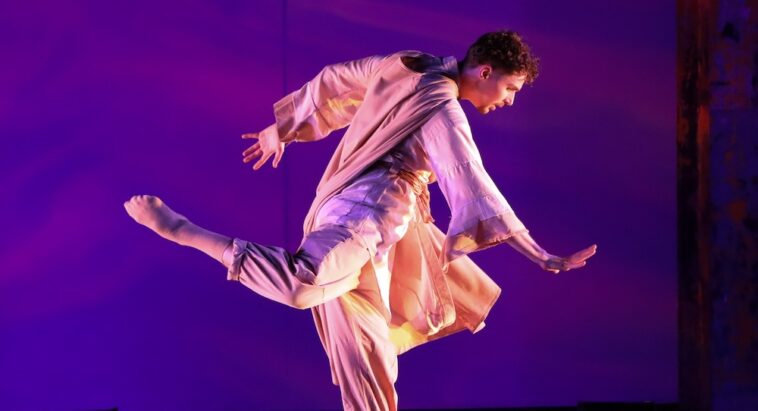
Joshua L. Peugh’s The Tempest was an ambitious undertaking, a challenge the team met with command and joy. The work’s notable strengths – clear characterization and clever prop use, for example – began with the very first scene: the storm. Billowing sheets were the sails stretched and tossed by the storm’s fierce gusts. Circular movements underscored swirling wave and wind currents.
Thus began a plot of the past uncovered, connections healed, and new life forged – and, ultimately, freedom for its characters through such healing and new life. Through it all, Peugh’s movement vocabulary was layered, yet ultimately easily digestible: with just enough intricacy to build character and unfold plot, bit by bit.
Separate characters moved with signatures – such as with gesture motifs and consistent movement quality – that made them distinct as personas. The ensemble’s performance quality brought these choices to vibrant life.
Ken Shiozawa brought an animalistic slinkiness to Caliban, making him both mysterious and fascinating. Nathan Crewe-Kluge built a Prospero both enigmatic and intriguing, sly and with a certain warmth. Jenna Torgeson shone as Ariel: effervescent through zippy turns and jumps, and with a smile just as bright. Margot Aknin delighted as Miranda, dancing with youthful softness and good-heartedness. Tyler Diggs danced Ferdinand with strong, grounded wholesomeness.
A duet between them – light, airy, expansive – gave the sense of love having bloomed and freedom from that love tasted. A trio of flower-crowned women offered a soothing pastoral feel. New life, a new day, seemed to be right around the corner. Sailors and servants of King Alonso (Josh Thake) provided humor and a sense of the quotidian to this grand tale of royals, shipwrecks, and attempted sabotage. Once again, top-notch theatricality made these dynamics immensely enjoyable.
Brandon Carson’s score added poignancy and atmosphere to all of the above. Modern sounds mixed and melded with much more classical inspirations, all together creating something that felt just right as support for what took the stage.
Elizabeth Bourgeois’ costumes were in a period vein, yet also effectively simple and unassuming – feeling realistic while also fully accommodating the dancers’ physical demands. Stephen Petrilli’s lighting did what skillful lighting tends to do: not call attention to itself, being complementary to the aesthetic and mood at hand, yet – if one were to focus in on it – beautiful in its own right.
This adaptation of The Tempest is the second play shaped into a dance that I’ve recently seen – and I hope to see even more choreographers take on the task. All of the nuances that the page holds may not come through in movement (and it does help to have a synopsis, like was available for both of those adaptations). Yet perhaps the art form of dance can present visceral truths that the page could never confer.
Perhaps – to point back to stated theme – there is freedom in such breaking of the boundaries of medium, to therein discover more of what a story has to illustrate. Until the next time we in the audience are lucky enough to experience what results!
By Kathryn Boland of Dance Informa.
Alana Frutkoff, Ben Frost, Brandon Carson, Choreographer, choreographers, choreography, dance review, dance reviews, Daniel Bjarnason, Danielle Genest, Elizabeth Bourgeois, Grace Byars, Jenna Torgeson, Josh Thake, Joshua L. Peugh, Ken Shiozawa, Lauren Difede, Margot Aknin, Mia Nolte, Nadia Bradfield, Nathan Crewe-Kluge, Newport Contemporary Ballet, online dance review, review, Reviews, Stephen Petrilli, Tyler Diggs




GIPHY App Key not set. Please check settings