
Share

Tweet
Share
Share
CitiBank Opera House, Boston, MA.
May 10, 2026.
Laughter might not be the first thing that comes to mind with “serious” concert dance. Yet, some of my favorite works have made me laugh. A glance, a smirk, a gesture, an expression: all these subtle offerings can speak a thousand hilarious words.
Short of humor, joyful dance can lighten spirits weighed down by the world outside of the theater. The soaring of leaps, lifting of hearts, and collective energy of an ensemble is a great prescription for those pesky “blahs”. The works in Boston Ballet’s Spring Experience – all unique and exemplary in their own ways – offered such joy and humor in spades.
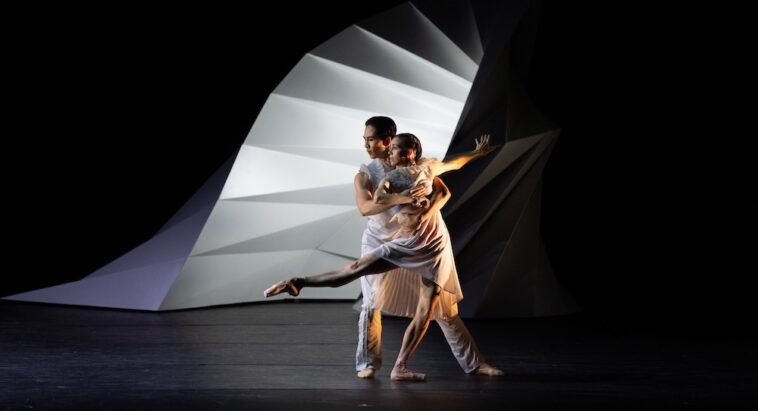
Lia Cirio’s After opened the program. It was as dynamic in its duality as it was when I reviewed its premiere in 2024. It was also as vibrant and vigorous as I remember it being. I felt enlivened just taking it in.
Interestingly, this time I analyzed less and simply appreciated the beauty of the moving art more. So it can be with experiencing works of art more than once; repeat experiences are almost always different, but there’s really no predicting different in what exact way.
Next came William Forsythe’s Herman Scherman (1992), as rigorously refined and technically astounding as any other Forsythe work…and with a pinch of the title’s quirkiness.
The aesthetic and approach felt a bit neoclassical “bare bones”: single-hued costumes and backdrop (costume design by Forsythe and Gianni Versace, stage design by Forsythe), just humans moving in relationship with music and with each other. Those simple elements were more than enough to delight. Variance in tempo and dynamics also felt effective; I sometimes think that Forsythe’s work can be so fast and intricate that it’s easy to miss all that it has to offer. With this work, I felt like I could savor it all.
The opening duet, danced by Madoka Sugai and Tyson Ali Clark, balanced staccato and legato qualities. Their spines would stop on musical accents and swerve on following resonances. Within that were funny touches such as a hip popping just so or a head placed at an unexpected angle.
The quirkiness deepened with Sugai exiting, then entering with a yellow skirt – colored and shaped almost like a daffodil cup. Clark soon did the same, and the audience chuckled. The pair continued the technical mastery, peppered by little delightfully wacky choices here and there, until the scene changed to a large ensemble.
They danced with similarly off-beat nuances, yet brought a little extra sassiness and attitude to that: expansive movement, proud bearing, vivacious energy. With certain quick sequences of extensions and jumps, observing the intense intricacy and speed, I couldn’t help but feel awe; yes, these are obviously elite professionals at the top of the game, but – stepping back a bit – it’s a reminder of the astonishing things humans can do. Perhaps Forsythe’s work pushes them to their edge, and they stood their ground there, with both command and joy.
The laughs continued to the end, with the ensemble plopping down on the stage, lights out, curtain down….exhausted. With the stamina and athleticism this work seemed to require, who in the world could blame them? It’s not the first time I’ve seen a choreographer use such an ending, but it works for me every time. I clapped hard once the curtain rose again and the dancers took their bows, laughing just a little through a smile.
The mammoth and memorable Dances at a Gathering (1969), by Jerome Robbins, closed the program. A solo from Jeffrey Cirio began it, almost with a sense of nonchalant exploration: extensions low, walks in between certain phases. I savored the ease, and it was also a great reminder that starting at a 6 allows one to go to a 10 and have it feel like a 10.
And, as the movement became more muscular and allegro, it did just that. Yet a sense of calm remained: a sweet, pastoral softness. Costumes were classical yet unassuming – plain collared shirts and pants for the men, long and flowing dresses for the women (costume design by Joe Eula). They danced before a blue backdrop with the slightest white shapes suggesting clouds…pastoral indeed.
There was much tenderness, aligning with the soft feel at hand, yet also humor. Paul Craig and Jeffrey Cirio danced a duet where they waved off the other’s bravado, then attempted some “one-upmanship”. A musical chairs of dancing partners ensued in another section, with certain glances and slow turns just pitch-perfect comedic timing.
The audience laughed at another point when one ballerina clicked toes while being lifted. Something about her expression made it funny in a “you had to be there” sort of way. Comedy: yet another skill in the toolbox of these extraordinary artists, apparently!
Even more than humor was the ensemble’s joy; their delight in each dancing moment was palpable. That combined with the varied sections – duets, trios, quartets, full ensemble – made it truly feel like “dances at a gathering”, humans moving together in assorted configurations until it was time to go their separate ways.
The flashes of personality, of authentic humanness, coming through each performance seemed to also allow for that. These were embodied humans, not just dancers doing steps. Ergo, while there wasn’t a “narrative” at hand, I could see relationships between personas.
They were humans being and doing together, not a word needed – and bringing their joy and humor along for the ride. It felt like proof of the value of such things in concert dance, but also in how we might engage with fellow humans after leaving the theater. A smile, a joke, a touch of zaniness can go a long way towards easing and connecting hearts. Thanks for the important reminder, Boston Ballet, and – as always – I’m excited to see what comes next!
By Kathryn Boland of Dance Informa.
Boston Ballet, Choreographer, choreographers, choreography, classical ballet, contemporary ballet, dance review, dance reviews, female choreographers, Gianni Versace, Jeffrey Cirio, Jerome Robbins, Joe Eula, Lia Cirio, Madoka Sugai, online dance review, online dance reviews, Paul Craig, review, Reviews, Tyson Ali Clark, William Forsythe




GIPHY App Key not set. Please check settings