
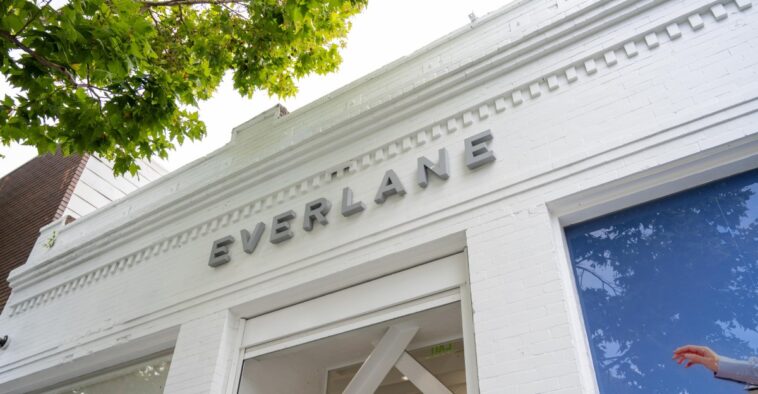
It was the sale heard around the millennial world: Eco-conscious Everlane was being acquired by fast-fashion kingpin Shein.
After a few tumultuous years, Everlane, an apparel brand loved largely by millennials looking for sustainable basics, reportedly went for the price of $100 million. When news broke last month, segments of the internet were up in arms. How could a brand built on radical transparency and ethical manufacturing fall so hard? And was this the beginning of the end for other millennial-coded brands, too?

Lauren Sherman is a fashion editor at Puck and broke the Everlane news. She tells Today, Explained co-host Noel King about how “millennial” brands — think: Allbirds, Glossier, and Sweetgreen, as well as Everlane — have been struggling under the radar for years, what the Everlane deal means, and if these brands can ever stage a comeback.
Below is an excerpt of their conversation, edited for length and clarity. There’s much more in the full podcast, so listen to Today, Explained wherever you get podcasts, including Apple Podcasts, Pandoraand Spotify.
You’ve been writing about this whole genre of brands that has unfortunately been tanking. And those are millennial brands. What makes something a millennial brand?
Millennials are specific because they’re very hard workers and they’re okay with selling out and they’re okay with commercialism. I think what a lot of big millennial brands represent is aspiration.
A lot of the brands that came up in the 2010s that were direct-to-consumer and digital-first were like, “We’re going to make it better. We’re going to make it more efficiently, we’re going to make it look cooler. We’re going to do all these things. And because we know better than our elders about how to run a business and how to make something really work.” And very few lived up to that promise.
You’ve been writing about a millennial brand that recently went through an incredible shift, and that is Everlane. Tell me about Everlane. What were its beginnings like and what was its pitch to consumers?
When Everlane launched, it was all about transparency — the idea that we are online all the time, we have access to a ton of information. Brands can’t lie to you anymore, so they’re going to give you all the information upfront. Everlane was like, “We’re going to tell you how much it costs to make our product. We’re going to tell you how much we’re profiting off of that. We’re going to tell you where the factories are. We’re going to tell you what fabric we use.”
“A lot of consumers kind of pushed back on anyone who was touting being socially conscious in the market.”
But the other thing that they did from the beginning was they tried to make cool clothes. This was an era — 2010, 2011, 2012 — where the Gap was sort of waning. Amazon wasn’t as at the front of our lives when it came to apparel in particular. And so there wasn’t a place that everybody was going to for their basics.
Everlane’s promise was, “We’re going to give you the coolest basics on the planet — these great box-cut tees and cool high-rise jeans — but we’re going to do it in a way that makes you feel better about purchasing it.”
And it worked for a time, because I remember people being very loyal to Everlane. But then what happened?
It worked for about 10 years, I’d say. I don’t know if you’re familiar with the term normcore, but they were at the center of the normcore trend. And then I’d say around 2018, 2019, they were doing really well. They were growing pretty fast, but they wanted to grow faster.
They started raising more money, and they just made some strategic changes to products that didn’t really jive with how the consumer was transforming as well. And so they sold a majority stake to a private equity firm. It just kept diminishing from there, and they really lost their place in the culture, whereas Uniqlo and all these other (brands) were rising up.
And then also, obviously, the anti-woke thing. They were associated with sustainability. And there’s this whole culture of, “Actually, we don’t care about that.” A lot of consumers kind of pushed back on anyone who was touting being socially conscious in the market.
Recently, the private equity firm that owned Everlane decided to sell the business to Shein, the Chinese fast-fashion conglomerate. When the deal was approved by the board, hours after I broke this news, the outrage was insane.
From who? From people who love the company?
People online who felt like it was an injustice. They were upset because (Everlane) was supposed to uphold all these values. And you’re selling to what in their minds is the antithesis of what Everlane supposed to stand for. Shein has an incredibly opaque supply chain and doesn’t share a lot of information. They’re not transparent. And also they sell stuff for really, really cheap, so you just assume that the way that they’re creating it is probably not the best possible way.
It sort of represented the death of those millennial brands, and also this place we are in the culture where nothing matters anymore. All these things that people stood for don’t matter. And I think it just really upset people.
A lot of these brands were started back when everything was a startup. There was a lot of venture capital money flowing in, and you didn’t really have to turn a profit, you just had to be doing something cool. Do you think that Everlane and some of these others are the equivalent of what happened with DoorDash and Uber, (where) you have to start making money now?
Yes and no. I think the difference is that Uber, a service business, eventually will be able to be profitable. Apparel businesses, it takes a lot and it takes a lot longer. There’s not really a demand for more apparel. If you can’t make it work, you just close.
In the end, the investors in Everlane didn’t really have a choice. And the thing for Shein is, they don’t need Everlane to be profitable. They can use it as an experimental little side piece.
What other brands are struggling?
(The makeup and skincare brand) Glossier is a great example of a brand that was really important to the consumer that has lost its footing. They have a new CEO and they’re trying to get back on track. But again, it was a matter of suddenly the message and the product were not as on-point as they had been, and they invested too much in the wrong things and didn’t focus on profitability. Beauty can scale faster than fashion, but it’s a similar thing.
(The sustainable shoe company) Allbirds — they really were focused on this one style shoe made with this environmentally friendly wool, and it was sort of a novelty. Now they’re in AI or something. They totally pivoted out of the shoe business. It’s very weird.
The one that has done really well is Warby Parker, and that’s because there is a monopoly in the eyewear business. They really did find a white space and were able to make a product that people really needed and they did it responsibly.
Can you imagine any of these brands — the Allbirds, the Everlanes, the ones that are really struggling — making a comeback?
Allbirds, no. Everlane, probably not. I’d say 2 percent chance Everlane. Allbirds, 0 percent. Glossier — there’s still a need for what they do and how they originally presented it. I think they could potentially get that one back on track.
But the reality is, in this market, we’re just going to see brands turn over more quickly. There are a lot of legacy brands that are still around, so it’s not like none of these things became the Levi’s of their category. And that’s what you kind of have to do to have longevity. If you want to be around for a hundred years, you have to be Louis Vuitton or Levi’s or Nike or what have you, to be able to really stick it out.




GIPHY App Key not set. Please check settings