
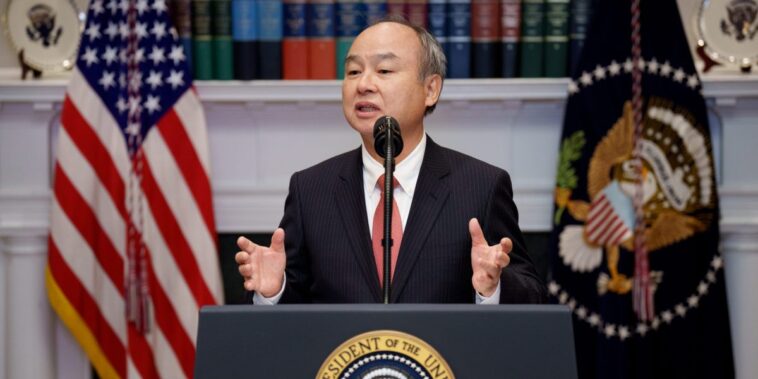
The billionaire founder of Softbank, who made a fortune backing companies with world-changing ideas like Alibaba, said Elon Musk’s orbital data center plans are as out there as the eccentric SpaceX founder himself.
“In the battle for AI, the next few years will be far more important than what might happen a decade or so from now,” Softbank CEO Masayoshi Son said Tuesday in response to a question at the annual shareholder meeting for Softbank’s wireless and broadband division Tuesday, Bloomberg reported.

Sending AI data centers in space doesn’t make sense, he explained, because it will take many years and lots of money. Instead, Softbank is focusing on building out data centers here on Earth.
“He who strikes first wins,” he said.
While Son noted that Musk is a “remarkable agent of change,” he said his idea for orbital data centers misses the mark because their main purpose would be to cut back on electricity costs, a negligible line item for data centers. Compared to hardware and chips, he said, electricity represents a fraction of the total cost of operating a data center, he explained.
Softbank is instead staying grounded. The company is one of the main backers of the Stargate project led by OpenAI that aims to build AI infrastructure across the U.S. In January last year, Son visited the White House to announce Softbank’s initial commitment of $19 billion for the project that plans to invest a total of $500 billion into the effort over four years. Building more data centers on Earth immediately rather than planning to build in space years from now is the way to go, he said Tuesday.
Besides, any costs saved by the plentiful, and clean, solar power harnessed in space would be canceled out by the additional costs transporting the required materials into space and maintaining the facilities, he added. Communication delays between Earth and space would also be an issue.
Earth over orbit
Although Son may be unimpressed with Musk’s orbital data center idea, SoftBank has plenty of out-of-the-box plans of its own. At the company’s annual shareholder meeting Wednesday, Son set a target of raising SoftBank’s net asset value to 1 quadrillion yen ( $6.4 trillion) over the next 16 years, fueled by its pursuit of “artificial superintelligence,” a system he has said could be 10,000 times smarter than a human. A quirky presentation shown at the shareholder meeting this week also highlighted Softbank plans to create robots that can be used in high risk work such as underwater welding as well as in disaster rescue operations. Son, 68, also dismissed talk of an AI bubble as “blasphemy against AI” and said he has no plans to retire anytime soon.
The disagreement between Son and Musk over orbital data centers is the latest flashpoint between the two billionaires, but it is hardly the first time they have clashed. The two billionaires met back in 2017 met to discuss Softbank investing in Tesla before talks broke down over disagreements over ownership, Bloomberg reported. Later, Musk publicly criticized the Stargate project that is key to Son’s AI strategy, saying the company didn’t have enough money to pull it off.
“SoftBank has well under $10B secured. I have that on good authority,” wrote Musk in a post on X after the project was announced last year.
Some experts have previously told Fortune that while orbital data centers may be feasible, they will face large hurdles and a longer timeline than expected to come to fruition, if they ever do. Boon Ooi, a professor at Rensselaer Polytechnic Institute, previously told Fortune that to generate just one gigawatt of power in space, you would need about one square kilometer of solar panels. While SpaceX has helped bring down the cost to take materials into space, as of 2018 it still cost $2,720 per kilogram to take material into low Earth orbit on the company’s Falcon 9 rocket, according to NASA.
“That’s extremely heavy and very expensive to launch,” Ooi said at the time.
To be sure, the energy constraints facing Earth-based data centers that orbital data centers aim to tackle are very real. Global data centers last year consumed 448 terawatt-hours—more electricity than the entire nation of Saudi Arabia. U.N. researchers estimate that number will double by 2030mainly to meet the growing demand for AI.
Despite the challenges involved with bringing orbital data centers to fruition, Musk has made them central to SpaceX’s investment thesis. The company went public earlier this month in the biggest IPO in history, and Morningstar analyst Nicolas Owens wrote in a report that investors were paying a $72 premium on SpaceX’s initial share price for the chance to get in on its lofty orbital data center ambitions.
“The more likely you believe cost-competitive orbital AI data centers will be, the closer to the offering price a reweighted valuation of SpaceX gets, and those extra projects could be seen as free options,” he wrote.




GIPHY App Key not set. Please check settings