
What I did not know until I read about it later is that squirrels forget. They bury far more than they ever dig back up, and many of those acorns are never recovered at all. Some of them quietly become the trees that will one day feed a squirrel that has not been born yet. The diligence I had been admiring was real, but so was the forgetting, and the two turned out to be inseparable.
I have thought about that small act of forgetting more than I would like to admit, because there is something uncomfortably human in it. We spend so much of our lives preparing for the future that we sometimes lose sight of what we were preparing for in the first place. We save, we invest, we delay gratification, and we make the responsible decision repeatedly until, somewhere along the way, responsibility quietly becomes the goal itself. We become the squirrel, so busy storing acorns that it forgets to eat.

When the memory matters more than the money
Last week, I wrote about my daily $1.92 Tim Hortons decaf and argued that sometimes the spreadsheet is wrong. That little ritual was never really about the coffee, but about buying myself those 20 uninterrupted minutes, squirrel and all. While I was writing it, I got to talking with my colleague and friend Jessica about the bigger version of the same question—the once-in-a-lifetime purchases that conventional personal finance wisdom warns us against. For her, it was flying to Europe for Taylor Swift’s Eras Tour. I laughed when she told me, because I had just done something remarkably similar.
Featured travel credit cards
featured
Scotiabank Gold American Express Card
Earn up to 6 Scene+ points per $1 spent and save on foreign transaction fees.
GO TO SITE
Interest Rates:
20.99% purchase, 22.99% cash advance, 22.99% balance transfer
Welcome offer:
$450 value
Earn 25,000 bonus Scene+ points by making at least $2,000 in everyday eligible purchases in your first 3 months. Earn an additional 20,000 Scene+ point bonus when you spend at least $7,500 in everyday eligible purchases in your first year.
featured

American Express Cobalt Card
Earn up to 5 MR points per $1 spent and transfer them to partner loyalty programs.
GO TO SITE
Interest Rates:
21.99% purchase, 21.99% cash advance, N/A balance transfer
Welcome offer:
$150 value
Earn 1,250 points for each month you spend $750, up to a maximum of 15,000 points.
featured

MBNA Rewards World Elite Mastercard
Get 5 MBNA Rewards points per $1 across five categories, plus an annual bonus of 10% in points.
GO TO SITE
Interest Rates:
21.99% purchase, 22.99% cash advance, 22.99% balance transfer
Welcome offer:
$200 value
Earn 20,000 bonus points (approximately $165 in cash back value) after you make $2,000 or more in eligible purchases within the first 90 days.
The way Jessica describes the decision is the part I keep coming back to. She had missed out on tickets at home, could not justify the North American prices, and found herself one night scrolling through other fans’ videos, in her words, just dying inside that she could not be there. European tickets turned out to be a fraction of the cost, so she pulled up flights and sat with it for about 10 minutes. Then, she asked herself a single question: was she more likely to regret spending the money, or regret missing the concert? She booked the flight, and then, she admits, cried for half an hour out of pure excitement.
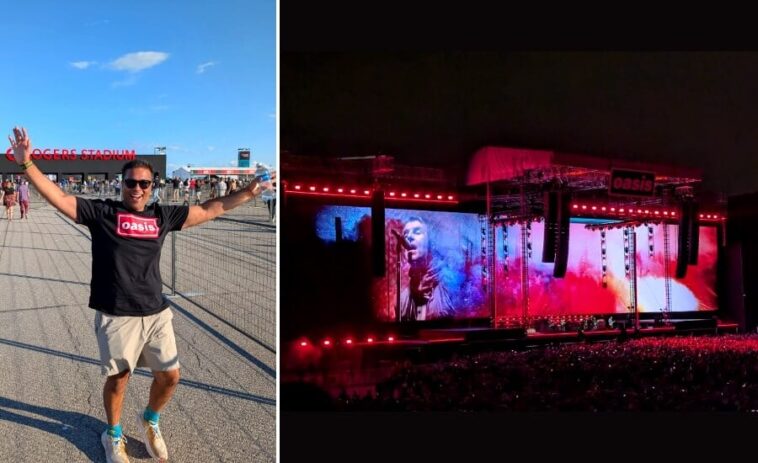
Mine was Oasis. Not one night, but two, back-to-back, in the most expensive seats I could buy, with more merchandise than I have ever purchased for anything else in my life. I dragged my wife along to the first night despite the fact that she is not really a fan, made my dear friend Katy wait beside me for two hours at the Oasis pop-up shop in London last summer, and then queued for another two hours in the Toronto sun a few days before the show—just for the merch.
If you had met me 20 years ago, you might not believe that sentence.
The cost of always being responsible
In my early twenties, a series of badly timed investments forced me to start over financially. Then came the life of a perennial entrepreneur, aspiring to something bigger while living far smaller than most people imagined. Those years taught me discipline, resilience, and resourcefulness, and they also left me with a relationship with money built almost entirely around caution. Money came in, the bills were paid immediately, savings and investments were prioritized, and whatever remained—if anything remained—was what I allowed myself for the occasional indulgence.
Most people would call that responsible, and they would probably be right. But responsibility has a shadow side we do not talk about often enough. When it becomes your entire financial identity, it can quietly convince you that spending money on yourself is something that always requires a defence.
Article Continues Below Advertisement


Skip Ad
X
When everyone around me was upgrading, the new cars and the renovated patios, I felt like the squirrel hoarding against some tough season I was sure was always just around the corner. For years, I lived exactly that way, always storing, always preparing, until eventually I could no longer remember what I was preparing for.
Then, Oasis announced their reunion.
Not a purchase, a milestone
I first saw Oasis in 2005, while I was studying in Cardiff, Wales. A few years later, they broke up, and like millions of fans I assumed that chapter had closed for good. Between that night and this one, almost everything about my life changed. I moved countries a few times, got married, became a father, and built businesses that variously succeeded and struggled. I lived through financial setbacks that reshaped how I thought about money, and many professional successes that once felt impossible. Twenty years have passed.
So, those tickets were not simply admission to a show; they were a way of acknowledging the distance between the person I had been and the person I had become.
Compare the best HISAs rates in Canada
Could I have bought cheaper seats? Of course. Gone for one night instead of two, skipped the merchandise entirely? Without question. The optimizer inside me suggested every one of those alternatives, and for once it lost. Not because I abandoned the financial principles I believe in, but because I finally understood that I was not buying a product. I was marking a milestone, and that distinction matters more than the optimizer wants to admit.
When we talk about investing, we almost always mean money put into assets that produce financial returns, whether stocks, real estate, a business, or an education. Those are all worthwhile, but somewhere along the way, many of us started believing they were the only investments that counted. What if that is not true?
What if some of the most valuable things we ever spend money on are precisely the ones that produce no return a spreadsheet could ever measure?
Some things don’t need to earn their keep
Jessica told me she still thinks about that weekend almost every day. She talks about the show the way people talk about the few nights that rearrange something in them: tens of thousands of fans inside the stadium in Munich and tens of thousands more gathered on the hills around it, all singing the same words at once. When certain songs come on now, she is transported straight back.




GIPHY App Key not set. Please check settings