
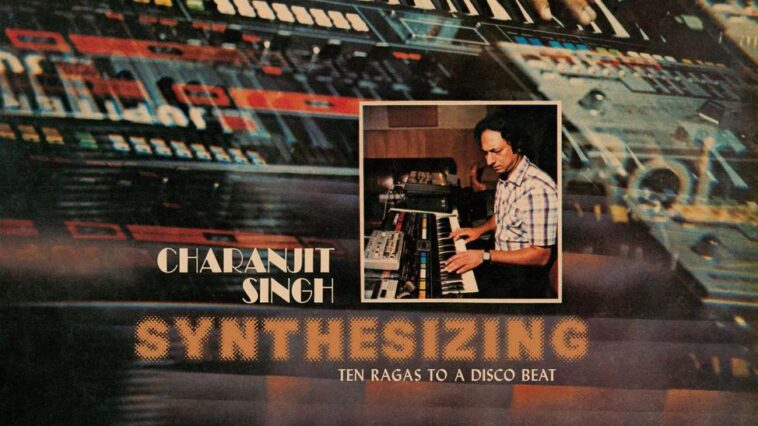
The South Asian diaspora witnessed a wave of musical innovation in the early 1980s, producing a number of records that would go on to earn landmark status. In Calgary, recent college graduate Rupa Sen was visiting her brother when composer Aashish Khan heard her singing and asked her to provide vocals for what would become Disco Jazz, a frenzied disco-rock-funk record that would eventually gain a following via YouTube’s suggested videos feature in the mid-2010s. In Southhall, 22-year-old Kuljit Bhamra was using the first Roland synthesizer created and a CR-8000 drum machine to make disco and funk beats. His mother, Mohinder Kaur Bhamra, sang Punjabi folk melodies over them, and the first British Asian dance album, Punjabi Disco, was born. Back in India, Charanjit Singh had just discovered the newly released Roland TB-303 bass synth. He fused it with the sounds of the Roland TR-808 drum machine and the Roland Jupiter-8 synthesizer to craft Synthesizing: Ten Ragas to a Disco Beat, a record whose undulating frequencies uncannily anticipated the sound of acid house, which Chicago trio Phuture would codify with 1987’s “Acid Tracks.”
Blockbuster Indian films like 1980’s Qurbani and 1982’s Disco Dancer, as well as Nazia Hassan’s 1981 solo record Disco Deewane, had brought American disco to the subcontinent’s musical mainstream. The music was slinky, glamorous, dripping in delicious campiness. But Sen, Bhamra, and Singh’s records, however inspired by the moment, were different: more expansive, more exploratory, less chorus-driven, and stranger—so much so that they were overlooked at the time, only gaining recognition decades later.

No score yet, be the first to add.
Since the 1960s, Singh had been working as a successful session musician who played everything from steel guitar to synthesizer to electric violin, and he contributed to numerous songs that transformed Bollywood music. He is responsible for the droning Farfisa Transicord notes in singer Asha Bhosle and composer RD Burman’s “Dum Maro Dum,” the track that brought psychedelia to Bollywood. He also played synth and bass on Laxmikant–Pyarelal’s iconic soundtrack for the film Bobby, among dozens of other popular collaborations. He credits his work with Burman for introducing him to the bass guitar, which Burman brought to Indian film music. They had a symbiotic relationship: Burman has said that he relied on Singh to introduce modern sounds into his compositions. Singh’s work allowed him to travel, and on a trip to Singapore he got hold of the new Roland instruments. He had the idea to “play all the Indian ragas… give the beat a disco beat—and turn off the tabla,” and thus was born Synthesizing: Ten Ragas to a Disco Beat.
Fusing the melodic and harmonic structure of classic Indian ragas with the sheen of synthesized sound, the album transmits a sense of unbridled joy in discovery. The songs, which he recorded over the course of just two days, twist and elongate, cascade and flutter, totally unencumbered as they iterate and snowball into transcendent, jubilant weirdness.




GIPHY App Key not set. Please check settings