
PonyWang

The Calamos Global Total Return Fund (NASDAQ:CGO) is a closed-end fund, or CEF, that invests its assets in securities from all over the world. This should be immediately apparent given the name of the fund, and like all closed-end funds, it delivers the majority of its total return to the shareholders through the payment of regular distributions. This has allowed the fund to boast an 8.98% yield at the current price, which is in line with some of the highest-yielding equity funds in the market. Here is how the yield of the Calamos Global Total Return Fund compares to that of its peers:
Fund Name
Morningstar Classification
Current Yield
Calamos Global Total Return Fund
Hybrid-Global Allocation
8.98%
Clough Global Opportunities Fund (GLO)
Hybrid-Global Allocation
11.14%
Eaton Vance Tax-Advantaged Global Dividend Opportunities Fund (ETO)
Hybrid-Global Allocation
8.12%
Guggenheim Active Allocation Fund (GUG)
Hybrid-Global Allocation
9.54%
LMP Capital and Income Fund (SCD)
Hybrid-Global Allocation
8.81%
Thornburg Income Builder Opportunities Trust (TBLD)
Hybrid-Global Allocation
7.71%
Click to enlarge
The fact that this fund can invest in both equities and debt securities is something that should appeal to most investors. After all, equities are much better at protecting the purchasing power of their principal than fixed-income securities, and they have favorable tax treatment in the United States. Indeed, as I pointed out recently, some fixed-income funds may struggle to beat inflation on an after-tax basis. This is one reason why I am hesitant to purchase any long-dated bond right now, despite yields being more attractive than they have been in the past decade. The Calamos Global Total Return Fund should not have this problem, though because it can invest in equity securities as well as things such as convertible bonds that frequently benefit from stock price appreciation. The fact that this fund has an attractive yield also should make it somewhat attractive to retirees and other individuals who depend on their portfolios to produce the income that they require to afford their lifestyles.
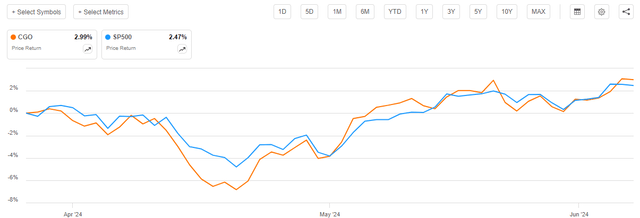
As regular readers can likely remember, we previously discussed the Calamos Global Total Return Fund in late March 2024. The equity market has been reasonably strong since that date, while the performance of most fixed-income securities has left something to be desired. The Calamos Global Total Return Fund tends to trade more like an equity fund than a bond fund, though, so we can probably expect that it has had a reasonable performance since the publication of the previous article. This is indeed the case, as the Calamos Global Total Return Fund has gained 2.99% since the March 24, 2024, publication date of the previous article:
Seeking Alpha
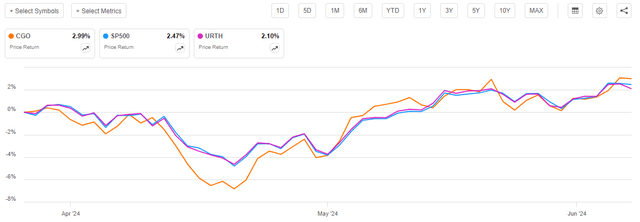
As we can immediately see, the fund’s performance has largely been in line with that of the S&P 500 Index (SP500). However, this fund has been a bit more volatile, as it declined more than the index during the mid-April correction period but also rose more than the index during the following rally. The fund’s performance was also a bit better than the MSCI World Index (URTH) over the same period:
Seeking Alpha
We can see that the S&P 500 Index and the MSCI World Index traded almost identically over the period. That is mostly because all the excitement about artificial intelligence that the market has been exhibiting recently has resulted in the companies that constitute the S&P 500 Index comprising a significant portion of the MSCI World Index. The performance of the Calamos Global Total Return Fund was similar to both indices, albeit a bit more volatile.
However, in actuality, the fund managed to beat both indices by quite a bit. I explained why this is the case in the previous article on this fund:
A simple look at the fund’s price performance over a given period does not provide an accurate picture of how the fund’s investors have actually done. This is because closed-end funds such as the Calamos Global Total Return Fund typically pay out most or all of their investment profits to the shareholders in the form of distributions. The basic objective is to keep the portfolio’s assets at a relatively consistent level while giving the investors all of the profits earned by the portfolio. This is the reason why these funds tend to have much higher yields than just about anything else in the market. It also means that investors always do better than the share price performance alone would suggest, as the distribution provides a return in excess of any appreciation in the share price.
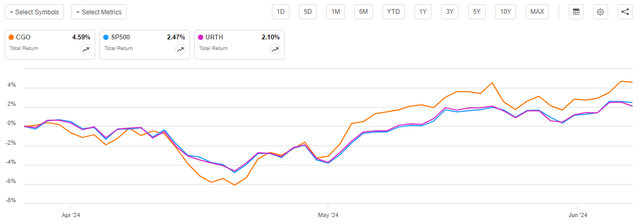
When we include the distributions that the Calamos Global Total Return Fund has paid out over the past two-and-a-half months, we get this alternative chart that shows how investors in the fund have actually done over the period:
Seeking Alpha
Here we see that investors in the Calamos Global Total Return Fund have outperformed the S&P 500 Index by 212 basis points over a two-and-a-half-month period. That is certainly not a bad return over the period. Unfortunately, it has only been a temporary situation, since this fund has underperformed the broader equity market over most extended periods, even when we include the beneficial impact of the fund’s distributions. We saw this in the previous article on this fund.
Obviously, a few months have passed since we last discussed this fund, so several things have changed. This article will focus specifically on those changes and provide an updated thesis that includes new developments in the fund as well as the world at large.
About The Fund
According to the fund’s website, the Calamos Global Total Return Fund has the primary objective of providing its investors with a high level of total return. The website does not provide an in-depth description of how the fund will achieve this goal, however. All the website states is this:
The Fund seeks total return through a combination of capital appreciation and current income by investing in a globally diversified portfolio of equities, convertible securities, and high yield bonds.
The website does not state any specific requirements regarding the percentage of the fund’s assets that will be invested in any individual area. The fund’s annual report provides a much more detailed description of its strategy, however:
Under normal circumstances, the Fund will invest primarily in a portfolio of common and preferred stocks, convertible securities and income producing securities such as investment grade and below investment grade (high yield/high risk) debt securities. The Fund, under normal circumstances, will invest at least 50% of its managed assets in equity securities (including securities that are convertible into equity securities). The Fund may invest up to 100% of its managed assets in securities of foreign issuers, including debt and equity securities of corporate issuers and debt securities of government issuers, in developed and emerging markets. Under normal circumstances, the Fund will invest at least 40% of its managed assets in securities of foreign issuers. The Fund will invest in the securities of issuers of several different countries throughout the world, in addition to the United States.
This description apparently gives the fund a great deal of freedom to invest in pretty much whatever the management wants. However, there are a few restrictions:
At least 50% of the portfolio’s total assets will be invested in equity securities or convertibles, At least 40% of the portfolio will be invested in foreign equity or debt securities.
I must admit that I like these two restrictions, as they work well with the thesis that I have been presenting in quite a few recent articles. In short, investors should try to increase their foreign exposure (especially to securities that pay coupons or dividends in something other than U.S. dollars) and that equities are favorable to long-dated debt. In short, we want to avoid long-dated debt denominated in U.S. dollars because the value of the U.S. dollar is likely to decline over the coming years. I outlined this thesis in another article that was published on Seeking Alpha last week, so there is no need to repeat it in detail here. In short, though, this fund appears to be hitting the major things that we want to hold in the face of long-term U.S. dollar weakness – equities and foreign securities.
It does appear that the fund’s managers agree with this sentiment to some degree. In the commentary section of the annual report, management made this statement:
From a regional standpoint, the portfolio’s largest weights are in the United States and Emerging Asia, while the smallest absolute weights reside in EMEA and Emerging Latin America. We maintain relative overweight positions in Emerging Asia and Europe, while the portfolio has underweights in the United States and Japan. Allocations to Emerging Asia increased during the period, with additions to China and India. By contrast, the allocation to the United States decreased over the period.
We immediately notice that the fund’s management states that it is underweight to the United States and that it decreased its exposure to the United States over the period. The annual report is for the full-year period that ended on October 31, 2024, but the report was not published until the end of December, so it is not clear exactly what months are included in the period. Either way, it does appear that the fund’s management is beginning to believe that there are better opportunities outside the United States than inside of it.
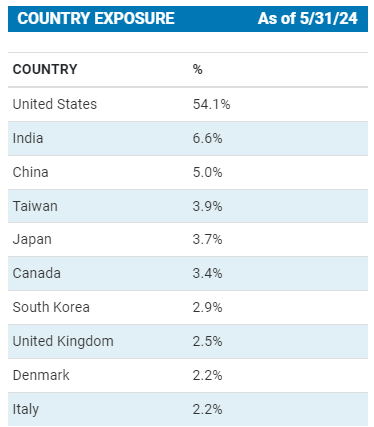
It does appear that the fund has begun increasing its allocation to the United States since that time, though, which suggests the opposite of the previous statement. Here are the fund’s country weights as of May 31, 2024:
Calamos Funds
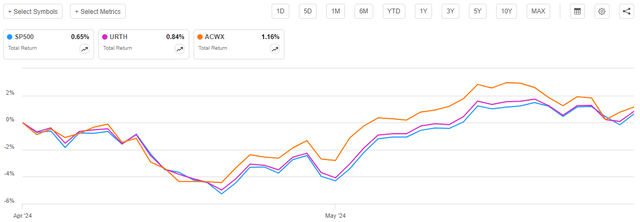
When we last discussed the fund back in March, the country weight chart said that the Calamos Global Total Return Fund had 51.8% of its assets in the United States. The fund’s quarterly commentary for March 2024 states that the fund had 51% of its assets invested in securities of American issuers. However, now we see that 54.1% of the fund’s portfolio is invested in the United States as of May 31, 2024. Thus, it appears that the fund has increased its weighting to the United States during the past two months. This was certainly not caused by the United States outperforming the rest of the world over the period. In fact, it underperformed during the months of April and May 2024:
Seeking Alpha
As we can see, the MSCI All-Country World ex-U.S. Index (ACWX) outperformed both the S&P 500 Index and the MSCI World Index over the March 31, 2024, to May 31, 2024, period. Thus, the increase in the fund’s allocation to the United States that we see over that period was a conscious decision by the fund’s management. In short, the fund’s management would have had to sell some of the fund’s foreign stocks (hopefully realizing a gain in the process) and then used the proceeds to purchase American securities during a period in which American equities were underperforming the rest of the world. I am not sure if that is a particularly great idea and would like to hear the fund management’s rationale for it.
The European Central Bank cut its benchmark interest rate last week, which could be either a headwind or a tailwind for European equities. While we have generally been accustomed to lowering interest rates being a tailwind for equities, that is not always the case if an economy falls into a recession. By all accounts, inflation in Europe is below that of the United States, and the economy of the Eurozone is generally in weaker shape than that of the United States by most metrics. Normally, a weak economy points to lower equity valuations, so perhaps the fund’s management is looking at the potential carry trade. In short, European citizens borrow euros, convert them into U.S. dollars, and then use those U.S. dollars to purchase American equities. This was actually one of the reasons for the ten-year-long bull market that existed during the 2010s, as foreign money flooded into American assets. It is possible that the fund’s management expects this same thing to happen and is trying to front-run it, but we probably need to wait a few months before management provides its thesis.
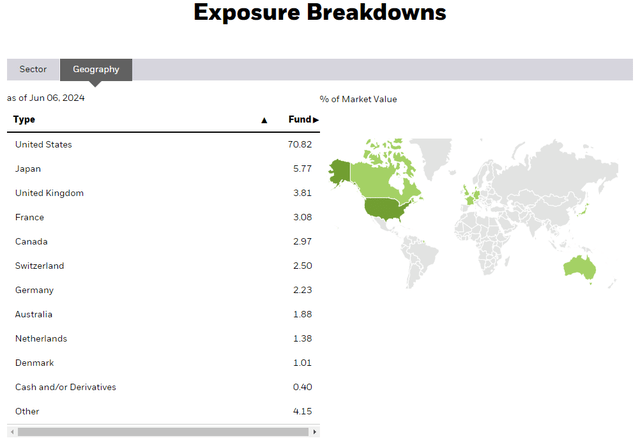
Unfortunately, the increase in American equities does mean that the Calamos Global Total Return Fund will not be quite as good at diversifying our portfolios away from the United States as it was a few months ago. However, we can still see that the fund is below the 60% maximum American weighting that its filings state that it is allowed to have. It is also well below the 70.82% American weighting that the MSCI World Index has:
BlackRock
Thus, the fund is still doing decently at achieving a high level of international diversification. It is just not as good as it was a few months ago. The fund does have a 120% annual turnover, though, so it could effortlessly reduce its American exposure again once it secures some short-term profits from whatever short-term trend caused it to move money into the domestic markets.
Leverage
As is the case with most closed-end funds, the Calamos Global Total Return Fund employs leverage as a method of boosting its effective total return. I explained how this works in the previous article on this fund:
Basically, the fund is borrowing money and using that money to purchase fixed-income assets. As long as the purchased assets have a higher yield than the interest rate that the fund has to pay on the borrowed money, the strategy works pretty well to boost the effective yield of the portfolio. As this fund is capable of borrowing money at institutional rates, which are significantly lower than retail rates, that will usually be the case.
Unfortunately, the use of debt in this fashion is a double-edged sword because leverage boosts both gains and losses. As such, we want to ensure that a fund is not employing too much leverage because that would expose us to too much risk. I usually do not like to see a fund’s leverage exceed a third as a percentage of its assets for that reason.
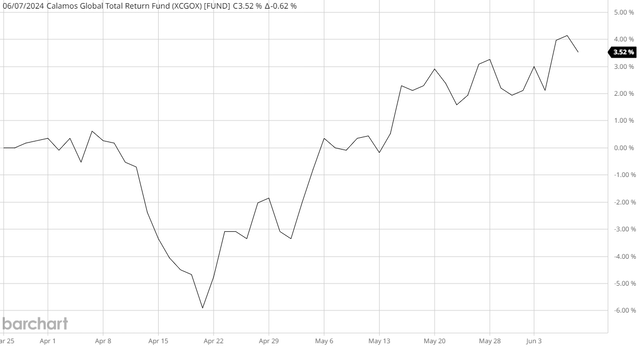
As of the time of writing, the Calamos Global Total Return Fund has leveraged assets comprising 32.19% of its portfolio. This represents an increase from the 31.71% leverage that the fund had the last time that we discussed it, which is a bit unexpected. After all, as we already saw, the fund’s share price rose since the previous article was published. The fund’s net asset value has also increased by 3.52% over the period:
Barchart
Normally, we would expect that an increase in net asset value would decrease a fund’s leverage as opposed to increasing it. The exception here might be if the fund borrowed more money as asset prices were increasing in an attempt to amplify its gain. If that was the case, it does seem to have worked, as the fund did beat both the S&P 500 Index and the MSCI World Index over the period. It also appears that its portfolio outperformed the fund’s share price, which has implications for the fund’s valuation. We will discuss that later in this article.
Despite the increase in leverage, the Calamos Global Total Return Fund remains below the one-third of assets level that I would ordinarily prefer. Here is how it compares to its peers:
Fund Name
Leverage Ratio
Calamos Global Total Return Fund
32.19%
Clough Global Opportunities Fund
28.66%
Eaton Vance Tax-Advantaged Global Dividend Opportunities Fund
18.50%
Guggenheim Active Allocation Fund
23.28%
LMP Capital and Income Fund
19.95%
Thornburg Income Builder Opportunities Trust
0.00%
Click to enlarge
(all figures from CEF Data.)
This could perhaps be concerning, especially for more risk-averse investors. As we can clearly see, the Calamos Global Total Return Fund has a significantly higher level of leverage than any of its peers. This could suggest that the fund is using more leverage than is appropriate for its strategy, and is thus exposing its investors to a higher level of risk than we would prefer. Honestly, though, I think it is probably okay right now but would suggest that those of you who may be especially risk-averse keep an eye on it to ensure that it does not increase by very much more.
Distribution Analysis
The Calamos Global Total Return Fund has the objective of providing its investors with a high level of total return, but it pays out most of its investment profits to the shareholders like all closed-end funds. The fund achieves this via a managed distribution policy, which it explains in its annual report:
Closed-end fund investors often seek a steady stream of income. Recognizing this important need, certain Calamos closed-end funds adhere to a managed distribution policy in which we aim to provide consistent monthly distributions through the disbursement of the following:
Net investment income Net realized short-term capital gains Net realized long-term capital gains And, if necessary, return of capital.
We set distributions at levels that we believe are sustainable for the long term.
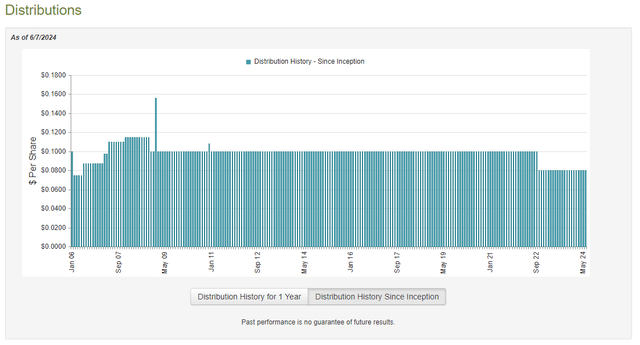
The Calamos Global Total Return Fund currently pays a monthly distribution of $0.08 per share ($0.96 per share annually), which gives it an 8.98% yield at the current price. The fund has generally been consistent with its distribution over time, but has not been perfect:
CEF Connect
As I stated in the previous article:
This payment history might appeal to those investors who are seeking to earn a safe and consistent income from the assets in their portfolios. The distribution cut in 2022 might be a bit annoying, but most funds had to cut their payouts following the market decline in that year. It is generally best when a fund cuts its distribution rather than maintains it at a level that is destructive to net asset value because such net asset value destruction does not tend to be sustainable over extended periods. Perhaps the biggest problem here may be that the fund’s distribution remains stable rather than grows with the passage of time, so it does not allow investors dependent on the distribution to maintain their purchasing power. Of course, most closed-end funds have that problem, and it is fairly easy to overcome by simply reinvesting some portion of the distributions that are received.
The problem with managed distributions is that they can result in the fund distributing more money than it can earn from its portfolio. After all, the distribution itself is stable, but market returns are much choppier over time. As we saw in the last article, the Calamos Global Total Return Fund failed to cover its distribution during the full-year period that ended on October 31, 2023. It has not released an updated financial report yet, so there is no real point in repeating the analysis.
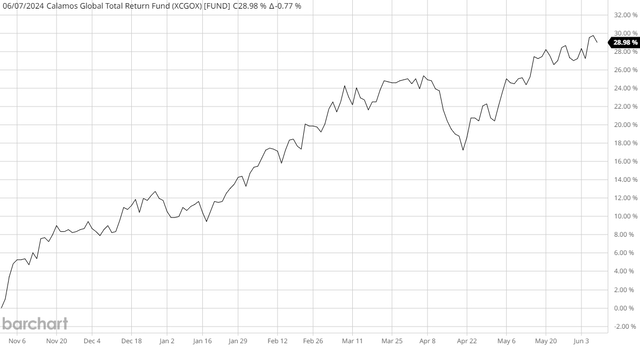
It does, however, appear that the fund has managed to cover all the distributions that it has paid out since the closing date of the most recent financial report. We can see this by looking at the fund’s net asset value. This chart shows the fund’s net asset value since October 31, 2023:
Barchart
As we can see, the fund has covered all the distributions that it has paid out during the most recent fiscal year and still has a substantial level of profits left over. Therefore, it appears that the distribution is probably about as safe as we are going to see.
Valuation
Shares of the Calamos Global Total Return Fund are currently trading at a 9.56% discount on net asset value. This is relatively in line with the 9.32% discount that the fund’s shares have averaged over the past month, so the current entry point looks reasonable.
Conclusion
In conclusion, the Calamos Global Total Return Fund is one of the few global funds that actually has an internationally diverse portfolio. As we have seen in various previous articles, many funds that claim to invest globally actually have an over-allocation to the United States. This is a problem for American investors, who should be trying to limit their exposure to this particular country because they live and work in it. The fund has increased its American exposure recently despite that country underperforming globally, which is disappointing, though.
Calamos Global Total Return Fund appears to have solved the problem of its distribution not being covered, and in fact, the portfolio has delivered an incredible level of excess returns during the current fiscal year. When we combine this with the fund’s current discount valuation, there appears to be a lot to like here.




GIPHY App Key not set. Please check settings