
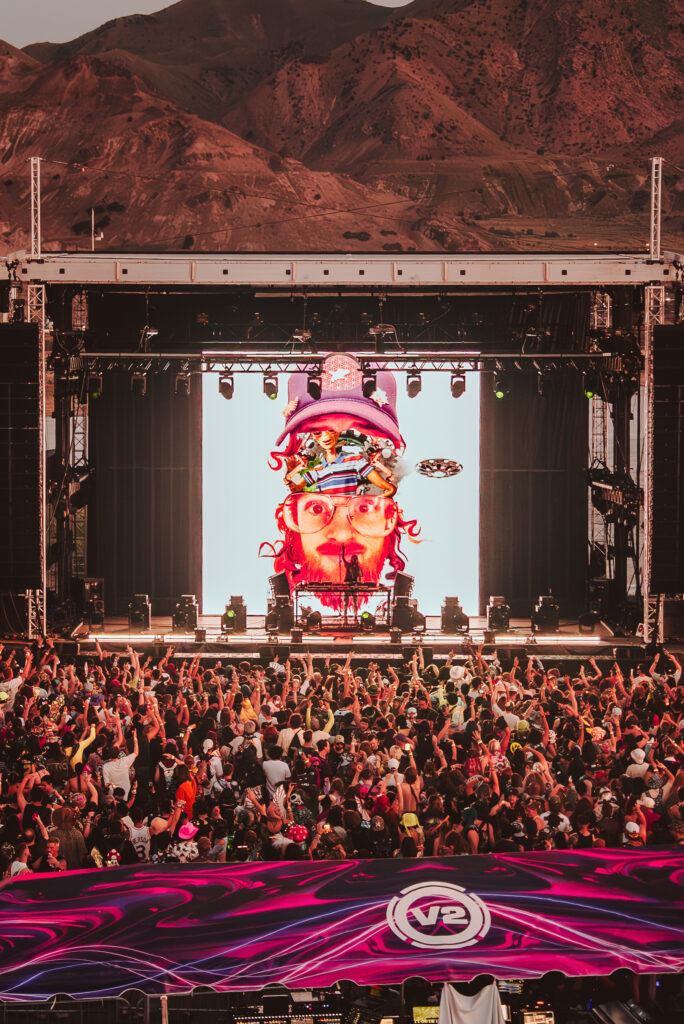
The more tightly choreographed a live show becomes, the easier it is to wonder what’s being lost. In DJ culture, where reading the room and pivoting in the moment are paramount to the craft, precision can seem at odds with spontaneity.
For bass music producer and ZOT Records founder AHEE, the opposite has been true. By merging his music and visuals into a single system through Rekordbox Performance Mode, he’s expanded his creative freedom and gained more flexibility behind the decks. Although the feature has existed for a decade, he believes he’s the first “touring dubstep act to take advantage of it to the fullest extent.”
So what happens when music and visuals are conceived, designed and performed as one?
Traditionally, DJs control the music while VJs run the visuals. AHEE collapses that divide by building both into a single file, controlling the entire audiovisual experience in real time on CDJs.
AHEE, whose real name is Chris Adams, says he’s always viewed music and visuals as interconnected. He has a background in VJing and even created a music video for Weezer early in his career.
“I’ve had synesthetic experiences, which is the combining of the senses. So it always made a larger impact on me when both visuals and sound were aligned,” Adams tells EDM.com. “I never really got to combine those two things in a professional sense until just this year. I’ve done both things professionally, but now, it felt like this was the time where I could truly have the technology to combine them.”
Credit: Jozizzy
True to form for Rekordbox, the much-maligned software often bemoaned for its compatibility issues, there are still some technical hurdles to overcome before Adams’ system is ready for major festival stages, he said. But he’s already proven the concept in club environments.
“The end result is, I feel so much more satisfied as an artist because I’m not just expressing myself through the music, but also through the visuals,” Adams explained. “I’m giving people this synesthetic experience that’s flowed from my creativity, through two different mediums.”
For Adams, every new track now begins with a bigger question than just, what should it sound like? The questions are now: What should it feel like? What should it look like? And what does it become once it reaches the stage?
That creative process begins in the studio. Rather than producing a song first and pairing visuals later, Adams builds both in tandem. Using Video Sync within Ableton, he edits, chops and sequences video clips just as he would drums or synths, treating visuals like another instrument in the composition.
“I’m taking those programs’ abilities and pushing them to the max, so they’re doing things that nobody anticipated those programs could do,” Adams said.
That mindset carries into his performances. He enjoys keeping fans on their toes by weaving memes, lyrics and pop culture references directly into his visuals.
“One that I’m particularly happy with is, I’ll mix the ‘Crazy Frog’ meme with my song ‘Bug Eater,’” Adams says with a chuckle. “I think that that meta is really funny because frogs eat bugs, but then sonically, they also go really well together. It’s this fun meta narrative, while also being nasty bass, while also being funny.”
 Credit: Image courtesy of Press
The biggest surprise is that all of this audiovisual preparation has actually made Adams more spontaneous behind the decks.
Most audiovisual performances require DJs to commit to a setlist, so a VJ knows exactly which visuals to trigger. Adams’ system works differently. Because every song carries its own synchronized visuals, he can change direction mid-set without breaking the experience.
“I’m actually able to improvise in the moment more,” he said. “This allows me to improvise both with the visuals and the music, in my selection, pacing and mixing of them.”
While this new system has transformed his own artistic process, Adams stops short of calling it the future of live performance.
“I don’t know how many people would be willing to put in the amount of work that this takes,” he said. “I don’t know if it necessarily changes the future, but it changes my future. It changes how I approach my art, and how I think about not just the songs, but the visuals, too.”
 Credit: Image courtesy of Press
Looking ahead, Adams hopes to see Rekordbox Performance Mode’s capabilities expand into lighting, lasers and pyrotechnics through DMX protocols.
“I could almost visualize it,” he said. “I hit a pad on stage and it triggers a music sample, a video clip, lasers, pyro and lights, all from one button. The amount of creative control an artist could have would be bewildering to experience.”
While venue limitations mean this setup won’t appear at every AHEE show, Adams is building what he calls “the biggest concept using this technology” for his upcoming Mission Ballroom performance in December. Tickets are available here.
Follow AHEE:
X: x.com/officialahee
Instagram: instagram.com/iamahee
Facebook: facebook.com/aheemusic
TikTok: tiktok.com/@officialahee
Spotify: tinyurl.com/yc8kykr4
The post “It Changes My Future:” How AHEE Discovered Deeper Creative Freedom With Rekordbox Performance Mode appeared first on EDM.



GIPHY App Key not set. Please check settings