
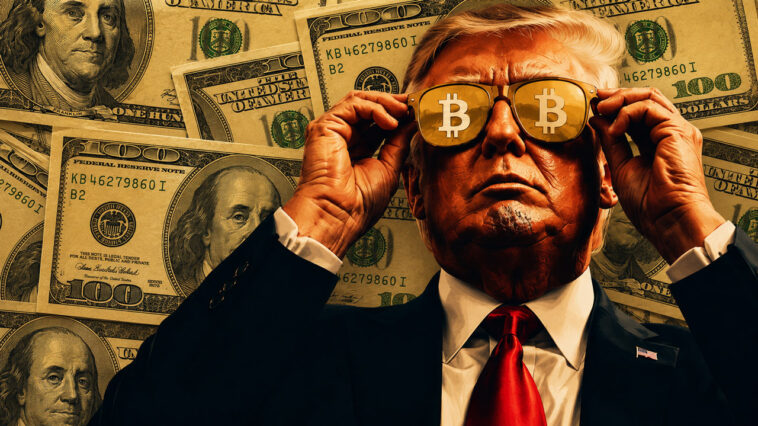
Donald Trump’s latest financial disclosure showed how closely digital-asset policy, personal financial interests, branded tokens, and presidential power now sit together.
His highly scrutinized recent filing points to a governance problem that extends well beyond any one politician, because crypto can convert access, symbolism, and regulatory attitudes into value faster than older business interests ever could.

Presidential financial disclosures usually draw attention because of the total. However, the more important issues concern how the income was generated, which entities carried it, what products sat behind it, and how sensitive those products are to decisions made by the same federal government linked to the disclosure.
 Related Reading
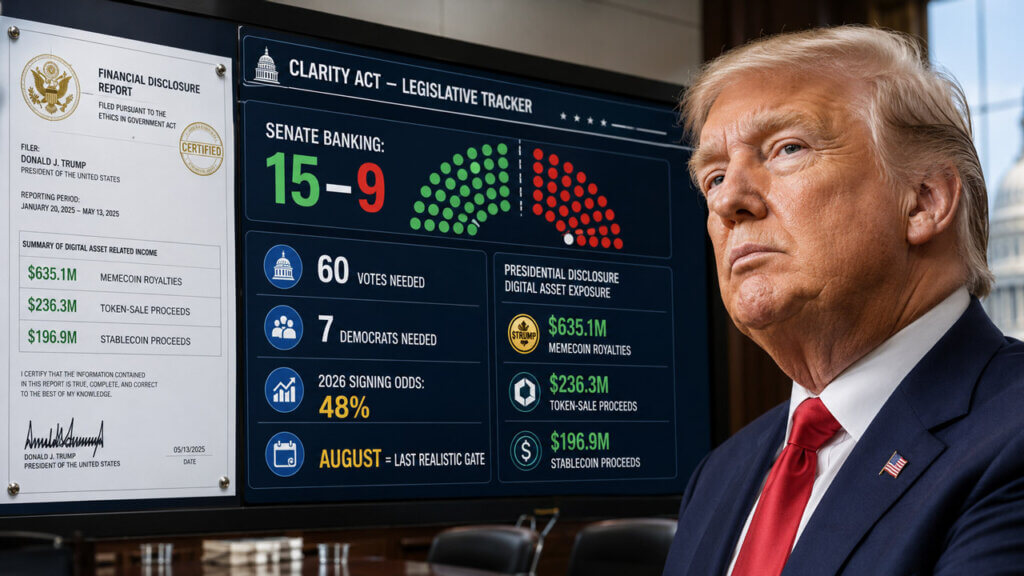
Trump’s financial disclosure puts $1B crypto payday at center of CLARITY Act vote
Trump’s disclosure gives CLARITY supporters a compliance defense, but also puts his memecoin, stablecoin, BTC, ETH, and staking exposure at the center of Congress’ unresolved ethics fight.
Jul 1, 2026 Gino Matos
That’s what makes Trump’s crypto exposure more serious than other ethics disputes involving his hotels, licensing deals, or marketable securities. Crypto compresses several functions into one domain: it’s an investable asset class, a fundraising mechanism, a branded consumer product, a policy target, and a global market-structure debate all at once.
When a president is economically tied to ventures inside that domain, the overlap between public action and private benefit becomes much bigger.
Public reporting on the annual filing with the Office of Government Ethics indicates that the disclosure includes large crypto-related revenue streams, including income tied to Trump-branded token licensing and to World Liberty Financial.
While the line items matter, they are only part of the narrative. The filing shows a political economy in which the president appears linked to ventures whose value, distribution, and commercial prospects move with the government’s stance on crypto.
Politics can become a price signal for crypto
Traditional businesses usually take longer to respond to public policy, but crypto responds faster and across multiple channels at once. A favorable enforcement signal can improve sentiment across a network, and looser banking regulation can widen the commercial room available to issuers and intermediaries.
A White House summit, executive order, or reserve announcement can change how institutions interpret the asset class and how counterparties value the ventures attached to it.
Crypto businesses often react even faster to political shifts. Tokens can be launched quickly, traded globally, marketed continuously, and tied to communities that react almost immediately to political cues.
A branded token, a stablecoin, or a governance-linked venture can simultaneously accumulate value through distribution, licensing, treasury reserves, trading activity, and network effects.
In that environment, the line between policy climate and private upside grows much thinner than it looks in older sectors.
All of this makes Trump’s crypto disclosure more of an institutional problem than a scandal.
Stablecoin law, the SEC’s and CFTC’s positions, banking access, federal policy toward digital assets under Executive Order 14178and the White House’s attitude all shape the commercial environment around crypto.
When the president and his family hold visible interests in that environment, the market has good reason to view policy through a personal financial lens. That view can then take hold even when a policy position has a defensible public-interest rationale of its own.
That’s also why disclosure alone feels less reassuring here than it often does in older ethics disputes. Disclosures give the public a map of exposure, which is useful, but they don’t resolve the deeper problem when the underlying assets can reprice rapidly in response to political proximity.
Older presidential conflicts offer only a loose comparison. Hotels, licensing deals, and passive investments can raise serious ethics concerns, but they rarely react to political events with the speed or reach of a crypto venture.
Crypto trades around the clock across global venues, and that speed makes it super sensitive to politics. Public office becomes a more immediate input into private financial ecosystems.
CryptoSlate Daily Brief
Daily signals, zero noise.
5-minute digest 100k+ readers
Whoops, looks like there was a problem. Please try again.
You’re subscribed. Welcome aboard.
Trump’s crypto disclosure shows the industry loses something when the boundaries blur
The crypto industry wants pension funds, advisers, banks, payment companies, and lawmakers to treat digital assets as durable financial infrastructure.
That effort gets harder when the most visible political figure tied to the sector also appears to be a major financial beneficiary of crypto-linked ventures. Once that association hardens, every favorable policy move risks being read as self-dealing, even when the underlying policy argument stands on respectable ground.
That comes at a high cost for crypto. Stablecoin legislation can be viewed through the interests of connected issuers and ventures, while a Strategic Bitcoin Reserve announcement can lift confidence in Bitcoin and the wider sector.
Even broadly applicable policies can therefore attract suspicion when politically connected businesses stand to benefit.
Any kind of enforcement pullback can easily look like a general policy reset while still inviting suspicion that proximity and access played some part. The industry may gain regulatory breathing room in that environment and still lose the institutional trust it needs for broader adoption.
The filing is best understood as a warning about governance in the digital-asset era. Crypto has created markets in which influence, affiliation, and value interact with unusual speed and efficiency.
That helps explain the sector’s energy and growth, but it also makes conflict risk more immediate because political proximity can become part of the asset itself, and markets can price that proximity long before legal rules are refined enough to contain it.
Any serious response has to go beyond disclosure formalities. Conflict rules for digital assets would need to address counterparty transparency, recusal expectations around sector-specific policy, direct and indirect token-linked monetization while in office, and the treatment of governance rights or revenue claims held through affiliated entities.
The older blind-trust framework reaches only part of that issue because many crypto ventures derive value from branding, access, and regulatory climate in ways that remain economically potent even when day-to-day management is delegated.
You can see the significance of that shift without taking a partisan political view. A sector that wants to be treated as financial infrastructure needs clearer separation between public power and private token economics.
Trump’s disclosure shows how difficult that separation becomes once a president’s economic interests sit inside a fast-moving, policy-sensitive digital market.




GIPHY App Key not set. Please check settings