
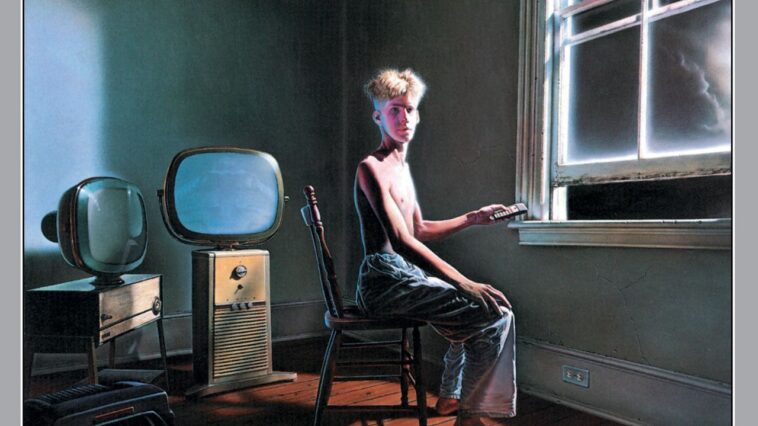
Despite the rising tension, there was one thing they could all agree on. They weren’t happy with the muddy production of 1984’s Grace Under Pressure, which they recorded in brutal, repetitive sessions with Supertramp producer Peter Henderson. So they regrouped in a studio in rural Canada to bang out some demos.
The songs that emerged from these sessions at a barn in Elora, Ontario, weren’t all that different from Grace Under Pressure, but they were faster and harder, with Lee’s chops on the keyboards crowding out Lifeson’s guitar even more. They called in Peter Collins to produce what would become Power Windows, making Lifeson even more nervous: “Whoever thought that Rush would be produced by the same guy who did Air Supply?”

The band was bewildered by Collins’ appearance: “A small man with a beard and glasses, someone you’d expect to find behind a desk in an accountancy,” Lee wrote in his autobiography. But they hit it off, enough for him to be able to suggest new approaches to the songs they’d written. He preferred quick, one-take instrumentals the band could build on, rather than trying to get the perfect snippet of guitar or bass or vocals over and over again.
It seemed like a simpler approach, but Rush’s sound actually became more dense and loaded with samples and all kinds of synthesizers. Collins even suggested a choir and orchestra to embellish a couple of the tracks. The infamously averse-to-guests trio thought, why the hell not, and they were bowled over to see these professional musicians recording their tracks. They would later credit making the album as some of the most fun they ever had. (“Working with the orchestra was hilarious, because it just looked so ridiculous watching all these people playing along to our music. They’d all be sitting there with their cans on, fiddling with their violins or whatever, and our song would be going BAAM! BAAM! BAAM! We’d be in hysterics,” Lifeson said shortly after the LP’s release.)
Though it was meant to get the band back on track from whatever errant path they had gone down, Power Windows is actually the synthiest of Rush records. It proudly wears Collins’ more-is-more style on its sleeve, making good use of a 24-track mixing desk. It’s easily the band’s gaudiest album, loaded with bright, sparkly keyboards that could have been borrowed from a Thomas Dolby production. Lifeson’s misgivings aside—“keyboards are not even real instruments,” he says in the band’s 2010 documentary Beyond the Lighted Stage—he delivers flamboyant, funky riffs and solos that go crazy on the whammy bar, his guitar taking on the tone of wobbly liquid mercury. And, of course, Peart’s bonkers drum fills are way up front in the mix, with a new layer of electronics mixed in to give the rhythm section a subtler, more layered touch.
Power Windows also has some of Rush’s best pop songs. It follows the Permanent Waves and Moving Pictures formula of massaging what would be verbose lyrics in anyone else’s hands—like the history of the atomic bomb in “Manhattan Project,” or the nature of nationalism in “Territories”—into FM radio sing-alongs, but these songs are absolutely jam-packed with vocal hooks everywhere they can fit. As usual, there’s a theme. Power Windows is a reference to a then-luxurious car add-on, but it’s also about the way people wield power, whether militarily, politically, or financially.


GIPHY App Key not set. Please check settings