
Dance Magazine has been both a resource for and a reflection of the dance community since publishing its first issue (then titled The American Dancer) in 1927. As the magazine’s centennial approaches, we’re examining how the publication has grown and changed over each decade, highlighting some of our most memorable covers. Next, a deep dive into the 1990s, a vibrant period when underground subcultures entered the mainstream.
The 1990s were a decade of fusion—technology and analog, mainstream and underground. Club culture and the music-video industry filled the dance world with inspiration and new ideas. On concert stages, modern and contemporary choreographers drew on a variety of influences and traditions to create fresh, distinctive work.

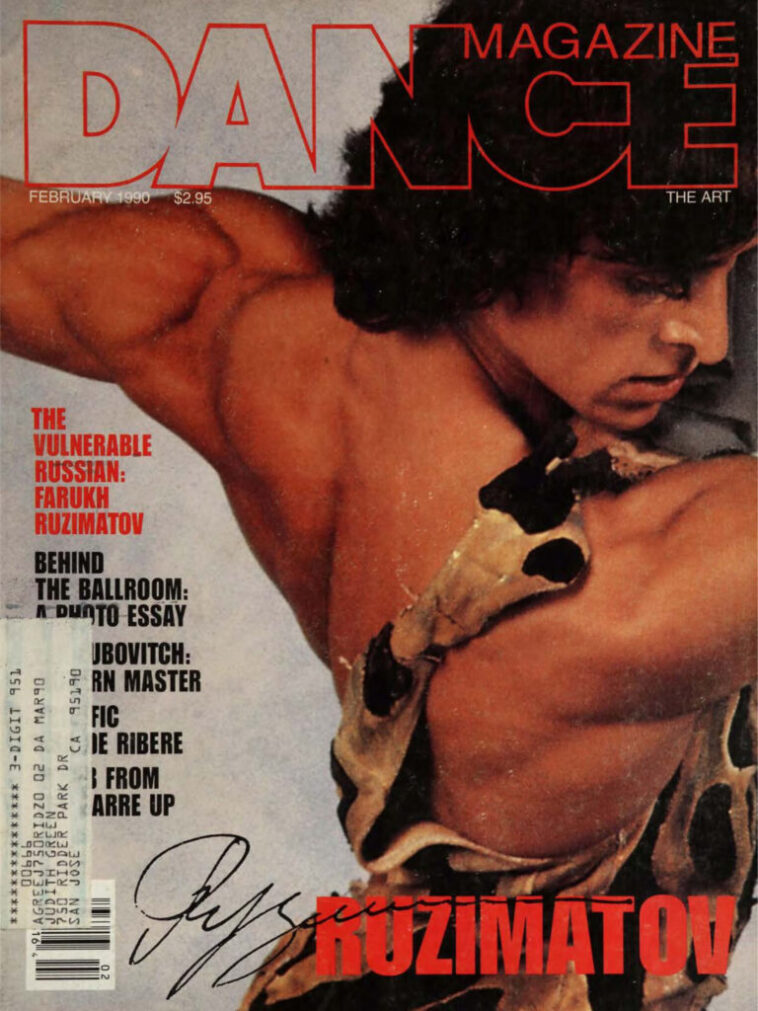
February 1990
Cover photo of Farukh Ruzimatov in Oleg Vinogradov’s Knight in the Tiger Skin, courtesy Monroe Warshaw
Dance Magazine’s February 1990 issue featured the Russian ballet dancer Farukh Ruzimatov. The cover story explored how Ruzimatov’s androgyny impacted his artistry. He described typical balletic masculinity as a cage, choosing instead a more fluid approach to classical danseur roles.
January 1991
 Cover photo of Mikhail Baryshnikov and Mark Morris, courtesy White Oak Dance Project
Led by two dance icons of the decade—Mikhail Baryshnikov and Mark Morris—White Oak Dance Project combined ballet and modern dance techniques throughout the 1990s. As our January 1991 cover story noted, the company also set itself apart by prioritizing older dancers.
September 1992
 Cover photo of Christopher Chadman, Denise Faye, Scott Wise, Faith Prince, Gary Chryst, and JoAnn M. Hunter, by Jack Mitchell
The dance-focused revival of Guys & Dolls in 1992 brought a fresh take to a classic show. Christopher Chadman’s sharp, athletic choreography helped make the production one of Broadway’s most successful revivals of the ’90s. Its colorful September 1992 cover shot reflected the decade’s eclectic spirit.
March 1993
 Cover photo of Merce Cunningham, Robert Swinston, and Chris Komar, by Roy Round
During the ’90s, Merce Cunningham explored the fusion of dance and technology. His groundbreaking 1992 work Enter used LifeForms software, a human-animation program that expanded his choreographic possibilities. Cunningham would continue to experiment with LifeForms—later renamed Dance Forms—until his death in 2009.
December 1994
 Cover photo of Masazumi Chaya, by Jack Mitchell
The December 1994 cover featured Masazumi Chaya, then the newly appointed associate artistic director of Alvin Ailey American Dance Theater. Chaya represented a changing of the guard following Ailey’s passing. The cover story noted that, while bringing his own perspective to the organization, he also worked hard to preserve the integrity of Ailey’s vision.
August 1995
 Cover photo of Desak Made Suarti Laksmi in The Legend of Dalem Dunkut, by Jack Mitchell
In 1995, the Indonesian National Institute of Art came to Emerson College, hosting workshops and sharing Balinese dance techniques. Dance Magazine’s choice to feature a Balinese dancer on the August 1995 cover shows the influence of international dance during this era.
January 1996
 Cover photo of Merce Cunningham, by Jack Mitchell
In January 1996, Dance Magazine honored prominent dance photographer Jack Mitchell as he retired from the profession. Mitchell was not only an important artist in the dance world, but also a significant figure in our magazine’s history: Many of our most iconic cover images (including this silhouetted shot of Merce Cunningham) are his work.
April 1997
 Cover photo of Evelyn Cisneros, by Jack Mitchell
Evelyn Cisneros, then a principal at San Francisco Ballet and one of the first Mexican American ballet stars, was featured in this memorable image, from Val Caniparoli’s Lambarena, on our April 1997 cover. The accompanying story praises her ability to move fluidly between classical ballet and modern techniques—a versatility that was becoming a ballet-company standard.
August 1998
 Cover photo of Mia Michaels, by Steven Caras
R.A.W., or Reality at Work, a new-wave jazz-dance company led by Mia Michaels, graced the August 1998 cover. Michaels’ work focused on emotional expression and storytelling—an approach that, a decade later, would also characterize her popular routines for “So You Think You Can Dance.”
March 1999
 Cover photo of Martha Graham, courtesy Dance Magazine Archives
In 1999, Dance Magazine put Martha Graham on the cover of its March issue, which looked back at 100 years of dance, highlighting her as one of the century’s predominant artistic forces. The feature describes how Graham gave her successors not just a technique to preserve but a foundation to build on. As one of the story’s most powerful lines declared: “She lived whatever emotion she wished to personify, never merely displayed it.”
The post A Look Back: Dance Magazine in the 1990s appeared first on Dance Magazine.




GIPHY App Key not set. Please check settings