
Share

Tweet
Share
Share
The Strand Theatre and Ballroom, Providence, RI.
June 28, 2026.
A trumpeter riffed while the whole audience cheered and clapped along, in rhythm. It was a musical interlude of Revolve Dance Project’s fifth annual show Revolutions. That sort of moment always brings unique electricity to a space, and it certainly did here.
The show brought elements that it does every year: classical and contemporary movement premieres paired with original live music, as well as ways in which it’s pushed forward from the prior years’ shows. As more par for the course, what resulted from that pushing forward showed me potential to continue upping the ante – and excited me to see that happen (I only see signs pointing to that it will).
In isolation, Revolutions offered just enough edge to enervate and just enough calm to soothe. Seeing this program each year allows me to see trends, but also appreciate the singular feel for each one.
Danielle Diniz’s jazzy romp Night Cycles opened the program. It opened with an explosion of speed and expansiveness, the five dancers meeting the pizzazz of the live jazz score (composed by Luther S. Allison). Movement was classically grounded, but also sprinkled with jazzy ingredients: pencil turns, parallel shapes, cha-cha steps. Simple costumes of white tops and dark navy bottoms effectively complemented the understated classiness of all that.
Also aligning with that feel was the ensemble’s calm contentment – simply breathing through and savoring each moving moment. I felt the same just experiencing it from them. Audrey Lukacz added a little more fire and intrigue to her solo, peppering emotional variance into this non-narrative work. Overall, their fluid energy filled the stage and then poured out from it.
Lauren Flower’s memorable and touching Sugarcoat followed, danced by Charlotte Nash and John-Paul Simoens. A live singer (Katie Martucci, also Composer for the score) accompanied the dancers with this work, her voice soulful and rich. The movement met those rich, layered textures with every count. It again built upon a classical base – accumulating stylistic variance and an uncommon kinetic understanding on top.
Flower’s vocabulary had a striking way of melting expansive line into a release, a curve, a fold. It also offered a sophisticated sense of spiral, with line growing from or diminishing into circularity. Nash and Simoens executed all of that with so much attunement to each other that they seemed to move together as one organism – even while certain moments had them in opposition.
The opposition never lasted long, and their breathing together through each new weight shift and momentum pathway kept me feeling easeful, peaceful. As the score and lights dimmed, they found stillness – looking to upstage together. That felt like hopeful continuance, one of them moving forward together – into whatever they may find.
Kurt Douglas’ Melodic Mosaic came just before intermission, with a dash each of delightful quirk and compelling mystery. Businesswear-inspired costumes of bright colors, a score with an edge of mystery (composed by Katie Jenkins), and highly athletic – but also funky – movement all met right at the start.
Part of me thought “hmm, I’m not so sure these elements align” – but I came to see that as perhaps the point. “Melodic mosaic” indeed! All of these disparate elements ultimately did cohere, making the incongruous actually harmonious, and there was something soothing in that.
The edgy mysteriousness continued to pulse through the work, so both effects were on offer.
It takes intention and command of craft to make such a bold approach work. For me, all in all it did. A second section even added variance of tempo and overall energy – something I always root for. The piece was a sensory, energetic smorgasbord – and I certainly came away satiated.
Something much more strictly classical came after intermission: the Act II Pas de Deux from Petipa’s The Sleeping Beauty, with Nash and Simoens returning. It was the height of classical elegance, rhinestones shining and penchés picturesque…no matter that we were sans fancy opera house and sprawling stage. The pair’s versatility was impressive, with them as commanding in this high classicism as they were in Flower’s much more contemporary work.
I could see some people feeling like this work didn’t fit in the program, stylistically speaking – but I appreciated the change of pace. This work also made me realize that more such excerpts in programs like this could greatly expand access to classical works, at least give a taste of what the genre has to offer to those who cannot or just do not attend long story ballets. In my book, such expansion of access is an inarguable positive. Thus, even as something so classical, this pas de deux contributed to the program’s innovative spirit.
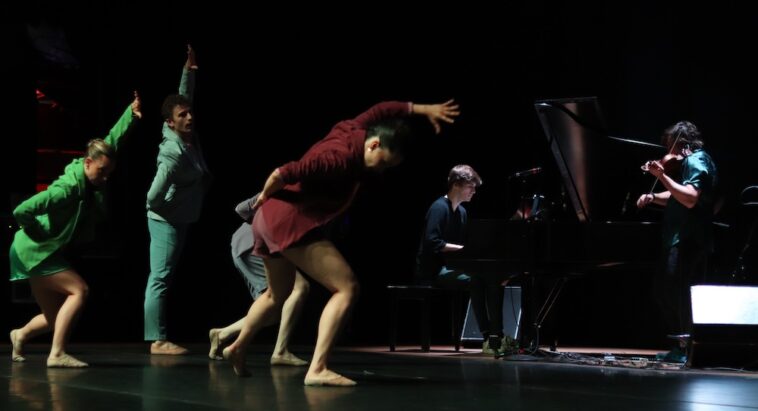
Emily Adams’ Moonsick closed the program, a work offering yet more outstanding movement styling and atmosphere. Dancers wore beautiful watercolor-streaked tops, in earth tones, with the live score (composed by Jim Oblon) seeming to draw influence from indie and classic rock. Gestures such as rubbing the neck while walking built a sense of emotional turbulence. From there, partnering that pushed limits of flexibility and physical laws only sharpened the undercurrent of unease.
An animalistic feel even simmered as the piece progressed: movement at times ferociously grounded, at other times racing forward with wild abandon. As throughout the program, a strong classical foundation supported something fresh, daring, and – to my eyes – totally singular. Aram Hengen’s solos stood out as particularly strong, memorable artistry.
Even for the edginess at hand, the cohesion of elements and the way my curiosity was piqued had me feeling that calm satisfaction I had throughout the program. Particularly when considering the work’s multiple sections, and an ending that felt like it could flow into further sections (with a sense of continuance rather than final resolution), I also felt like the work had potential to be expanded into something longer, with an even more developed concept.
Just as I have with the preceding shows from Revolve Dance Project, I also saw further potential in what they’ve built. I love a short program: one hour, in and out and on with life! But with the strengths of the program as it was, I found myself wondering what they could do with such expanded concepts – crafted into evening-length works, longer shows on bigger stages, for example.
Regardless, the commitment to bold new dance works paired with custom-composed live music is something exceptional in and of itself. Every dancer knows the moving-to-live-music difference, and Revolve Dance Project is bringing at least some of that feeling to their audiences. Sometimes we even clap along. Until the next time we do!
By Kathryn Boland of Dance Informa.
Aram Hengen, Audrey Lukacz, Charlotte Nash, Choreographer, choreographers, choreography, classical ballet, Contemporary dance, dance review, dance reviews, Danielle Diniz, Emily Adams, female choreographer, female choreographers, Jim Oblon, John-Paul Simoens, Katie Jenkins, Katie Martucci, Kurt Douglas, Lauren Flower, online dance review, online dance reviews, review, Reviews, Revolve Dance Project




GIPHY App Key not set. Please check settings