
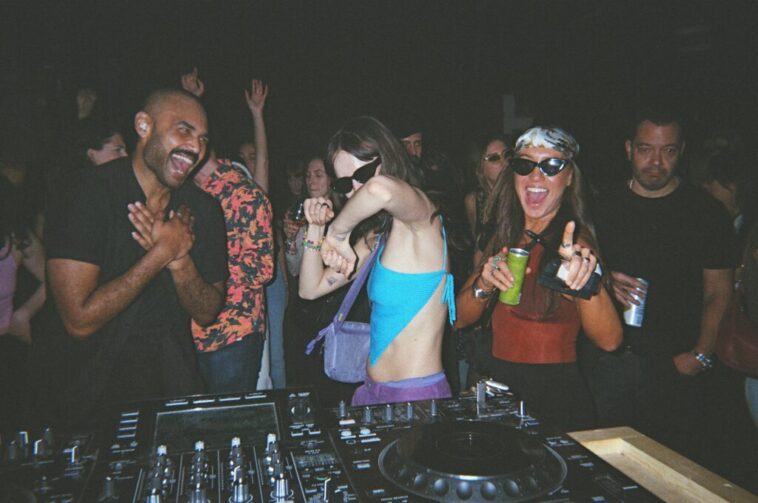
On any given week in New York, there are roughly 200 electronic music events to sift through.
“This is so cool but also so insane,” Kseniya Sovenko of NYC Rave Girls tells EDM.com. She would know, since combing through all of them is part of her weekly routine.

For most people planning their night out, that volume is daunting. Every party promises the best night of your life, the way every corner pizza joint claims the best slice in the city. A newcomer has to figure out which flyer is overselling itself, which crowd is there to dance rather than film, and which door won’t leave them stuck in line for an hour. Not to mention, a woman heading out alone wants to know whether she’ll spend the night dancing or watching her back.
Promoters, publicists and algorithms are constantly clamoring to shape people’s weekend plans. But few have earned the kind of trust locals now place in NYC Rave Girls, two best friends whose strongest credential is that they actually spend their weekends on the dancefloor.
Beyond their thoughtfully curated weekly “rave recs,” the duo is known for their no-phones parties and vibrant Discord community of over 10,000 members. But how Kseniya Sovenko and Mary Wolff came to be NYC Rave Girls is a fortuitous story.
Credit: Image courtesy of NYC Rave Girls
Years ago, they worked at the same digital fitness company, and for a while, they were just distant coworkers. That changed when Kseniya noticed the type of house music Mary was playing in the classes she taught. Sensing a shared taste in music, Kseniya invited Mary to Hot Honey Sundays’ annual boat party in 2021.
“There’s nothing like locking in a friendship by being stuck on a boat with someone you’re hanging out with for the first time,” Mary says with a laugh. “We danced for hours.”
As they continued to spend more nights on the dancefloor, they quickly realized they were “twin flames in music.”
Like any pair of ravers, they had a habit of breaking down each night once it ended, weighing the sound, space, and crowd on the way home. Filming one of those debriefs had been more of a light joke than a fully formed idea. But on a whim in 2023, they posted an unedited clip of themselves reviewing a Tal Fussman and Echonomist show at the now-closed Kings Hall. It caught on with just enough people to be worth doing again.
Soon after, Mary and Kseniya began posting a monthly roundup of event recommendations. They were crisp about why a given show was worth it, and the picks caught on quickly so they shifted to a weekly list. When it comes to curation, there’s more editorial rigor behind it than a casual scroll suggests, and it all comes down to one very contested word.
“The word ‘underground’ in and of itself is extremely subjective, and it exists only in context,” Kseniya believes. For her, the term works like a Russian doll. “To someone whose nights out are pop concerts at Madison Square Garden, Knockdown Center is underground. To a Knockdown regular, maybe it’s Basement. To a Basement regular, it might be Zero Chill. Sometimes I feel like underground almost becomes a contest that people use to leverage how cool they are.”
For NYC Rave Girls, there’s a clean line. Anything listed publicly, like on Resident Advisor, Dice or Shotgun, is fair game to post about. But if an event isn’t selling tickets openly, it stays off the list.
“Those communities and spaces should be protected,” Kseniya emphasizes. “And if anyone ever reaches out to us and says they don’t want us to talk about their party, we will absolutely respect that.”
Their selectiveness never tips into snobbery though. The duo bristles at the reflexive disdain for mainstream artists and their fans. “Mainstream artists are good, obviously so many people love them, and you’re allowed to like what you like,” Kseniya reasons. “Somebody might come into the electronic music scene because that’s what they found first since it was the most visible. Later, it becomes their gateway into the local scene of smaller artists, and we should support that pipeline.”
But mainstream artists might not make their list for other reasons. “When Dom Dolla comes to town, we don’t need to promote his show,” Mary implies a globe-trotting headliner will pack the room with or without them. The local events are the ones that need the oxygen.
“People also get upset when, for example, we don’t promote Hot Since 82 at the Edge,” she adds about a show they ultimately chose not to cover, despite him being one of her favorite producers. “We knew the crowd, we knew the vibe, and we felt there were other DJs that weekend with a similar energy where someone might have a better time.”
Each recommendation gets weighed against the same criteria: whether the event will be fun, whether the space will be good, and whether the crowd will show up to actually dance.
“We don’t have a crystal ball,” Mary admits. “But we’ve done a lot of field research.”
As their early following grew, one request kept surfacing in the comments: solo ravers, many of them women, wanted to know how to find people to go out with. So in June 2024, the duo launched a Discord as the answer.
“It was very group chat vibes,” Kseniya recalls of the early server. Back then, it was small enough that every message sent a notification. The moment it stopped feeling like an internet project came a few months into the Discord’s life, when the duo organized a meetup at a House of Yes show.
Around 50 people turned up. “We took up the whole dancefloor together,” Kseniya beams. “We were all in the Onyx Room just dancing so hard together, and anywhere I looked there was a friendly face. That was a really cool moment of taking it out of the group chat into the real world, and people actually showing up.”
Since then, the Discord has grown to over 10,000 members. Maintaining the soul of any community gets harder as the numbers climb because a big enough group can dilute whatever made something worth following in the first place. “The way that we try to offset that is just by being as authentic as possible with who we are, how we show up in this space, and how we interact with our community,” Kseniya believes. “I’m still in the Discord, chatting and answering questions, all day every day.”
The duo also refuse to pursue growth for its own sake. They don’t flood the calendar with their own parties or push anyone to hit follow on their socials. “We’re not trying to grow at all costs,” Kseniya explains. “The ball’s rolling, we’re happy with the pace that we’re going at, and we’re not trying to maximize it.”
Authenticity comes down to setting an example in the most literal way. “We try to be really good stewards of what we want to see in the scene,” Kseniya says. “Whenever we’re out, we’re just dancing our asses off, and people see that’s genuinely how we show up in this space. We also host free community meetups, make etiquette posts about how to show up on the dancefloor, and emphasize the importance of ear protection.”
Ask Kseniya to define raving and the idea of partying barely enters the answer. “Raving is coming into a space to contribute energy and to be part of the experience, rather than coming as a spectator,” she believes.
It’s a philosophy she absorbed over six trips to Burning Man, the same place she met and eventually married her husband. “The whole ethos of Burning Man is radical participation and inclusion,” she notes. “Unless you go to specific fundraising camp parties, those principles aren’t always aligned at clubs in New York. Here, it’s driven more by promoters, revenue, and artist worship, so the audience comes in with a different point of view.”
Once they started throwing their own pop-up style, no-phones parties, the NYC Rave Girls ethos was simple: the dancefloor is for dancing, respect the space, take care of each other, say hi to someone new, enjoy the moment, and be yourself.

Like any project that gains a decent following, their rise has drawn criticism.
“We’ve definitely been put under a magnifying glass and scrutinized to a degree that some of our peers haven’t been because we’re women and because we do things in a social-first way,” Kseniya adds. “A lot of people reduce us to being just influencers versus community builders because we’re good at social media, but we’re good at social because we did it for work,” she points to their marketing backgrounds. “It doesn’t mean that our intentions aren’t pure.”
The double standard sharpens whenever money enters the conversation. “If counterparts in the scene that are doing similar things are males, they get a hall pass for things that we would get really blasted for, like making money from partnerships and events,” Kseniya says.
But their actions back up their intentions. NYC Rave Girls parties typically start at $15, with most tiers selling between $20-$30, a modest rate by New York standards.
“We’ve turned down more things than we’ve ever run with, even if there’s a monetary upside for us, because it’s too commoditized or doesn’t align with our values,” Mary adds about their paid partnerships.
For her, the stakes are baked into their name. “The word rave has such a long and deep history attached to it,” she points out. “Commercial and rave were never in the same sentence. We really want to stay true to what the core of dancing and raving is, and we understand that we have a lot of visibility, so we have to be sacred about what we support.”
Caution is innate to Mary. “I’ve always been a skeptic in my own personal life,” she states. “Even the first party we threw, I was like, I don’t know about this. But then it sold out, and so did the next one.”
But a full house meant less to her than the way it happened. “We did it all through organic marketing,” Mary says of one of the biggest milestones of the journey so far. “We didn’t do any ads, it was all through our community.”
Kseniya cites personal stories from the community as the most special milestones. “Hearing ‘I met my best friend on your Discord,’ or ‘I wore your T-shirt out to the show and I made so many friends on the dancefloor’ makes a big difference,” she beams.
Perhaps what they’re proudest of is the makeup of their community. “Our parties are majority women, which is really cool because that’s kind of rare to see in nightlife, especially in New York, where it’s very masculine and male-dominated a lot of the time,” she says. “Is this only for the girlies? Nah, being a rave girl is a state of mind. We’re grateful for the guys who get it, who lead by example, support the energy we’re building, and look out for us. The best dancefloors include all of us, but we will say, girls to the front.”
These days, Mary and Kseniya say they’re busier than they ever imagined. Their inboxes are overflowing with promoters, labels, and touring artists pitching all sorts of collaborations.
Increasingly, the requests come from outside New York, and the temptation to expand has been there from the start. Before either of them thought of this as a career, they made a “dream big” list, and “opening up different chapters in other cities” was at the very top.
For now though, that remains a distant possibility more than an immediate goal. What they’ve already got is in full swing.
Their second annual Indepen-Dance ran this past Fourth of July, a sold-out fund-raver with Moving Company that stretched ten hours across two stages at Bogart House. It sent 25 percent of its proceeds to Make the Road New York, which supports immigrants across the tri-state area.
Later this month, they’re hosting a house dance class at House of Yes, taught by Huu Rock, one of the city’s most talented house dance instructors, and capped with a set from Caleaf Seller, a pioneer of the New York house dance movement. It’s a community event that doubles as a nod to the Black, Latino and queer communities that built the form. And in August, they take over Signal, one of the most revered clubs in Brooklyn, for a full night of their own with an all-female lineup featuring Bonnie Spacey, Heidi Lawden, La Vega, and Kseniya herself (who goes by Ksenyeah on stage).
Whatever comes next, their answer stays rooted in the same principles: community over clout, dancing over spectating, and a floor where everyone feels welcome.
The post How NYC Rave Girls Turned Post-Rave Debriefs Into a 10,000-Person Community appeared first on EDM.




GIPHY App Key not set. Please check settings