
Shamel Pitts likes to say that when he dances, he tries to “mark his memories” all the way back to his mother’s womb. It’s a way of accessing everything the womb space represents to him: generativity, possibility, primordial humanness.
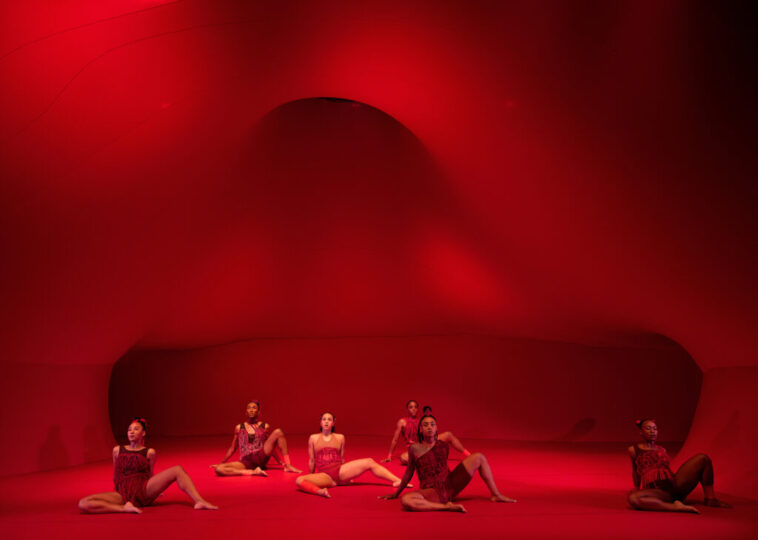
In his latest work, Marks of RED, he asks the dancers to engage in this same practice. Within a womb-like set designed by Mimi Lien, six Black women and femmes do so rivetingly, channeling butoh, nightlife culture, sumo wrestling, and the divine feminine in an exploration of memory and Black embodiment.

While Marks of RED is the first of his pieces Pitts does not perform in, it does seem marked by the memories that have shaped him: his many years as a Gaga practitioner and Batsheva Dance Company member; his love for nightlife; his interest in Afrofuturism and technology; his deep collaborations.
TRIBE in Shamel Pitts’ Marks of RED. Photo by Kameron Herndon, courtesy Walker Art Center.
In some ways, the same could be said for all of Pitts’ multidisciplinary, visually arresting works. Since his choreographic career began in 2015, his rise has been extraordinary. His five major pieces have toured extensively, he’s won a trove of awards, and he’s launched and grown TRIBE, a unique Brooklyn, New York–based performing-arts collective.
“He’s a singular artist, and he’s also the founder of a collective, and he’s also part of a tradition, and he’s also making his own traditions,” says Melanie George, who curated Pitts’ Touch of RED at Jacob’s Pillow and now collaborates with him as a dramaturg, or “artistic doula.”
“He’s able to simultaneously center Blackness and an individual voice. He’s in the avant-garde space but also in the center and being celebrated. His work is of America but not American at all; it’s of Earth, but also futuristic, but also super-present.”
A Risk Worth Taking
Pitts’ artistic return to the womb feels especially consequential because he was almost literally born dancing: His mother went into labor while out dancing with friends, and gave birth in a taxi on the way to the hospital. “She either danced me out of her womb, or I danced myself out of her womb,” he says. After his birth, family members commented on his skin tone, saying, “He’s not so Black—he’s red,” says Pitts. “Red” became his lifelong nickname.
Pitts grew up in the Bedford-Stuyvesant neighborhood of Brooklyn, dancing at parties his mother would throw, or with informal hip-hop crews. “I was always fascinated by how these adults came together to dance for any occasion,” he says. Sometimes, he would choreograph, arranging and instructing his mother’s friends.
 Shamel Pitts in rehearsal. Photo by Tony Nelson, courtesy TRIBE.
Those nights instilled a love for dance that inspired Pitts to audition for the prestigious Fiorello H. LaGuardia High School without any formal training. The audition was the first time he’d ever worn tights and ballet shoes, and he kept kicking the barre doing battements. But he got in. “I think they saw some openness and curiosity and imagination that made them feel I was worth taking a risk on,” Pitts says.
At LaGuardia, Pitts fell in love with the formalism of ballet and the drama of Graham. Soon, he started training at The Ailey School, too, in an effort to catch up with his peers. He caught up and then some, attending The Juilliard School for college, where he won the Martha Hill Award for excellence in dance.
From Gaga to BLACK BOX
At Juilliard, Pitts was introduced to the work of Ohad Naharin, who came to set a piece on the students. Unfamiliar with Naharin’s work, Pitts discovered a video of his solo, King of Wara, and was moved to tears. “It overwhelmed me—it ignited something inside,” he says. Dancing Gaga, Naharin’s movement language, and performing his Tabula Rasa at Juilliard, “unlocked the human and animalistic and primal part of my body and my dancing that I had connected to when I was a kid,” Pitts says. “There was so much about what happens to my body in nightlife spaces that was also coming up in Gaga.” Pitts danced an excerpt from King of Wara for his senior solo, and set his sights on someday joining Naharin’s company, Batsheva.
After Juilliard, Pitts performed with Mikhail Baryshnikov’s Hell’s Kitchen Dance and Ballets Jazz Montréal. Naharin and Pitts reconnected when Naharin was visiting Montreal, and Naharin offered Pitts a spot in the Batsheva Ensemble, Batsheva’s junior company. Pitts spent a year there before joining the main group in 2010.
 Shamel Pitts (with shaved head) and Tushrik Fredericks in Touch of RED, part of Pitts’ RED Series. Photo by Maria Baranova, courtesy TRIBE.
His early years at Batsheva were challenging. Though he quickly became one of the troupe’s standout dancers, he wondered if he really belonged. “I was always told that I was such a ‘Batsheva dancer,’ but I wasn’t sure if that was true,” he says. Pitts was the only Black dancer in the company, and one of few Black Americans living in Tel Aviv, where Batsheva is based. “I felt hyper-visible, which sometimes was alienating,” he says.
Still, Pitts was soaking up information, both from Naharin and from the raw expressiveness of his fellow dancers. And he found another creative outlet in the elaborate nightlife “activations” he would create around Tel Aviv with visual artists, musicians, and other collaborators. “I became really interested in collaboration,” he says. “I started to hear my voice as an artist, and I brought that into my dancing at Batsheva, and things became great there.”
The self-actualization Pitts found in nightlife spurred him to create his first dance. A small, oddly shaped room in his apartment and a black journal he wrote in daily became the seeds for 2015’s BLACK BOX. The 30-minute solo premiered on Pitts’ 30th birthday at an intimate gathering in his apartment for 30 friends. Though initially small in scale, BLACK BOX already reflected Pitts’ commitment to collaboration: He worked with a producer, two DJs, a body-paint artist, and a projection artist.
BLACK BOX also marked a departure from the kind of dancing Pitts had been doing for six years. “At Batsheva, there’s a lot of physicality and virtuosity,” he says. “I started to research movement that didn’t move so much”—like durational tableaus that simmered with intensity. (Later, he’d discover that his work in some ways resembled the slow control of butoh.) There were also nods to nightlife, the “polyrhythms and chaos and euphoria and purging,” he says.
Collaboration and Transformation
The next year, Pitts left Batsheva to pursue his own work. He moved to Brazil to collaborate with Mirelle Martins on the duet that would become the second piece in his BLACK Series, BLACK VELVET. He spent the next several years on the road, teaching Gaga, setting Naharin’s work, and touring an expanded version of BLACK BOX, plus BLACK VELVET and the third work in the trilogy, BLACK HOLE.
With each work in the BLACK Series, Pitts’ vision grew more ambitious: more collaborators, more performers, more elaborate sets, more technology integrations. “My work was becoming very communal,” he says. “It was only fully actualized with all of our parts coming together.” For example, lighting and video artist Lucca Del Carlo is credited as one of the primary creators of BLACK VELVET, and it’s clear why: His striking video mapping is integral to the duet.
 Taylor Stanley in Shamel Pitts’ Redness at Jacob’s Pillow. Photo by Danica Paulos, courtesy Jacob’s Pillow.
BLACK HOLE was born after the 2016 election, when Pitts was pondering alternatives to a world he felt was broken. “I got really interested in black holes as a potential portal to a place where we can further our shared humanity,” he says. The resulting work, featuring three bronzed, alien-like dancers, most clearly embodies the Afrofuturism movement that Pitts’ work has become closely associated with. But Pitts says that, for him, Afrofuturism “is an ethos” rather than an aesthetic—one that values radical imagination, and Black prosperity and liberation.
Forming a TRIBE
Pitts’ work quickly gained traction and critical acclaim. Naharin’s shadow tends to loom over former Batsheva dancers, but from the beginning, Pitts’ pieces felt singular. When George first saw his work in 2018, “I thought, This is different than anything I’ve ever seen,” she says. “He also drew a crowd that I didn’t normally see at dance performances. I don’t know anyone who is doing what he is doing, or the way he is doing it.”
Despite his successes, Pitts was feeling lost. “I felt like, ‘Where is Red?’ ” he says. “No one called me Red anymore. I wanted to tap back into my roots, and the neighborhoods that raised me. I wanted to live somewhere again.” He moved back to Brooklyn in 2019 and launched his performing-arts collective TRIBE, with the intention of both giving back to the community where he grew up and creating a space where his highly collaborative approach to artmaking could thrive.
 TRIBE in Shamel Pitts’ Marks of RED. Photo by Alex Apt, courtesy TRIBE.
With TRIBE, Pitts “walks the walk” of fostering a true collective, says George. “He manages to be the chief visionary, but there’s also this shared caretaking for the work where everyone feels integral to the process,” she says. Pitts is well-suited to the delicate task of cultivating an egalitarian environment. “He has the enviable quality of being clear about his own vision without losing his sense of humor,” says Claudia Rankine, the acclaimed poet who collaborated with Pitts on her play Help, and now sits on the TRIBE board. “He’s both humble and sure, and that combination allows you to follow him wherever he wants to go.”
In addition to Pitts’ work, TRIBE has also produced pieces by other members of the collective, including Marcella Lewis, who performs in Marks of RED. Lewis says that, as a member of the collective, she can use TRIBE’s resources to help with budgeting, grant writing, and marketing for her own choreography. “I feel like I’m part of something unique and innovative that can lead the dance world into a better space,” Lewis says.
The Return of Red
As Pitts was rediscovering the “Red” of his youth, he was also starting a new choreographic trilogy: The RED Series. It began with the short dance film Lake of RED, created in quarantine—a kind of companion to BLACK BOX with its confined setting, spoken-word poetry, and pulsating nightclub aesthetic.
 Shamel Pitts (with shaved head) and Tushrik Fredericks in Touch of RED, part of Pitts’ RED Series. Photo by Alex Apt, courtesy Jacob’s Pillow.
Then came Touch of RED, which Pitts developed partly at a Jacob’s Pillow residency. He was there when the historic Doris Duke Theatre burned to the ground early one morning in November 2020. The fire, and the trauma it caused, lives on in Touch of RED, which takes place in a futuristic boxing ring. “There’s a lot of heat and friction and intensity in it,” he says. Touch of RED was scheduled to make its Pillow debut in 2025 in the new Doris Duke, but was delayed by another tragedy, when Pillow staff member Kat Sirico died in an accident. It finally opened the Pillow season this past summer. “It feels like a phoenix rising from the ashes of that devastation,” says Pitts. Marks of RED, the most recent work in the RED Series, premiered earlier this year, and will make its New York City debut in January at Lincoln Center, the campus where Pitts attended both high school and college. “My formative years were spent there, so to bring my work there is a huge moment for me,” Pitts says.
For now, Pitts is focused on growing TRIBE, including launching a platform called TRIBE Studios, which invites artists and community members into the collective’s process through workshops, conversations, movement practices, and multidisciplinary exchanges. (He likens it to the atelier at a fashion house.) He recently purchased a condo in the Brooklyn neighborhood where he grew up, which serves as both his home and the TRIBE headquarters, including offices, communal spaces, and two guest bedrooms where he often hosts artists.
This offstage work feels like an extension of the Afrofuturistic ethos he channels in his choreography. “It’s a call to action for artists from the diaspora to create new stories, and imagine a future where we thrive,” Pitts says. “And to be a part of the creation of that future.”
The post Shamel Pitts Imagines—and Creates—New Futures for Dance appeared first on Dance Magazine.



GIPHY App Key not set. Please check settings