
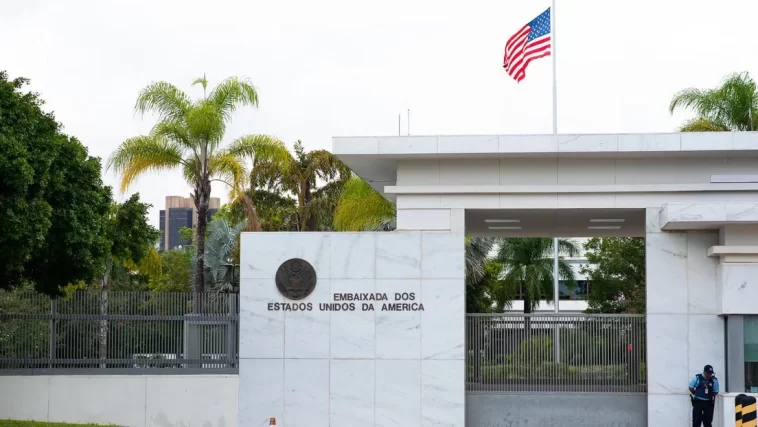
The United States Embassy in Brazil caused a political shockwave after publicly referring to Brazil’s Supreme Court as the “Moraes Supreme Court” on its official X account.
This statement directly singled out Justice Alexandre de Moraes, the main judge overseeing legal cases against former President Jair Bolsonaro. The unusual choice of wording came with a sharp warning.

US officials linked new, heavy tariffs on Brazilian steel, orange juice, and pulp—set at 50%—to what they described as attacks on Bolsonaro and restrictions on free speech.
The Embassy’s message warned that these measures respond directly to actions by the Supreme Court and President Lula’s government, with many observers interpreting this as a sign the US government wants Judge Moraes removed from influence, regardless of the cost.
Such direct criticism from an embassy toward another country’s high court is extremely rare. The move drew immediate condemnation from leading figures in Brazil’s government and legal community.
 U.S. Embassy’s “Moraes Supreme Court” X Post Signals Tough American Stance in Brazil. (Photo Internet reproduction)
Many accused Washington of interfering in Brazil’s legal affairs and disrespecting the country’s institutions. The US, however, has not backed down.
The White House says it will keep the new tariffs in place unless Brazil changes course on its legal actions against Bolsonaro. The tariffs threaten to disrupt billions of dollars in trade.
Brazilian goods at risk make up a large chunk of earnings for Brazil’s farming and manufacturing sectors, which employ thousands.
US companies could soon pay much more for everyday items, including orange juice—Brazil supplies over 60% of US imports in that product. Brazilian officials quickly promised retaliation under the country’s Economic Reciprocity Law.
This law enables Brazil to increase tariffs, suspend trade benefits, or restrict US investment if foreign governments take similar action. Brazil’s leaders denounced what they called “outside pressure” and affirmed the independence of their courts.
Following the dispute, Brazil’s currency dropped by more than 2% against the US dollar. The dust-up has rapidly soured cooperation between two major regional economies.
Market analysts warn of growing risks for both sides. Ordinary citizens may soon feel the impact through lost jobs or higher grocery bills. The strong language from the Embassy marks a major shift.
America’s response looks to push Brazilian judges, especially Moraes, off cases the US considers politically motivated. With both governments standing firm, a diplomatic solution now looks difficult, and business uncertainty is likely to continue.




GIPHY App Key not set. Please check settings