

utah778/iStock via Getty Images

“I Read The News Today, Oh Boy”
Lennon-McCartney, January 1967.
Review and Outlook
2Q
YTD
1-Year
3-Year
5-Year
Wedgewood Composite Net
7.1
0.3
11.9
19.1
15.5
Standard & Poor’s 500 Index
10.9
6.2
15.2
19.7
16.6
Russell 1000 Growth Index
17.8
6.1
17.2
25.8
18.2
Russell 1000 Value Index
3.8
6.0
13.7
12.8
13.9
10-Year
15-Year
20-Year
25-Year
30-Year
Wedgewood Composite Net
12.6
14.2
11.0
8.3
12.3
Standard & Poor’s 500 Index
13.7
14.9
10.7
8.0
10.5
Russell 1000 Growth Index
17.0
17.5
13.0
7.9
11.1
Russell 1000 Value Index
9.2
11.6
8.1
7.8
9.4i
Click to enlarge
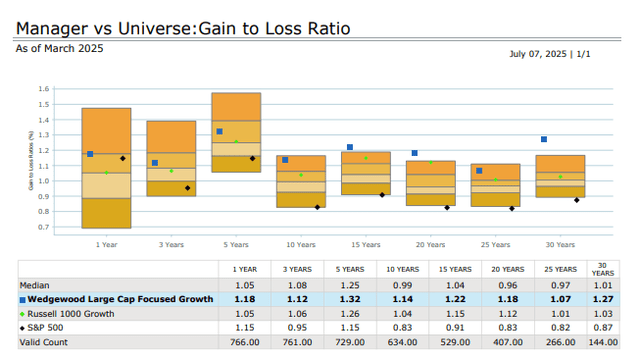
Source: PSN Large Cap Manager Database. Data calculated for managers on gross-of-fee return basis. Past performance is no guarantee of future results. Future results may differ materially from past results. Please see additional disclosures on page 17.
i. Portfolio returns and contribution, expressed as percentages, are calculated net of fees. Contribution to return calculations are preliminary. Returns are presented net of fees and include the reinvestment of all income. “Net (actual)” returns are calculated using actual management fees and are reduced by all fees and transaction costs incurred. Past performance does not guarantee future results. Additional calculation information is available upon request.
Q2 Top Contributors
Avg. Wgt.
Contribution to Return
Taiwan Semiconductor Manufacturing (TSM)
8.40
2.88
Meta Platforms (META)
8.24
2.31
Microsoft (MSFT)
6.43
1.96
Booking Holdings (BKNG)
5.65
1.41
Alphabet (GOOG)(GOOGL)
7.57
1.08
Q2 Bottom Contributors
UnitedHealth (UNH)
2.78
-3.03
Copart (CPRT)
5.57
-0.83
Apple (AAPL)
6.72
-0.52
Tractor Supply Company (TSCO)
5.01
-0.29
O’Reilly Automotive (ORLY)
3.45
-0.23
Click to enlarge
Top performance contributors for the first quarter include Taiwan Semiconductor Manufacturing, Meta Platforms, Microsoft, Booking Holdings and Alphabet. Top performance detractors for the fourth quarter include UnitedHealth, Copart, Apple, Tractor Supply Company and O’Reilly Automotive.
During the quarter, we purchased Zoetis (ZTS) and sold UnitedHealth. We added to Microsoft, United Rentals (URI), CDW (CDW) and Zoetis. We trimmed Visa (V), Edwards Lifesciences (EW) and Alphabet.
Meta Platforms was once again a leading contributor to performance for the quarter – and our best portfolio performer since the panic-selling lows in the stock back in September of 2022. Revenue grew +16% despite ad-spending headwinds related to trade protectionism, and operating margins expanded thanks to continued investments in automation, driving a stellar +37% growth in earnings per share. The Company has been a consistent beneficiary of artificial intelligence (AI) over the past several years, investing aggressively in deep learning recommendation systems that help power its products, which reach nearly half the population of the planet. Meta’s AI investments, combined with its massive scale, allow the Company to quickly spin up new products across its digital advertising real estate to reinforce its competitive positioning. Meta’s core Family of Apps products are backed by extremely large and complex (i.e. difficult to copy) AI recommendation systems that have to sort through billions of datapoints in real time and come up with the probability of a user clicking on something. Meta is one of the few companies that has been able to consistently and, most critically, profitably monetize AI technologies for shareholders, and we continue to hold the stock as a top position in portfolios.
Microsoft was also a top contributor to portfolio performance during the quarter. The Company showed continued terrific organic revenue growth of +15% and +19% growth in operating income (foreign exchange-neutral, respectively), helped by continued seat growth in Office365. It also showed a key acceleration in its Azure cloud infrastructure business, driven by demand for AI-compute capacity. We added to our position before the strong rally, given that valuations had contracted to levels that were starting to discount away upside from Microsoft’s solid positioning in AI.
Booking Holdings contributed to performance as travel spending across the Company’s core ex-U.S. markets, particularly Europe, remained healthy. The Company also continues to take share in alternative accommodations. The Company is on track to expand margins after a few years of reinvestment. Over the past several years, Booking has been aggressively reducing its share count at what we think have been attractive multiples, helping compound earnings at a solid, double-digit clip.
UnitedHealth was a leading detractor from performance during the quarter. Medical costs in their key Medicare Advantage business are spiking as the Company uncharacteristically misjudged the morbidity of its newest members. Additionally, there was another rare miss for what we believed was the “Tiffany” health care operator, which fumbled their execution at Optum Health. This oversight led to the Company pulling their 2025 earnings guidance along with the turnover of key management, including their CEO. We were surprised by the severity of this miss along with the execution missteps, and we decided to liquidate our holdings because the long-term, double-digit growth trajectory of the Company has been thrown into question.
Copart detracted from performance during the quarter. Adjusted volumes were flat (up +1%), which was a bit weaker than expected. Copart continues to have dominant market share in the salvage resale market. However, their primary competitor, IAA, recently bid aggressively for market share at a large insurance carrier customer (likely Progressive). While disruptive in the near term, we believe this shift in volume is not sustainable because Copart’s service offering is superior to IAA’s. We continue to hold Copart as a core weighting in portfolios.
Apple detracted from performance after investors became impatient with the Company’s AI development efforts – particularly the promises made but promises not kept with Siri integrated with AI. It is much too early to conclude that Apple cannot succeed in developing a compelling AI-assisted offering for its device and software ecosystem. For decades, Apple’s proprietary hardware and software have enabled the Company to consistently provide unmatched user experiences that consumers increasingly rely on a daily basis. Whether Apple – with their unmatched installed base of over a billion user devices – develops its AI with eager partners or over a slightly longer timeframe than what investors hoped for does not change the Company’s core competitive differentiation that comes from years of integrating custom silicon with internal operating system software.
Tractor Supply detracted from portfolio performance during the quarter after posting a modest decline in earnings on slightly negative sales driven by unfavorable weather during the spring selling season. The vagaries of inclement seasonal weather, be what they may, Tractor Supply continues to be a best-in-class retailer that focuses on serving their niche customers living in and maintaining rural homes and homesteads, with higher-than-average incomes. During the height of COVID-19 in the U.S., the Company grew substantially faster than their historical rates. Since then, and as consumer spending patterns have over-corrected back towards services, we have seen growth normalize. However, Tractor Supply continues to exhibit excellent returns on capital and has ample addressable market to continue driving double-digit earnings growth through 2030.
Company Commentaries
Zoetis
We recently initiated a position in Zoetis (ZTS), the global leader in animal healthcare. The Company provides a range of products from medicines and vaccines to diagnostic testing, plus a variety of related products and services for pets and livestock in over 100 countries. In the U.S., where the Company generates roughly 55% of its revenue, its business skews heavily toward pets. In the rest of the world, the Company’s business skews more heavily toward livestock, particularly in developing markets. Globally, the split between animal types falls roughly 70% pet and 30% livestock.
Like most of its largest animal healthcare competitors, Zoetis was spun out of a large human pharmaceutical company (Pfizer (PFE)) which historically has handled a significant portion of the heavy lifting behind scientific breakthroughs. Pfizer created many of these products for human use, and Pfizer holds and defends many of the patents licensed to Zoetis. While Zoetis still trumpets its research and development investments, the business, has historically pursued generally lower risk/higher reward R&D, such as extending an existing product to a new animal species or making an alteration to an existing product to target a new indication.
We have been monitoring Zoetis and other animal healthcare companies for many years. The industry has long boasted healthy and steady growth rates. Critically, Zoetis also boasts high and improving levels of profitability.
Zoetis
key statistics (fiscal years ending December)
2016
2017
2018
201G
2020
2021
2022
2023
2024
Revenue growth
2.6%
8.6%
9.8%
7.5%
6.6%
16.5%
3.9%
5.7%
8.3%
EBITDA margin
33.6%
37.1%
37.6%
38.8%
40.6%
41.8%
42.0%
41.7%
42.0%
ROIC
16.2%
15.6%
1G.G%
18.8%
18.1%
1G.6%
1G.4%
20.8%
21.3%
Click to enlarge
source: company reports, internal Wedgewood calculations
EBITDA = Earnings Before Interest, Taxes, Depreciation, and Amortization
ROIC = Return on Invested Capital (proprietary Wedgewood calculation)
The pet side of the business continues to be driven by increasing pet ownership. Plus, changing attitudes toward the quality of care of pets have resulted in longer pet lives. All of these positive trends went another step higher during COVID-19 – highlighted previously in our discussions of long-term holding, Tractor Supply Company. The livestock side of the business has been driven by rising population growth and long-term trends toward improving incomes and quality of life around the globe, all leading to increased demand for meat protein.
The pet/companion animal industry has been accepted as a steady secular growth industry for some time now. Drivers of growth have included greater pet ownership (more people owning pets and people owning multiple pets), better care for pets that leads to longer pet lives, and an expansion of pet conditions needing treatment.
This growth trend includes the personification of pets and their inclusion as family members rather than just an animal – think of all the people who now call themselves “pet parents,” for example. Further, consider the presence of pets as co-stars (or sometimes as the stars themselves) on social media platforms.
As pets live longer as a result of better care and changing attitudes, they end up requiring more care overall and more advanced care. Whereas a pet’s serious illness historically might have led owners to make the difficult decision to “put the pet to sleep,” owners over time have been opting to treat their pets for more advanced conditions.
It is also worth noting that this has not been a yes-or-no, all-or-nothing proposition: just because some pets are given better care, new treatments, and so on does not mean that all of the pets that could benefit from these treatments are receiving them. Zoetis cites Apoquel as an illustration of this. The Company created the market for this pet dermatology product twelve years ago. Today, while there is more competition for the product, yet volumes are still growing at a double-digit percentage rate. The population of pets keeps expanding, a higher percentage of pet owners continue to use the product over time, and there is still opportunity for both drivers to grow.
As we have highlighted in the past with our long-term holding, Tractor Supply Company, all of these pet-related trends took an accelerated step upward during COVID-19. The data below is from the American Pet Products Association, which conducts a biennial survey of pet ownership. The 2021 report covered the 2019-2020 period, which already would have included some COVID-19-related benefit from pet ownership, so that is not quite a pre-COVID baseline. Nevertheless, you can see that 7% more households owned dogs, and 15% more households owned cats over the ensuing four years.
Unites States Pet Ownership
Households Owning Pets (millions)
2025
chg v ’23
chg v ’21
2023
2021
Dog
68
-1%
7%
69
63.4
Cat
49
8%
15%
45.3
42.7
Click to enlarge
source: American Pet Products Association Survey (biennial)
It can be difficult to quantify many of the more subjective long-term drivers of the business – for example, tracking changing attitudes as more people consider pets as their “pet children” rather than the animal barking at potential intruders from the backyard. We can only highlight the results of many of these intangibles, which have appeared in the financial results of the broad industry and of companies such as Zoetis. The data below again comes from the American Pet Products Association.
United States Total Pet Industry Expenditures
(in billions of $)
Year
Spending
% change
2025 (est)
157
3.3%
2024
152
3.4%
2023
147
7.3%
2022
137
10.5%
2021
124
19.2%
2020
104
7.2%
2019
97
6.6%
2018
91
n/a
Click to enlarge
source: American Pet Products Association
While both sets of data show a cooling off of growth, to some degree, from extremely elevated levels around the pandemic, we think the clear step up in the population of pets owned in the U.S. and the fact that these pets are all beginning to age, will continue to benefit the steady growth of the industry into the foreseeable future. Finally, while we have been speaking specifically of the U.S. pet market – the Company’s largest, and the market where we can get our hands on the best information – most of these drivers have been relevant in the rest of the world, as well, particularly in developed markets.
Livestock is a smaller portion of the Company’s business but represents the majority of its revenues in developing markets, especially – some of which, such as Brazil, are important markets. The drivers of this growth have been steady for decades: increasing population growth and rising standards of living in developing markets, both leading to increasing demand for meat proteins. As you can see in the OECD data below, while overall protein consumption has been rising over the past 20 years, consumption of meat, dairy, and fish (all categories where Zoetis has significant business) has been rising the most, and especially in developing markets.
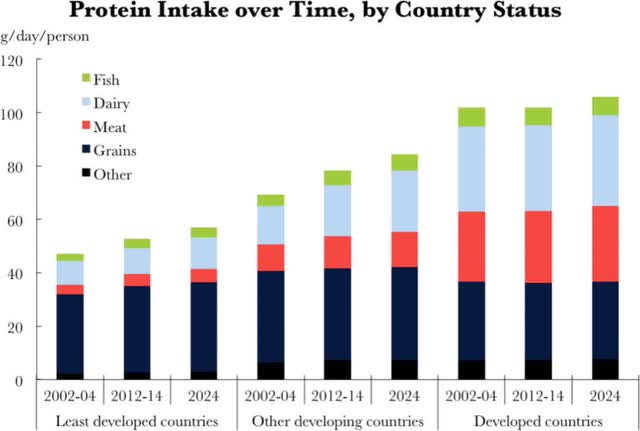
Source: OECD-FAO Agricultural Outlook
We often say that there are no undiscovered gems in the U.S. large-cap growth company universe, realistically: the largest, fastest-growing companies in the world’s largest public equity market generally have been noticed by more than a few people. This, by definition, is why they have large-cap market capitalizations. However, much to our surprise, we do occasionally manage to find a relatively unknown stock in our universe – Motorola Solutions (MSI) being a prominent example, back when we purchased the stock. Key to our growth company/valuation discipline, it is overwhelmingly more common that we buy companies that are very well known, but we tend to buy them when other investors are not interested in them.
In the case of Zoetis, and other pet-related stocks that we continue to study, such as IDEXX Laboratories, we definitely noticed the positive industry trends, and the quality business models for many years. However, from watching the valuations of the stocks in the industry, it was very clear that everyone else had noticed, as well, and the market generally was happy to pay almost any price, irrespective of valuation, to own these businesses. Once the additional driver of the COVID-19-related pet ownership trends arrived, investors piled even more wildly into the industry – our clients and readers will remember the mad dash for “COVID-19 stocks” to the exclusion of everything else during this period (much as we’ve seen with “AI stocks” more recently). Zoetis and its peers benefited from this growth. We would note that private equity investors also piled into the industry during this period, snatching up private veterinary practices, in particular.
In a recent call with one of our clients, we were asked what we were really excited about in our portfolio. We had to think about this for a moment; as mentioned above, we know we are unlikely to discover some amazing business that nobody has ever heard of: “We’ve come across this great little thing called Facebook!” Rather, we tend to buy great companies when they fall out of favor. Perhaps there are controversies surrounding the companies, or temporary issues we firmly believe will dissipate or be quickly corrected. Often, the market just loses interest in a company or industry.
We claim to be long-term investors, and our behavior over 30+ years bears this out; therefore, we tend to get excited when we have been monitoring a great business for many years, and the market eventually presents us with an opportunity to buy it at an attractive entry point. This allows us to benefit not only from the compounding effect of the Company’s capital being deployed at attractive returns on investment over time, but it also provides the possibility of valuation expansion, as well. This has now happened with Zoetis.
If you look at the valuation of Zoetis in comparison to the broad market over the past ten years, you can see the stock has gone from an above-market valuation to a valuation that is now below the Russell 1000 Growth Index. Furthermore, while the valuations of both these indices have expanded over this time period, Zoetis now has retreated to a multiple last seen a long ten years ago.
P/E VALUATIONS (BASED ON NEXT FY EPS ESTIMATES) – Prior 10 years
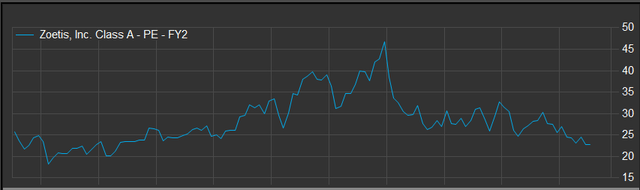
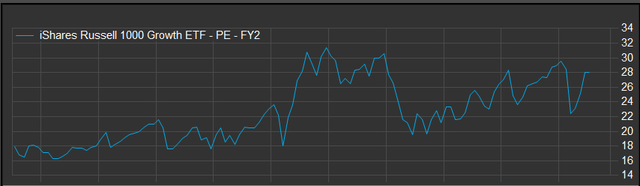
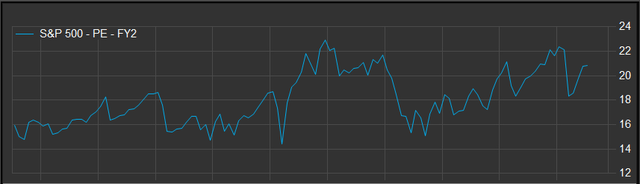
Source: FactSet Data Systems
The stock has now underperformed both of these indices over the prior 1-, 3-, and 5-year periods, after significant outperformance earlier in the period. Looking at the fundamental characteristics of the Company, as laid out above, we would argue that the only thing that has changed over the past ten years is that Zoetis is now a much larger, more profitable Company growing at a similar rate; the stock’s relative performance has been due primarily to market sentiment and valuation. We believe that, over the long term, reality tends to win; high-quality businesses earn the valuations they deserve at some point and will outperform the broad market. We believe we have been given the opportunity to do this with Zoetis now.
A Day in the Stock Market Life
Reading the rapid-fire, market-moving news – seemingly daily – over just the past few months, investors may well have exclaimed, Oh boy!
There have been weekly (often, daily) tariff-related market-moving headlines since tariff Liberation Day. Off again, on again rumored tariff deals. Stock market volatility measures (VIX) spike to historic levels. Major market indices plunge -20%. Many stocks plunge much worse. Tariff deadlines pause. Stocks rip. Middle East war. Israel destroys the once feared, impenetrable Iranian military assets. Iran’s missile-laden military partners and terror proxies are either uninterested, inert or destroyed themselves. B-2s fly from fly-over-country, flying non-stop halfway around the globe and destroying Iran’s nuclear assets. Oil… plunges?! VIX… plunges?! New bull market in stocks. Impossible? No. Unreal. Oh, boy!
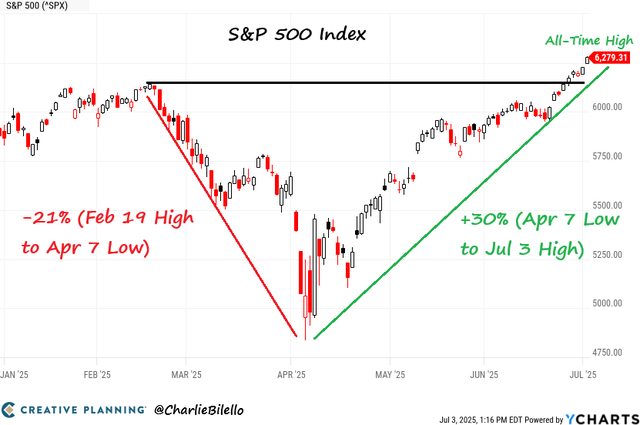
Mr. Market rewards. Mr. Market punishes. We’ve mostly enjoyed outsized rewards over the past half-dozen years. By the end of 2024, we had clocked approximately +30% returns over the past five of the six calendar years. Stock market rewards, when they are abundant, commonly lead to stretched valuations. This is where our portfolio ended by late 2024. Our fourth quarter 2024 Client Letter, written in early January was entitled “Curb Your Enthusiasm.” The stock market peaked in mid-February and began to slide. Then in early April, the Art of The Tariff Deal quickly clocked the stock market to a formal -20% bear market low. Since those lows on April 8, the stock market has not only discounted the worst of both outcomes, feared tariff-induced inflation and a tariff also induced hit to corporate earnings, but also, amazingly, an incredibly short Middle East War, to rise +25% – a new formal bull market.
As of this writing, the stock market has been on a historic run. The S&P 500 Index closed at an all-time high for the first time since February, marking a +30% rebound from its April low. According to the Kobeissi Letter, the stock market took just 89 trading days to recover between record highs. This is the fastest stock market recovery following at least a -15% drop in history and one of the swiftest in just three months.
Charlie Biello reports, “… It took less than 3 months from the April bear market lows for the S&P 500 Index to hit a new all-time high. This was the second fastest recovery for U.S. stocks in the last 75 years, trailing only the vertical rally in 1982.”
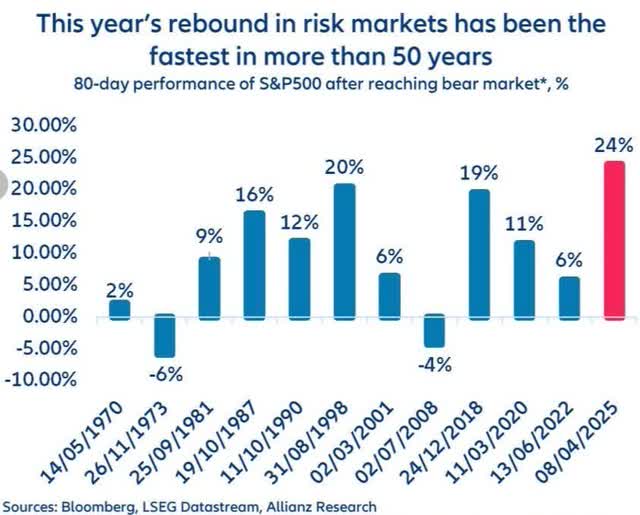
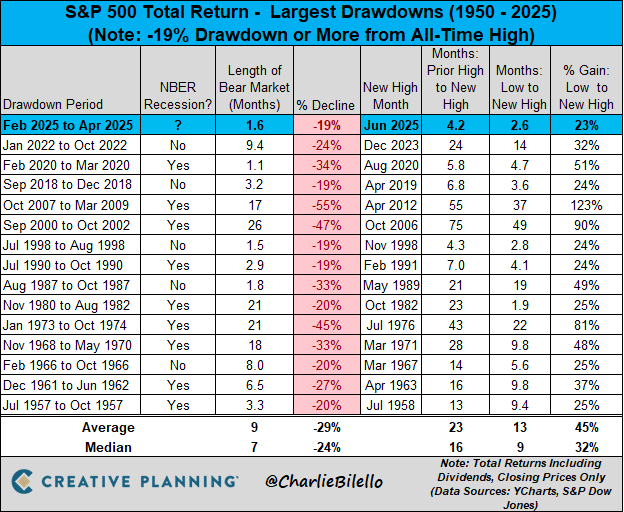
Although the stock market has posted new all-time highs, thus far, it has been a very narrow bull run led by technology stocks. To that point, the NASDAQ 100 Index posted an all-time high on June 24 and is up a remarkable +37% from April lows.
At the risk of becoming myopic, what with the Art of The Tariff Deal and the Art of the MOAB, far too many days this year seem like a day-in-the-life. On the punishment side, our portfolio was hit hard in the short bear market. Abundant punishment, when it is applied in force, feels like a boot on an investors neck. This is where our portfolio was in early April, full metal boot. Since then, our portfolio has rallied modestly, lagging the S&P 500 Index and significantly lagging the tech-heavy Russell 1000 Growth Index.
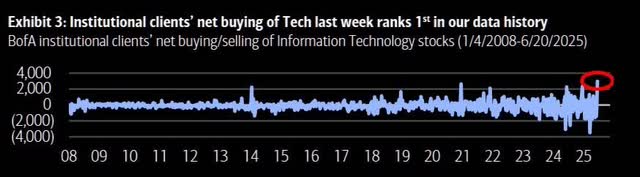
Source: BAML
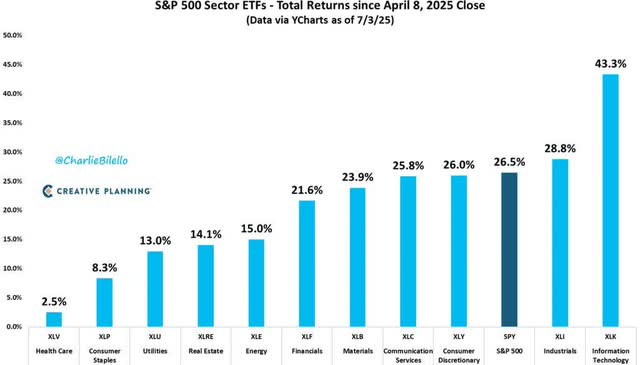
Within our technology stock portfolio holdings, while Taiwan Semiconductor Manufacturing, Microsoft and Meta Platforms – despite out-sized stock gains in the past two calendar years (2023-2024) – have all posted terrific second quarter and year-to-date gains, our other technology stocks have considerably lagged. These include Alphabet, Motorola Solutions, and by far the worst, Apple. Note too, these three stocks were among our best performers in 2023-2024, as well. The sharp narrowness of stocks to failing to make new all-time highs is borne is our portfolio was well. In addition to Taiwan Semi, Microsoft and Meta, there are just two other stocks (Booking Holdings and United Rentals) that have outperformed the Russell 1000 Growth Index; and just one other stock (Booking) at an all-time high. The same paucity of non-tech stocks at all-time highs is a common occurrence in early July.
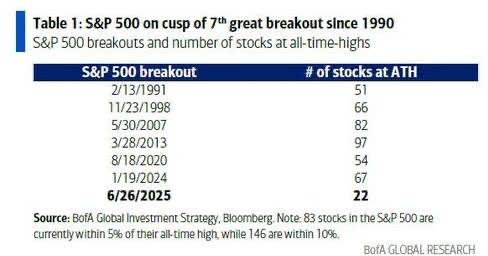
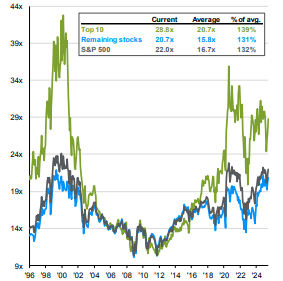
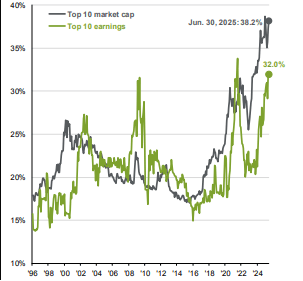
Along with the sharp appreciation in index-dominate technology stocks, the stock market is, no surprise, back to valuation levels that will likely be braked by stubbornly high interest rates. Note too, the sharp rebound of technology stock’s market capitalization as percent of the S&P 500 Index is back to near all time highs. Even more striking, the largest six stocks in the Russell 1000 Growth Index (all tech, of course) account for nearly 54% of the index!
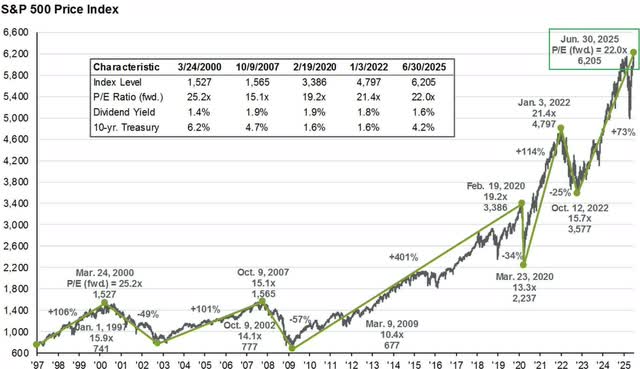
Source: J.P. Morgan Asset Management
P/E of the top 10 and remaining stocks in the S&P 500
Next 12 months, 1996 – present
Weight of the top 10 stocks in the S&P 500
% of market capitalization, % of last 12 months’ earnings
Source: J.P. Morgan Asset Management
All is not lost though for the enterprising, non-tech investor. Despite technology stock’s seemingly endless dominance in the performance charts, a growing list of stocks have become bargains – often from just benign neglect by the short-term obsessed institutional investor community.
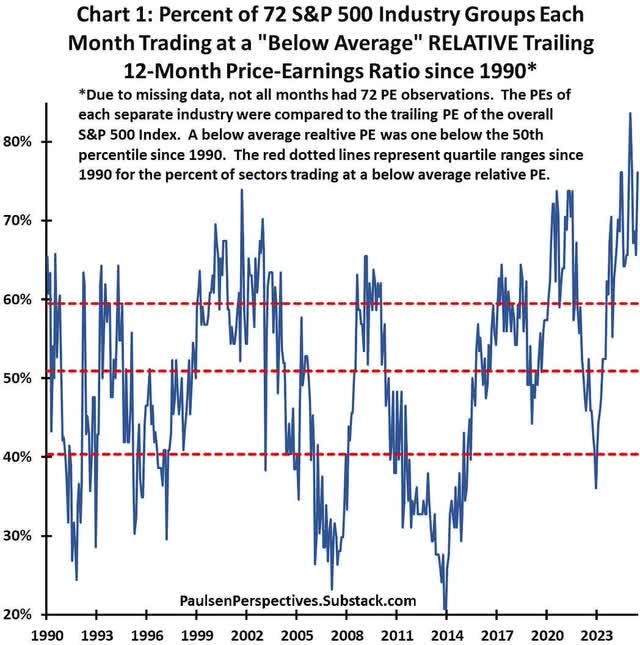
Consider the graphic below, courtesy of the estimable Jim Paulsen.
The graphic depicts the percent of the 72 industry groups within the S&P 500 Index which trade at a trailing “relative” P/E multiple below their respective 35-year average. As seen below, more than 76% of these industry groups are now valued at a below average P/E relative to the overall S&P 500 Index P/E.
This has been our more recent hunting grounds. This is where we recently found United Rentals and Zoetis. We hope to find more unloved beauties.
July 2025
David A. Rolfe, CFA
Michael X. Quigley, CFA
Christopher T. Jersan, CFA
Chief Investment Officer
Senior Portfolio Manager
Portfolio Manager
Click to enlarge
The information and statistical data contained herein have been obtained from sources, which we believe to be reliable, but in no way are warranted by us to accuracy or completeness. We do not undertake to advise you as to any change in figures or our views. This is not a solicitation of any order to buy or sell. We, our affiliates and any officer, director or stockholder or any member of their families, may have a position in and may from time to time purchase or sell any of the above mentioned or related securities. Past results are no guarantee of future results.
This report includes candid statements and observations regarding investment strategies, individual securities, and economic and market conditions; however, there is no guarantee that these statements, opinions or forecasts will prove to be correct. These comments may also include the expression of opinions that are speculative in nature and should not be relied on as statements of fact.
Wedgewood Partners is committed to communicating with our investment partners as candidly as possible because we believe our investors benefit from understanding our investment philosophy, investment process, stock selection methodology and investor temperament. Our views and opinions include “forward-looking statements” which may or may not be accurate over the long term. Forward-looking statements can be identified by words like “believe,” “think,” “expect,” “anticipate,” or similar expressions. You should not place undue reliance on forward-looking statements, which are current as of the date of this report. We disclaim any obligation to update or alter any forward-looking statements, whether as a result of new information, future events or otherwise. While we believe we have a reasonable basis for our appraisals and we have confidence in our opinions, actual results may differ materially from those we anticipate.
The information provided in this material should not be considered a recommendation to buy, sell or hold any particular security.
Click to enlarge
Editor’s Note: The summary bullets for this article were chosen by Seeking Alpha editors.
Editor’s Note: This article discusses one or more securities that do not trade on a major U.S. exchange. Please be aware of the risks associated with these stocks.




GIPHY App Key not set. Please check settings