
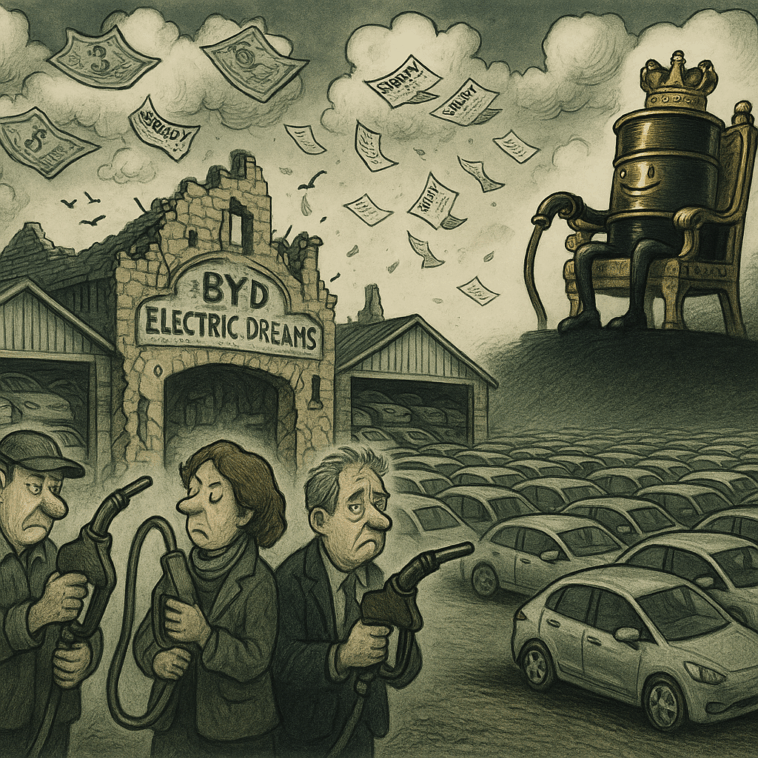
Chinese automaker BYD, the world leader in electric vehicle manufacturing, has hit its first production decline in 17 months, based on the company’s own official reports.
In July, BYD produced 317,892 electric and plug-in hybrid cars, down nearly 1% from the same period last year. Total sales grew only 0.6%, a clear sign that explosive growth is ending.

Behind the numbers is a bigger problem. BYD’s steepest fall was in plug-in hybrid production, which dropped nearly 25% from last year, while sales fell by more than 22%.
There was no seasonal reason for this drop. Previously, dips only happened around holidays. Now, the slump signals lasting problems.
For more than a decade, governments in China, the US, and Europe put billions of dollars into electric vehicle subsidies.
These included cash incentives for buyers, tax breaks for carmakers, and huge investments to build charging networks.
Spain extended EV incentives with €400 million this year; France cut its subsidy budget after spending more than €1 billion.
 BYD’s Production Slowdown Reveals Deeper Troubles for the Electric Car Industry
The US has also dialed back support, while shifting policy toward more fossil fuel projects.
Despite all this support, most car buyers outside wealthy urban centers remain cautious about buying EVs.
BYD’s Production Slowdown Reveals Deeper Troubles for the Electric Car Industry
Charging concerns, higher up-front costs, and doubts about real-life driving range keep demand limited.
In the US, only about a third of potential buyers say they seriously consider electric cars, according to the Pew Research Center.
Chinese makers, including BYD, also face major price wars. Pushed by falling battery material costs and more competition, companies slashed prices—hurting profits and putting pressure on suppliers.
Even in Europe, where EV sales grew 25% in early 2025 and electric cars claimed 17% of the market, momentum has cooled.
The largest European markets, Germany and the UK, still lead, but subsidy cuts in France led electric car sales to fall.
This is the real story: government money and policy alone do not guarantee a long-term electric vehicle boom.
The car market remains driven by hard consumer choices—not political ambitions. Makers now face shrinking profits, oversupplied factories, and competition that keeps getting tougher.
Overcapacity Sinks BYD as China Dumps EVs, Tesla Aims for RoboTaxi Riches
Demand growth depends less on policy, more on whether consumers truly want electric cars and feel ready to buy them.
By stepping back from the headlines, the figures show a tough reality for the EV industry.
Even market leaders like BYD must confront slowdowns and rethink their strategies as public support wavers and buyers hesitate.
Anyone interested in the future of cars—and the billions spent on trying to change it—should watch this space closely.


GIPHY App Key not set. Please check settings