
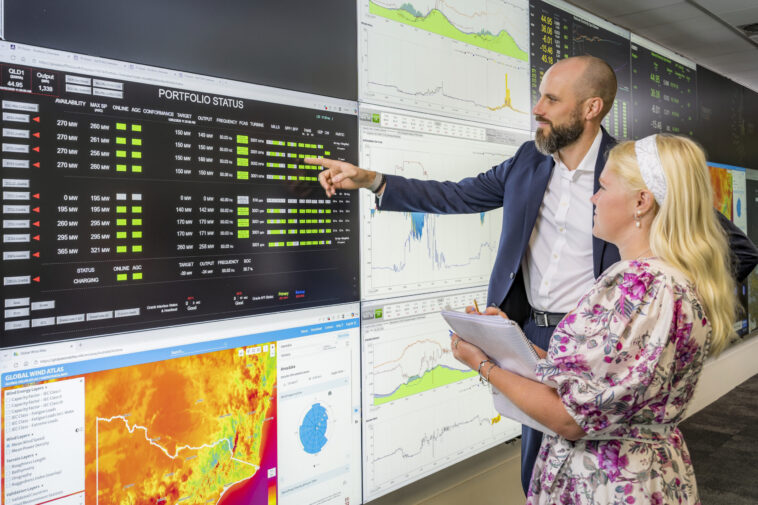
On a sweltering hot summer Queensland day, as air conditioners roar to life, Stanwell Corporation’s generation assets work behind the scenes to make sure more than a third of the state’s energy needs are met.
But as the energy system evolves – and Stanwell builds its portfolio to also include wind, solar and batteries – a new platform is quietly powering smarter decisions.

One of Stanwell’s major battery projects is now charging and discharging with precision, guided by artificial intelligence that predicts the optimal moments to act. Enabled by Stanwell’s new Stanwell Modelling Platform (SMP), this capability forms part of a broader shift underway at one of Australia’s largest energy generators, helping maintain grid reliability while supporting more affordable electricity for the future.
A Cloud-Powered ‘Brain’ for Energy
Stanwell is a government-owned utility known for providing reliable, affordable electricity to Queensland and beyond. But with Australia’s rapidly changing energy market, traditional methods aren’t enough. To address this and set the energy company up to embrace AI and innovation confidently, Stanwell built the Stanwell Modelling Platform (SMP) – essentially an AI brain in the cloud that helps make smarter, faster decisions.
“Think of it as our intelligent command centre,” explains Kevin Lin, Stanwell’s Chief Information Officer. “SMP lets us throw complex problems at AI models and get answers in hours or seconds, where it used to take weeks. We use it across the organisation for mission critical tasks like forecasting energy demand, supporting trading decisions, and managing safety risks. It’s changed how we operate.”
Built on Microsoft Azure with Microsoft AI services, SMP began in the trading department as an experiment in machine learning. It quickly proved its worth. Today, it’s an enterprise-wide platform weaving AI into the foundation of Stanwell’s business – from the trading floor to the safety office.
SMP brings Stanwell’s data and predictive models into one place. Engineers and analysts across teams can plug into it to solve tough questions: How much power will Queensland need next week? What’s the best way to run our battery storage today? Which safety inspections should we prioritise this month?
Smarter Trading and Bigger Gains
One of the first triumphs of SMP has been in energy trading – an arena where milliseconds and megawatts intertwine. Stanwell’s traders handle electricity sales in a market that shifts every five minutes. They’re now aided by AI that analyses mountains of market data to recommend when to buy, sell, or store energy.
Stanwell Executive General Manager Business Services Sophie Naughton said the Stanwell Modelling Platform is critical to be able to keep up with the market’s rapid changes.
“This significant increase in weather dependent energy generation, including Australia’s love of solar generation, is driving significant market volatility and new trading patterns,” Ms Naughton said.
“For our trading team it’s also driving the beginning of a ‘data tsunami’.
“Stanwell has a proud history of selling energy from two extremely reliable coal fired energy plants, but our portfolio is growing with generation and firming assets, power purchase agreements, each one bringing with it new and more complex data for our traders to analyse.
“This data is crucial for our success. It informs our energy pricing, contracting and how much energy our assets should generate and when.
“Our traders have to move faster than ever before so as you can imagine, the right software is also now critical.”
The most significant example is Stanwell’s large-scale battery system. By letting an AI model optimise when that battery charges or discharges, the company found it could improve asset performance by more than 200 percent. This improves the commercial viability of battery storage, enabling the delivery of sustainable low-cost energy more efficiently. Moreover, Stanwell is exploring options to extend AI optimisation across their portfolio of energy generation and storage assets.
Not just a win for Stanwell but also customers and the grid, a battery that operates efficiently can soak up excess solar power during the day and release it when people need it most in the evening. This helps stabilise the overall system and the supply curve, reducing market volatility.
“Yes, it improves our trading confidence,” Kevin Lin says. “But it also means we’re capturing affordable renewable energy and using it when demand peaks. That’s good for everyone – it eases pressure on prices and cuts waste. It’s a smarter use of the resources we already have.”
Forecasting the Future, More Accurately
Another win from SMP is in forecasting electricity demand – a fundamental task for any utility. Even a small improvement in forecast accuracy can mean big savings (and fewer 5pm surprises when everyone gets home and switches on the AC). By migrating their forecasting models to the Azure-powered platform, Stanwell’s analysts tapped into more data sources (such as detailed weather data and usage patterns) and more sophisticated algorithms. The payoff was a 30 percent improvement in forecast accuracy for certain time frames. In practice, that’s a huge leap. It means Stanwell can predict surges or drop-offs in power usage with greater precision.
For everyday Australians, better forecasts help in subtle but important ways. It enables Stanwell to have the right power stations online at the right times, improving energy security on high-demand days. It also means the company isn’t overproducing (which wastes fuel and money) or underproducing (which can spike spot prices). In the long run, efficiency gains like this can contribute to more stable electricity prices for consumers.
“When we know what’s coming, we can plan effectively and avoid expensive last-minute measures,” Lin says. “That goes directly toward keeping costs down for customers.”
From Hours to Minutes: Taming Risk and Complexity
Stanwell’s platform is also supercharging less visible but critical tasks, like risk management. In the past, running a complex “what-if” scenario on market prices or fuel costs could tie up a computer for hours and use costly resources. Now those simulations run on Azure at a fraction of the cost and in some scenarios, up to 15 times faster.
This means the company can run many more scenarios, more frequently, to stay on top of market volatility.
Culture Shift and Collaboration
SMP’s success is not just about technology, but also a shift in culture at Stanwell. By demonstrating quick wins, the team behind the platform won over colleagues from the executives to the plant floor.
This cross-company enthusiasm was crucial. Stanwell’s leadership decided to invest in scaling up the platform, and they empowered employees to experiment. What started as a trading team initiative became a company-wide movement. Today, the modelling platform is firmly embedded in Stanwell’s operations, with strong support from the top.

Lin, as CIO, made sure to involve IT and compliance teams early to integrate SMP into the company’s existing systems and security protocols.
“We didn’t want this to be a siloed science project,” he says. “It had to tie into everything – data pipelines, reporting tools, user access controls – so that the insights flow to where decisions are made.”
As the energy landscape evolves – with more distributed resources, electric vehicles, and smarter grids – the complexity will only increase. Stanwell plans to stay ahead of the curve. Lin envisions SMP continuously learning and improving.
“We’re just scratching the surface,” he says. “The beauty of AI is that it gets better with more data and use. Every day our platform is learning from new situations. We’re excited because as the tech grows, so do the benefits for our customers.”
For now, Queenslanders might not realise AI is working behind the scenes to keep their lights on and their energy bills in check. But at Stanwell, the shift is palpable. The company has turned data into one of its greatest assets. And in doing so, has lit a path where cutting-edge innovation and public service go hand in hand, powering a brighter future.




GIPHY App Key not set. Please check settings