
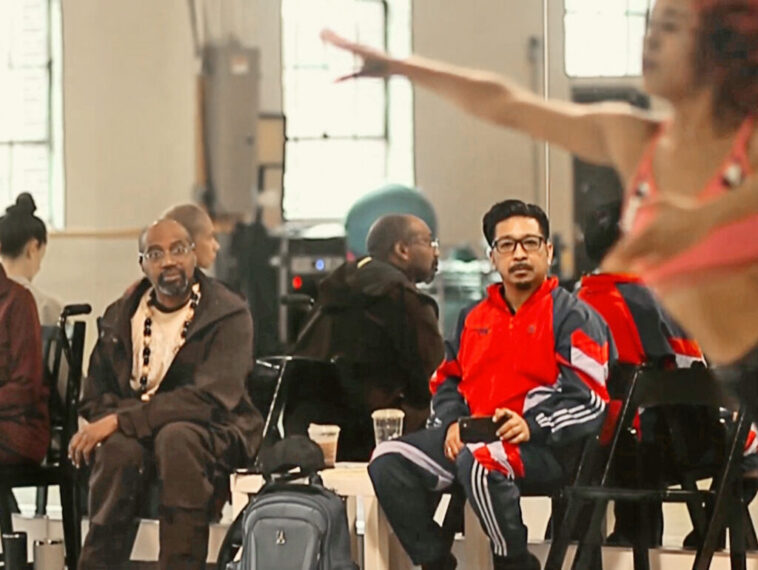
When Ronald K. Brown was in second grade, he went on a school trip to see Alvin Ailey American Dance Theater, returned home, and made his first dance. Seeing his interest, his mother took him to the Bedford Stuyvesant Restoration Plaza in their Brooklyn neighborhood for a dance class.
Ronald K. Brown and
Arcell Cabuag in the studio. Photo by Micah Isaiah, courtesy EVIDENCE.

Fast-forward to today: Brown has choreographed seven works for Ailey, and his group, EVIDENCE, A Dance Company, has a long-time residence at the Billie Holiday Theatre at Restoration, where he also co-directs the Youth Arts Academy. Those full-circle moments—which he calls “divinely humbling”—are only two points on Brown’s laundry list of accolades stretching back four decades. Among them: a Guggenheim Fellowship, a NY Dance and Performance Award (“Bessie”), a Fred and Adele Astaire Award (today the Chita Rivera Awards) for his choreography for the Broadway musical Porgy and Bess, a 2018 Dance Magazine Award, and a 2024 Dance Teacher Award of Distinctionshared with his associate artistic director Arcell Cabuag.
Brown marks another milestone this month, as the 40th-anniversary celebrations of Ronald K. Brown/EVIDENCE culminate with a homecoming season at New York City’s Joyce Theater from February 24 to March 1. While the two programs will showcase his influential choreographic style, which fuses Western contemporary dance with African diasporic traditions, it’s not just Brown’s longevity that is being celebrated. Unsurprisingly to anyone who has encountered his warmth and generosity of spirit, Brown is using the occasion to pay homage to two women who have impacted his work. The first program celebrates costume designer and musician Wunmi Olaiya, whom Brown has collaborated with since the early 1990s and who will sing live for the closing work of the program, Upside Down. The second is dedicated to renowned dance artist Toni Pierce-Sands, who died of cancer in November. It features Where the Light Shines Through, which Brown created for Pierce-Sands’ TU Dance in 2017, and Clear as Tearwater, a solo he made for Pierce-Sands. “My heart is so full even to talk about it,” Brown says.
Forty years is remarkable longevity by any standard, but especially for a contemporary-dance company. What does it mean to reach this milestone?
It’s incredible. I decided to start a company the month before I turned 19. I was like, “I want to start a dance company because I don’t see work that has real people onstage.” I wanted EVIDENCE to represent our families, our teachers, our ancestors. I think my grandmother gave me a couple hundred dollars, my mom gave me some money, so I could rent Mary Anthony’s dance studio. Some dancers said, “Oh, I’ll follow this young boy.” I just hoped…no, I really believed that I needed to make a space for EVIDENCE. But, you know, not knowing how long it would last. It’s been amazing how many people have said “Yes, we’ll support you” along the way, from dancers to board members and funders and theaters.
 Austin Warren Coats and Demetrius Burns in Ronald K. Brown’s Where the Light Shines Through. Photo by STUDIO AURA, courtesy EVIDENCE.
It feels very true to you to mark the anniversary of your company by celebrating the people you’ve worked with along the way.
One of the TU Dance members, she said: “This is divine providence.” And it is. All of this was in place before Toni made her transition. Me and Arcell asked Toni, “Can we dedicate this program to you?” And she was like, “Ron, I’d be honored.”
It’s my privilege to honor these women who have touched me so deeply. It’s very emotional—a well of emotions—but it’s a joy.
 Samiyah Lynnice in Ronald K. Brown’s Upside Down. Photo by Quinn B. Wharton, courtesy EVIDENCE.
So many of the works on these anniversary programs were originally created for other companies—Ailey, Philadanco, TU Dance, Cleo Parker Robinson Dance. What is it like bringing them all together to be performed by your dancers?
There’s something amazing about bringing material in-house, where we are together deeply enough that the material can marinate in the bodies of the EVIDENCE dancers. I love working with these dancers; so talented and generous all the time, in the studio and onstage. That’s kind of rare, unfortunately. Some dancers kind of want to phone it in. But not these dancers. It’s full, all the way.
When you’re working on an existing piece with a new group of dancers, how much do you tweak the material in response to the people in the room?
I have a kind of detachment about the work. It’s specific, but I feel like it doesn’t really belong to us. With Where the Light Shines Through, which we put on TU Dance in 2017, there’s so much new material that has been added to the piece with this new version. Arcell would sit back and say, “Oh, no, I think it needs this.” And then for Gatekeepers, which is originally put on six people, we were like, “Oh, these dancers are so beautiful. What if we turn it into a cast of nine?” So that’s what we did. (Laughs.) Push it!
I studied composition with Bessie Schonbergprobably in the late ’80s, and she became an incredible mentor. She said, “Speak up for yourself! I want you to do what you intend. Make sure you hold yourself accountable and do what you said you wanted to do.” And, “Don’t give in to the pressure to always do something new. Make sure people understand where you came from.” Those are two incredible lessons I hold dearly. So, on this program, there’s things from ’99 and from 2017. You see who we are and who we have been.
 Austin Warren Coats, Demetrius Burns, and
Micah Isaiah in Ronald K. Brown’s Where the Light Shines Through. Photo by STUDIO AURA, courtesy EVIDENCE.
You had a stroke five years ago. What has the road of getting back into the studio after that been like?
When I had the stroke, they were telling Arcell and my family that it might take me a year to walk or I might not walk again. And I was like, “What are you talking about? I’m going to dance.” (Chuckles.) One of the doctors, he asked me, “What’s wrong?” I said, “I can rehearse for five hours and I can’t stand up. I’m just so disappointed with myself.” And this doctor, he said, “Only good thoughts.”
I had an incredible team—my family, Arcell—that got me on my feet and got me walking. It has been really amazing to feel healing in real time. And the journey of recovery continues. The progress is not linear. When we come home, the wheelchair goes into a closet and I walk around the apartment with a cane, and sometimes without the cane. It’s a process that I’m enjoying.
Has your process in the studio shifted?
I rely on Arcell a lot more. He’s dancing every idea that we dream about. He’s the one that’s going to physicalize it. And then if I have a note for the dancers, sometimes I tell them, “I don’t know what I’m gonna do, but I’m gonna stand up to give you this note.” And I think that’s really what it’s about. That’s part of being a dancer: “I don’t know what I’m going to do, but I’m going to do what I can.” Right?
 EVIDENCE in Ronald K. Brown’s Upside Down. Photo by Quinn B. Wharton, courtesy EVIDENCE.
Forty years in, where do you find inspiration?
I think a lot of us have been talking about dance being a source of hope and joy. So I think that’s where I am. I made Grace in ’99, and then, in 2019, I made Mercy, and now Arcell and I are thinking we will close off the trilogy and build the piece Faith. That’s the next thing we’re dreaming about.
If you could go back to the early days of your company and talk to your younger self, what would you tell him?
Don’t be afraid of business and don’t be afraid of asking for money. Because those are two things that I kind of resisted until I incorporated. And even after that, I was like, “Oh, I don’t really want to ask for money.” No, but if you want these dancers to get paid, if you want them to have health insurance, you’ve got to get over that fear. Fear kills action, but action kills fear. I’m trying to keep that front of mind.
 EVIDENCE in Ronald K. Brown’s Upside Down. Photo by Quinn B. Wharton, courtesy EVIDENCE.
Looking ahead, what are your dreams for your company and yourself?
I would love the company to travel internationally to Cuba, and some parts of West Africa and South Africa. And building a home for the company. We’ve been at Restoration for 20 years now, but I know they have a campaign to tear down the campus and build it up again. And so we hope that we’re part of that. I just want to have a place where we can continue to support the next generation and these incredibly talented dancers.
Do you think about your artistic legacy?
I think about it, but I also see it. There’s a young guy at the Youth Arts Academy, Henry, who just turned 6 years old. He came to the dance concert for EVIDENCE at the Billie Holiday Theatre, and then he told his mom, “I want to go see more dance!” (Laughs.) And so when I think about the legacy, I think about these babies. And then dancers in the company who weren’t born when I made Grace but now they’re dancing Grace, or meeting dancers who say, “I saw Grace when I was 13 years old,” and now they’re performing and have careers. I see the legacy in there, in the young people I’m meeting.
The post As His Company Celebrates a Milestone Anniversary, Ronald K. Brown Looks to the Future appeared first on Dance Magazine.



GIPHY App Key not set. Please check settings