
Key Points
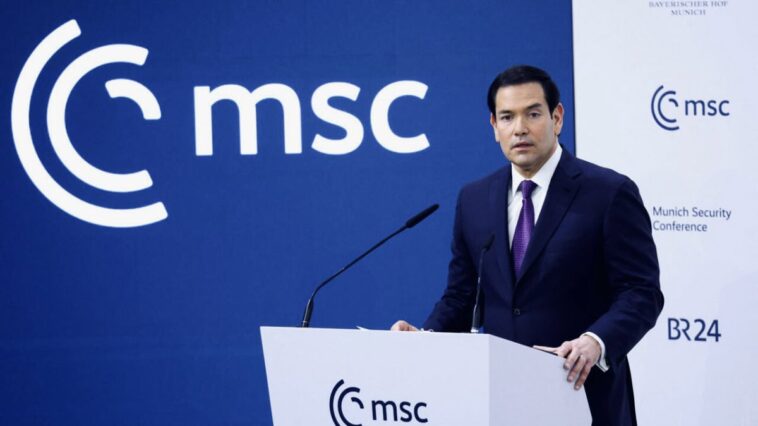
— In a sweeping civilizational address at the Munich Security Conference, U.S. Secretary of State Marco Rubio reframed the transatlantic alliance as a bond of shared ancestry, faith, and culture — not a defense contract to be renegotiated.

— Instead of scolding Europe over military budgets, Rubio delivered what amounted to a plea from a family member: get stronger, be proud, and walk with us — or we walk alone.
— The speech divided opinion sharply: the right hailed a rejection of Western decline; the left warned of exclusionary nostalgia dressed in diplomatic poetry.
Something extraordinary happened at the Munich Security Conference. The top American diplomat walked onto the world’s most important defense stage and, instead of demanding NATO budget numbers, asked a disarming question: what exactly are we defending?
His answer was not an alliance or an institution. It was a civilization — its people, faith, and culture.
Secretary of State Marco Rubio took the audience back to 1963, when this conference was born in a divided Germany with the Berlin Wall freshly built and nuclear war one miscalculation away.
He traced the West’s triumph over Soviet communism — then delivered the sting. That victory, he argued, bred a “dangerous delusion” that history was over, borders no longer mattered, and trade alone would keep peace.
What followed was not misfortune but choice. Deindustrialization, surrendered supply chains, self-defeating energy policies, destabilizing mass migration — all voluntary, all shared. “We made these mistakes together,” he said, refusing to lecture from above.
Then came the reversal. America’s bluntness, Rubio explained, comes not from arrogance but from something closer to love. Washington wants strong allies not because weakness irritates the U.S., but because it endangers the whole family.
The rhetorical climax was personal. Rubio traced America’s DNA through Europe — English law, Scots-Irish frontiersmen, French explorers, Spanish cowboys, Dutch New Amsterdam — then revealed his own roots in 18th-century Piedmont and Seville. “We will always be a child of Europe,” he said. A Cuban-American diplomat on European soil, making himself living proof of the bond.
On policy, he proposed reindustrialization, Western mineral supply chains, joint AI and space leadership, and reformed international institutions. He cited the Gaza truce and strikes on Iran’s nuclear program as proof that multilateral bodies can no longer solve real crises. His thesis in four words: decline is a choice.
From the left, critics see romanticized history that erases colonialism, flirts with Christian nationalism, and dismisses climate action as a “cult.” From the right, supporters see the first American leader in a generation willing to say the West is worth defending without apology.
Either way, the message carried a velvet ultimatum: America is moving, the door is open, but it will not stay open forever.
Read More from The Rio Times




GIPHY App Key not set. Please check settings