
Though Carmen de Lavallade lived to 94, news of her death last December came as a kind of shock: She seemed immortal. The most elegant of pioneers—Duke Ellington called her “one of the most ravishing women in the world”—de Lavallade was a self-possessed star of dance, theater, opera, film, and television in an era when Black performers faced enormous challenges in all of those fields. And throughout her seven-decade career, de Lavallade stayed onstage. She was 88 at her last performance, every bit as compelling as she was in her youth. It felt like she might dance forever.
Born in Los Angeles, de Lavallade was introduced to dance by her cousin Janet Collins and studied on scholarship with Lester Horton. De Lavallade quickly emerged as Horton’s muse and one of his company’s standout performers. In those early years, she profoundly influenced longtime friend Alvin Ailey, and in 1958 she became a founding member of Alvin Ailey American Dance Theater.

During the 1950s, de Lavallade appeared in multiple feature films, notably Carmen Jones with Ailey. She made her Broadway debut in 1954’s House of Flowers, where she met her husband and frequent artistic collaborator, Geoffrey Holder. Beyond the stage, she taught movement to actors at Yale University, directed Adelphi University’s dance department, and mentored scores of artists. Later in life she performed with PARADIGM, a company for veteran dancers that she co-founded with Gus Solomons jr and Dudley Williams in 1996.
De Lavallade, who received a Dance Magazine Award in 1966, was featured often in the pages of the magazine. That coverage traces the trajectory of her career—and creates a mosaic-style portrait of her singular talent.
From the DM Archives.
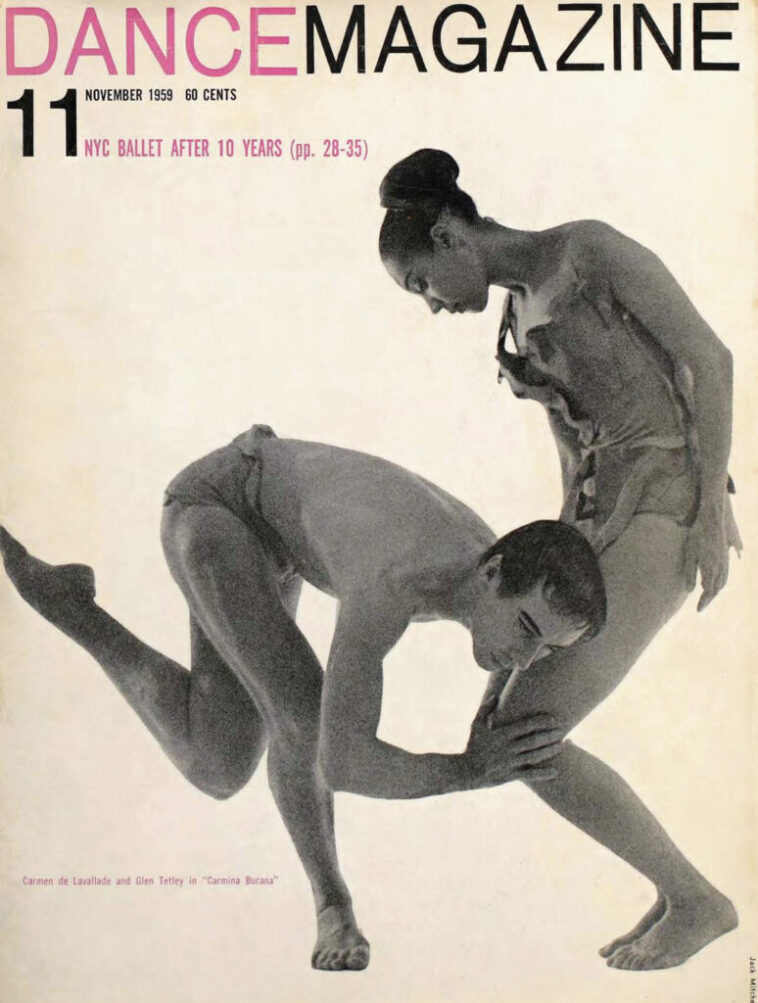
De Lavallade and Glen Tetley appeared on the cover of the November 1959 issue, costumed for John Butler’s Carmina Burana. Not only was that New York City Opera production reviewed in the issue (“The high point was an exquisite solo for Carmen de Lavallade,” Doris Hering wrote), but de Lavallade was also featured in the Brief Biographies column, which highlighted rising stars. “Lovely is the word for Carmen!” the profile began.
 From the DM Archives.
 From the DM Archives.
 From the DM Archives.
 From the DM Archives.
 From the DM Archives.
 From the DM Archives.
One of de Lavallade’s first mentions in the magazine came in this August 1958 profile of Holder, whom she’d married three years earlier. The feature included a dramatic description of how they met, from Holder’s perspective: “Once…Geoffrey had painted a woman with flowers on her head. Her features were soft, her eyes deep and dark, her neck long and graceful. While in House of Flowers, he met this woman. She was dancing the female dance lead in the show, and for him her work…was close in its grace, simplicity and range to what he himself was trying to express. After four days he knew this was the woman he would marry. And he married her.”
 From the DM Archives.
In an October 1966 review of the dancer’s performances at the Rebekah Harkness Foundation Dance Festival, Hering called de Lavallade a “magical creature.” “Few artists convey the sensuous pleasure of movement as Carmen de Lavallade does,” Hering wrote. “It comes from the fleet language of her hands as she rests them on the floor and suddenly turns them over. It comes from the solid yet sensitive curve of her feet against the floor’s surface. It comes from the easy, strong forward thrust of her legs, from the aristocratic head, from the shoulders folding gently downward, from the way her torso dips and then arches in an upswerving spiral.”
 From the DM Archives.
De Lavallade’s Dance Magazine Award profile, in the March 1967 issue, emphasized her multifaceted talent. “Long ago Lester Horton told me that no one in today’s theatre should try to get by on one skill alone,” de Lavallade said. “I am certain that time has proven him right. I, for one, am firmly convinced that a performer today should know how to dance and sing and act. And I feel fortunate in having had training which has helped me acquire these skills.”
 From the DM Archives.
In the October 1992 issue, critic Joseph H. Mazo described de Lavallade’s recent performance in John Butler’s Portrait of Billie—a work about the jazz vocalist Billie Holiday that had been created for de Lavallade more than 30 years earlier. At 61, de Lavallade remained “intensely musical and an outstanding actress-in-movement,” Mazo wrote.
 From the DM Archives.
A February 1994 Presstime News brief marveled at de Lavallade’s packed schedule: performing at The Joyce Theater, creating dances for the Metropolitan Opera, coaching actors and staging movement for straight plays, setting Lester Horton’s The Beloved on Dayton Contemporary Dance Company, and creating exercise classes for older students.
 From the DM Archives.
The magazine feted de Lavallade’s 50-year career in its August 1999 issue. “She is a luminous, articulate artist, a dream to work with and an inspiration to everyone who shares in her presence,” Donald McKayle said. Holder was not to be outdone: “She is the most beautiful woman in my world,” he said. “She is also a magnificent woman to live with, an exceptional dancer, and an incredible mother. God gave me a muse, and her name is Carmen.”
 From the DM Archives.
The December 2000 issue highlighted de Lavallade’s choreographic work, discussing the creation of Sweet Bitter Love, a showcase for Ailey star Renee Robinson. “I have so much respect for what (Carmen has) done as a dancer and in theater,” said Judith Jamison, then the company’s artistic director. “Quietly and elegantly, she has made a statement about how exciting and special dance can be.”
 From the DM Archives.
Most recently, de Lavallade was featured in the magazine’s From the Vault column. The piece described her six-decade relationship with Holder, who died in 2014, as “one of dance’s longest, most celebrated on- and offstage partnerships.”
 From the DM Archives.
The post Carmen de Lavallade: A Lifetime of Dance appeared first on Dance Magazine.




GIPHY App Key not set. Please check settings