
Share

Tweet
Share
Share
Ballet RI Black Box Theatre, Providence, RI.
February 21, 2026.
I love dance “traditions” that have emerged in my life – annually-presented shows that I see most, if not all, years. Ballet RI’s Made on Hope has certainly become one of them. Tradition, yes, yet the staged works are consistently fresh and forward-thinking.
That felt particularly true this year; the prompt concerned “the next era of human connection and communication,” and one likely could have never guessed that from the six works themselves (all of them world premieres). With ingenuity and sincere originality of thought, the choreographers turned a prompt into works of concert dance that boldly stood on their own.
Stephen Gunter’s thought-provoking Waves Behind Glass opened the program. He brought an experimental approach to investigating the impact of the computers we all carry around with us and have our faces in for too much time each day: our phones. This theme seems quite an obvious one as response to the prompt, yet Gunter approached it in a way I would not have seen coming.
He placed small microphones on two (out of seven) dancers’ pointe shoes, along with one microphone far downstage. The soundscape these microphones would create, complimentary to the set score, would create a unique experience each night, Gunter explained. The score was rhythmic, like a heartbeat, while the feedback from the onstage microphones was intermittent – therefore unpredictable.
I saw there a tangible representation of our heartbeats, and the breath connected to them, juxtaposed with the mobile notifications that can call our attention and challenge the calm of our physiology at any point. Additionally, just like two of the dancers carrying the microphones on their pointe shoes, many (if not most) of us carry our phones like an extra limb. The nondescript costumes (costume management by Maxine Wheelock) – black unitards under flowy white shifts – underscored the universality of the “distraction from my phone” experience.
The dancers’ strong, attuned unison also brought that sense of something shared. Movement shapes and pathways conveyed assurance and fortitude amidst the turbulence of those endless digital pings. Some might call Gunter’s connection to the program prompt a bit of a stretch, yet – because of all these abstract, yet poignant aspects that emerged – I found it daring and tenacious.
AJ Maio’s Beyond the Bereza came next, exploring the theme of communication and connection not through the phones in our pockets, but in places. We find connection and meaning in places that are familiar to us, but could we find the same in places we haven’t yet discovered, Maio asked in his current speech.
He called upon his own Ukrainian heritage to probe that idea: pair and group formations referencing folk dancing, colors and cuts in costuming reflecting traditional garb. The ensemble of eleven danced with a proud bearing: undeterred and unapologetic. They peppered that strength with pleasing fluidity, evincing their full kinetic fluency.
While they began the piece prostrated, bowing forward over their legs resting on stage, they ended it standing and facing upstage together – ready to confidently step forward together. That felt like a meaningful development to me. As the lights faded to dark, I also realized that the work inspired me to learn more about Ukrainian dance and culture. Maio asked if we might find meaning and comfort in places we don’t yet know, and the answer for me was wanting to give that a try.
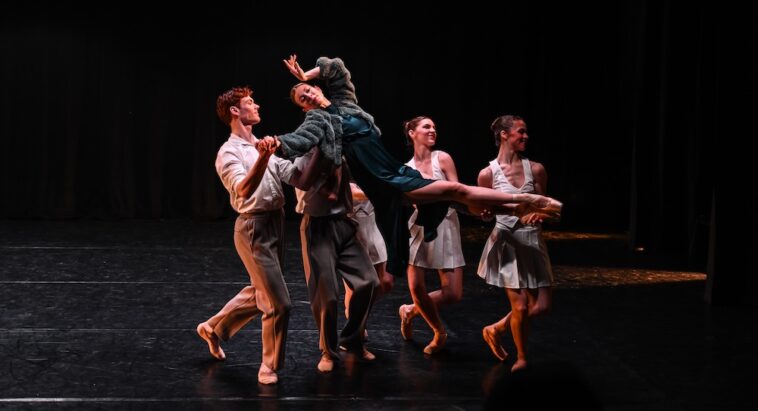
Heather Nichols’ La Vie De… came next, bursting with classic elegance and top-notch (at times even humorous) theatricality. She wanted to investigate the possible meaning in, and connection through, inanimate objects – more specifically, a fancy, fluffy green jacket. Standing out to me in the work was an effective quality of understatement: a presenting of “just enough” that built a sense of Old Hollywood, classic Broadway elegance.
The opening section starred Clay Murray and Katherine Vigly, who always bring equal parts movement mastery and theatrical artistry. They didn’t break the trend here, bringing me both smiles from silly antics and awed wonder from their dancing. Their personas played a bit of coy “hard to get”, but ultimately it was all about Vigly as the star in the hungry camera flashes. The whole ensemble brought acting chops such that I sensed the lives of full people even in those who didn’t say a word.
Alexandria Troianos and Darius Mealy danced the next section, embodying sweet tenderness. The coat was a connecting thread to the past section, one nevertheless with a separate mood and meaning. One moment that had me touching my heart, genuinely moved, was her putting her hand in his and them dancing forward together…mutually supportive and caring, come what may. Even more moving was the ending, in which Troianos handed the jacket off to someone who seemed to need it: a small reminder of human decency, and therein a poignant one to end on.
Jackson Calhoun’s The Transition of Power came after intermission, offered through another bold approach…and quite an ambitious concept: how humans have organized themselves in society from the beginning of time as we homo sapiens know it. Like many of the works, he not only managed to convey this theme without a word, but do so in a relatively short work (and less can truly be more, I always believe!).
The opening section portrayed early hunter/gatherer societies: highly egalitarian, largely matriarchal, and notably connected to the natural world. A central figure, dancing in the middle of a circle, implied a shaman – one that this community revered. The movement was ferocious, with a certain compellingly feral quality to it, yet which was also shaped and executed to remain clear and satisfying (both visually and energetically).
The next section had a similar freneticism – in both movement quality and organization across the stage. This turbulence felt aggressive rather than integrated, as it was in the first section, however. I saw embodied here the tendency towards war that evolved once humans settled on land and became attached to owning things, as Calhoun described in his curtain speech.
A final section brought a contrasting feeling of roteness and routinization: dancers walking in lines across the stage, dulled and drab, their individuality and passion flattened. This spoke to the modern age, as Calhoun had also referenced. We shall see what is yet to come in the human story, he had concluded in his curtain speech. That made me more fully recognize the commendable chutzpah in looking backwards in response to a prompt seeking a forwards gaze!
Clay Murray’s work For You was the penultimate in the program, probing how the media portrays queer stories. The movement vocabulary was beautifully expansive, yet also had a certain somber weightedness – as if sadness constrained spacious possibility for these personas before us. The ensemble danced with utmost power and committed presence – uncerscoring fortitude through whatever sadness or limitation.
Structure-wise, the ensemble of seven danced in a female/female, female/male, and then male/male pas de deux. Each was as powerful and technically commanding as the last (and I personally love to see defiance of concert dance gender norms!). Powerful moments such as a lifted dancer’s knees into their chest – fully held and supported, swaying gently – were connective tissue between the sections.
That sort of shared vocabulary underscored that these were all just human stories, no matter who was living them with whomever else. The ending further highlighted that truth; the whole ensemble reached both arms up, slowly yet assuredly, together facing and gazing out to us in the audience.
Styles Dykes’ bold and thoughtful Same Light, Different Eyes closed the program. The work made visceral the idea of life experiences – from birth onwards – shaping our perception, how we see the world and our own life events. The opening section presented somewhat primordial movements: an infant’s turns of head and reaching arms in search of their basic needs fulfilled.
Movement gradually evolved into something that looked like that of adulthood, with solos – danced apart from an upstage group – reinforcing the idea of individual perception. There is loneliness in having a singular view on the world, but unity in how we each have one. Notable attunement in pas de deux, as well as in group unison, had that collectivity feeling like the most important thing within that dynamic.
Elongating with full breath created expansiveness to accompany such collectivity. There were moments of tension and crafted disharmony, however; that’s just existing, especially with other humans who have their own ways of seeing, understanding, and acting. Yet the moments reflecting more possibility brought a sense of tenderness – particularly in the closing image of Katherine Vigly reaching out to the audience, and then two other dancers embracing her.
When we can acknowledge another’s perception, we can offer care – and therein expand possibility for them…a lovely thought indeed. Considering the whole program, “perception” and “possibility” feel like quite apt ideas. All six choreographers took the prompt in a tenacious, arguably daring direction. From open perception, they saw only a sky-high limit.
In his curtain speech, Stephen Gunter joked that he took the prompt in a bit of an obvious direction: our mobile phones. However obvious, it would be a worthy theme to embody – considering how ubiquitous cellular use has shaped our society, our minds, and beyond (for better and worse). To his credit, and to that of all company members who choreographed for the program, not one of them created something even remotely “obvious”…quite the opposite, really.
The result was six vibrant works with much to say and much to bring out of the theater: for heart, mind, and soul. That’s what can happen when dance artists – amazing people, truly – have opportunities and resources to bring their ideas to life. “We’ve done this program four years in a row, and our dancers have astounded me each year,” Director Kathleen Breen Combes said in her opening speech…same here, same here. I’m already excited to see what these artists cook up next!
By Kathryn Boland of Dance Informa.
Aj Maio, Alexandria Troianos, Ballet RI, Ballet RI Black Box Theatre, Clay Murray, contemporary ballet, Contemporary dance, dance review, dance reviews, Darius Mealy, Heather Nichols, Jackson Calhoun, Katherine Vigly, Kathleen Breen Combes, Maxine Wheelock, online dance review, online dance reviews, review, Reviews, Stephen Gunter, Styles Dykes




GIPHY App Key not set. Please check settings