
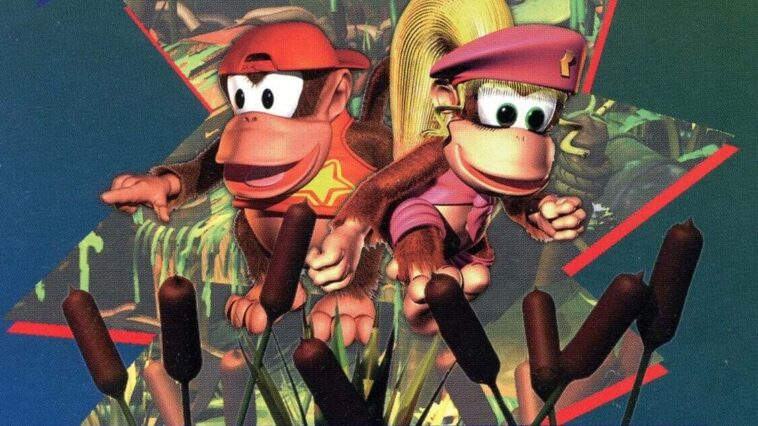
Throughout the 2010s, the YouTube algorithm would summon a mysterious transmission. Uploaded in 2012 by a user named “taia777,” the video featured a 15-minute loop of David Wise’s “Stickerbush Symphony” over a cascading image of thorn bushes in the sky, taken from the levels scored by the song in the 1995 Super Nintendo (SNES) game Donkey Kong Country 2: Diddy’s Kong Quest. This video appeared like an apparition to thousands of users, and the title was spelled in Kanji, making it difficult to rediscover on your own. The first “internet checkpoint,” as it became known, had to visit you.
When it did, users took it upon themselves to write sentimental passages to Wise’s sentimental score, reflecting in the comments on triumphs, tragedies, and affirmations on addiction, griefor simply being stuck in life. More than any other song from a Super Nintendo game, “Stickerbush” seems to have a therapeutic purpose. It appears when our chaotic lives need serenity, when carrying on means taking a moment to reflect.

Wise could never have anticipated the song becoming the anthem for the internet’s collective memory, but it was always intended to soothe chaos, both in his life and inside the game itself. Rareware (now Rare Limited), the British developer of the DKC trilogy, carved out an unprecedented niche in the fourth generation of console gaming, transcending standard 16-bit graphics with unreal pre-rendered 3D animations and backgrounds. These games were phenomenally designed, full of cheeky British wit and personality. They were also hard as hell, and Donkey Kong Country 2 was the most difficult. Almost left on the cutting room floor, Wise’s composition was chosen at the last second to score the game’s ridiculously difficult “bramble” levels: The song’s capacity for healing made the effort of trying and failing at these levels again and again feel worth it.
Pushing the SNES to its technical limits was practically an employee requirement while working at Rareware. As their most ambitious composer, Wise set his sights on the console’s SPC700 sound chip, maximizing its potential by conceiving an inventive, maddeningly strenuous composition process. The majority of SNES composers took a standardized route of composition, using a shared pool of MIDI instruments alongside Nintendo’s lent-out development tools. The SPC could easily recognize and process these sounds, and an entire score could snuggly fit within the tiny 64kb of allotted space. Wise knew that these hackneyed tools would get him nowhere.
Instead, he coded his own instruments from scratch, altering their pitches, lengths, and timbres second-by-second in a tracker with hexadecimal code. On an actual synth, like the Korg Wavestation, it takes a split second to write and record a series of complex notes with varying timbres. Wise’s coding meant it took days, sometimes weeks, to do the same. He felt “frustrated all the time,” but he kept pushing. By the time he got to “Stickerbush,” the arduous process was “mastered,” in that he no longer had to play refrains on a keyboard first: He’d code them directly from his hums.



GIPHY App Key not set. Please check settings