
Suzanne Haag’s 2023 reimagining of Petrushka veers far from the familiar ballet story. Instead of three puppets in a 19th-century fair booth, there are three artificially intelligent beings in charging docks. Instead of revelers making merry around them, there are humans whose interactions are mediated by virtual reality—in real life, they never touch each other.
For Haag, resident choreographer and associate artistic director of Eugene Ballet, the piece was a way to look at what technology is doing to humanity and human connection. She wanted to hold up a mirror to the audience to ask, “How do we feel about this?” she says. “Are we okay with this? Is this the direction we all want to be heading in?”

As AI technologies proliferate and become an increasingly inescapable fact of modern life, choreographers are not only experimenting with AI tools, but they’re also creating works that grapple with the potential repercussions of artificial intelligence and the existential questions it raises. “That’s what artists do,” says Lise Friedman, adjunct professor at New York University and co-organizer of a 2025 symposium on dance and technology. “Artists are always interested in looking around the corner.”
Peril and Promise
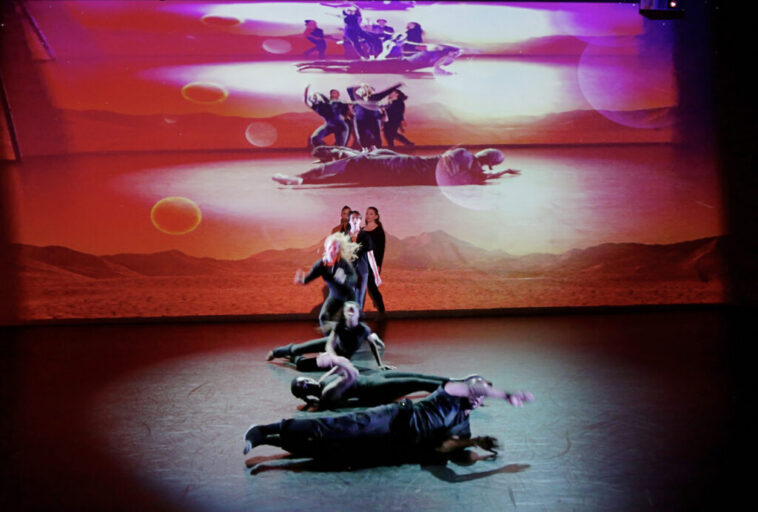
In Felice Lesser’s 2022 Trap Ist, the future is grim. “I was really worried right from the get-go with AI, about it taking over and destroying the human race,” says Lesser, whose work reflects this fear. “Nobody’s putting on the brakes, and that worries me.” Her narrative begins when a group of humans—including an aging choreographer, several dancers, and the audience—are beamed to another planet and enslaved by AI.
Ultimately, the humans in her story defeat their AI captors and get beamed back to an Earth-like planet. Having made the audience a part of the Trap Ist journey, she implicates and charges them with being part of what happens next, outside the theater.
Here and below: Felice Lesser Dance Theater in Trap Ist. Photos by Gerry Goodstein, Courtesy Felice Lesser Dance Theater.


“A lot of times, people see themselves in performance,” says choreographer Troy Schumacher, who explored AI, neuroscience, and bioethics in his 2022 Step the Brain Along a Path, a collaboration between Terminus Modern Ballet Theatre, Georgia Tech, and Emory University. He involved his audience in a more abstract piece probing both “what could go right and what could go wrong.” Performed just months before the public release of ChatGPT, “it wasn’t a ballet about, ‘Will a computer be able to write an email for me?’ ” he says. “It was a ballet about what happens when the AI discovers the parts of our brain that control our emotion or our physical capability.”
Schumacher chose to make the piece both optimistic and scary, to offer people a chance to ponder how advances that offer a sliver of hope to those who desperately need it can also be abused. What if technologies intended to help those with movement disorders, for example, were also used for fun—or for ill? One scene in Step the Brain Along a Path begins as a kind of game: A dancer’s limbs are controlled by other cast members without any physical contact. “The moment starts out quite humorous, and then it turns slightly nightmarish,” Schumacher says. “You start questioning: ‘What does that mean for my own body and my own bodily autonomy?’ ”
 Here and below: Troy Schumacher’s Step the Brain Along a Path. Photos by Felipe Barral, Courtesy Schumacher.

With and About AI
For some choreographers, using AI tools and other technologies as part of a creative process is their way of grappling with broader cultural, societal, and existential questions. “For us, a lot of times the subject is the how,” says Rashaun Mitchell, who presented Open Machine with choreographic partner Silas Riener in September. The piece imagines an AI programmed by experimental dance, making use of several types of machine learning—including speech-to-text transcription, body tracking, and 3-D modeling—to create live media.
 Here and below: Rashaun Mitchell and Silas Riener’s Open Machine. Photos by Paula Lobo (2) and Greg Kessler, Courtesy Mitchell and Riener.


AI tools are “exploding into our field of view and experience,” Riener says, “and I am wanting to use the medium of my own expression” to examine the implications. “If it was a three-dimensional shape, I’m rolling it around and looking at it from lots of different angles, and thinking about how these AI tools might allow or reveal certain kinds of new experiences,” he says.
In a sense, dancing with AI can inherently mean dancing about AI. “I don’t see a separation at all,” Friedman says. “You can’t grapple with one without grappling with the other.”
The encounters Raissa Simpson and her dancers had with technology while making 2023’s Performable Posthumanism influenced both substance and form. Dancing with drones programmed with AI, for example, altered the way the dancers navigated space. “We have lost a little bit of our humanity because we are trying to cater to the way that (the drones) move,” says Simpson, founder of San Francisco–based PUSH Dance Company.
Part of the Conversation
By dancing both with and about AI, artists are asserting that they and their art form should be involved in the larger discussion about these emerging technologies. “Dance is part of everything, and not just siloed in its own area,” says Mitchell. His and Riener’s deeply interdisciplinary approach to dancemaking is to “find a way to integrate it, or to highlight how it already is integrated,” he says.
Dances about AI can also illuminate the biases and inequities of the artificial intelligence field. Simpson’s Performable Posthumanism grew out of her interest in algorithmic fairness—or lack thereof—as the scope and prevalence of AI technologies continuously expand. “What I like to do is not just reflect the times that we live in, but start to unearth those voices that are not normally heard,” Simpson says. She collaborates primarily with Black technologists and estimates that about 80 percent of the performers she works with are Black and/or multiracial. Seeing them onstage, engaging with the technology, is important, says Simpson, who hopes it can help disrupt everyday conversations in the tech world.
“It always kind of baffles me that tech is largely male and white. Because you need everybody in the room,” says Simpson. That includes artists and minority and marginalized demographic groups. “People that don’t work in tech should definitely have a voice in how it’s developed, because they will be using it.”
 Here and below: PUSH Dance Company in Performable Posthumanism. Photos by Anthony Green (2), Courtesy PUSH Dance Company.


A Profoundly Human Art Form
Dance may not be the ideal medium for debating the semantics of algorithms or public policy. But it does offer something other forms of discourse about artificial intelligence may not: a visceral, emotional, profoundly human experience.
With dance, Haag says, “We’re using humans in real time to show this story or thought to other humans, and I think that allows for a greater connection,” especially if you’re seeing “someone that reminds you of you doing or feeling something you may do or feel.”
For Haag and others, reflecting on works created even two or three years ago is a reminder of how rapidly artificial intelligence has advanced and how deeply it has insinuated itself into every aspect of our lives. What felt futuristic and fantastical then seems imminent and urgent now.
Haag will have a chance to revise when she restages her Petrushka in April. “I feel like I just scratched the surface the first go-around, and I think I can dive deeper,” she says. She’ll keep exploring “how our world’s developing around the technology that’s available to us now” and what it means for humanity. “It feels a little more timely.”
But what hasn’t changed is that “I have no answers,” Haag says. “The whole ballet was a big question.” She and her fellow artists will continue to ask it—and invite audiences to do the same.
The post How Choreographers Are Making Works That Imagine the Implications of Artificial Intelligence appeared first on Dance Magazine.




GIPHY App Key not set. Please check settings