
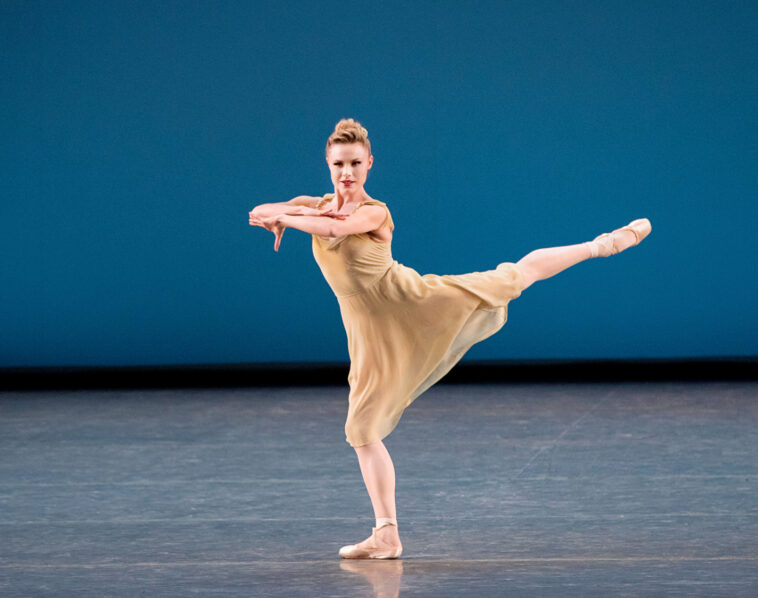
When Sara Mearns was a young dancer with New York City Ballet, she says, she kept finding herself in a certain kind of role: “big dancing, dramatic, romantic, emotional.” It took her late coach Susan Hendl to imagine her in something different, casting Mearns in Jerome Robbins’ Dances at a Gathering. “She was the first person that took a chance on me doing something quieter,” says Mearns. “I’m so grateful to her, because once she did that, then everybody else saw it and was like, ‘Oh, wait, she can dance another way.’ ”
Typecasting happens in dance just as it does in film, TV, and theater. It’s not uncommon for dancers to gravitate toward or get slotted into similar roles based on their technique, movement quality, personality, height, or any number of factors. It can become frustrating to feel like you’re doing the same kinds of roles over and over again. But it’s also possible to push past your “type”—whether that’s how you see yourself or how others do—to try new things, expand your range, change perceptions, and ultimately grow as an artist.

Expanding Beyond Strengths
The word “typecasting” comes loaded with connotations, often negative. And the practice can be limiting and even harmful, especially when it plays into racial or other stereotypes, says Francesca Harper, artistic director of Ailey II.
Ailey II’s Jordyn White rehearsing Judith Jamison’s Divining with Francesca Harper. Photo by Danica Paulos, Courtesy AAADT.
But typecasting isn’t always a bad thing, suggests Mearns. “When you immediately see somebody that has a certain strength, you want to emphasize that, you want to capitalize on that, and you want to show them in the best possible light,” she says. “So you play to their strengths. You give them ballets that they can excel in. And then, through that, they get stronger, and then maybe they can expand a little bit.”
Adam McKinney, artistic director of Pittsburgh Ballet Theatre, takes all sorts of considerations into account when programming and casting seasons. It’s true that some artists are more proficient at certain styles and steps, and that a company strives to produce the best work and experience for audiences. But a leader’s job, McKinney says, is also to develop dancers, giving them varied opportunities and challenges to help them evolve rather than pigeonholing them. “In fact, I try to cast against ‘type.’ ” he says. “We learn so much about ourselves, as artists and as people, through the repertoire that is offered to us.”
Taking Risks
It may feel like getting beyond typecasting is out of your hands as a dancer, but there are steps you can take to make headway. “Some of the things that I talk to my dancers about when they are feeling that they’re in a rut or being typecast is to really start training outside their specialty,” says Harper, who encourages dancers to study styles that contrast with their usual strengths, collaborate with new artists, and take workshops in settings where there’s less pressure. “We want to feel that we’re constantly expanding the spectrum of what we can share and offer and understand,” she says.
 Grace Rookstool, Ariana Chernyshev, and Diana Yohe in Cinderella. Photo by Aviana Adams, Courtesy PBT.
Creating her own work also helped Harper when she was feeling limited. Being a choreographer “was really exciting for me, to really get closer to my own artistry and my own voice, and then bring that to an audition, or bring that to another space,” she says. “Developing projects that share the different facets of your talent can shift how others perceive you.”
Perhaps most important is to remain open. “As artists, sometimes we have this clear trajectory in mind and we want everything to go as planned from day one. And sometimes there are unexpected opportunities,” says Harper, who encourages dancers to say yes when those diversions feel right. “See if embracing this discomfort can lead to some kind of artistic breakthrough.”
Communicating and Advocating
As a second-company director who works with young artists making the leap from student to professional, Harper frequently talks to dancers about advocating for themselves. “There’s nothing wrong in having a very elegant, respectful conversation and saying, ‘I just love this piece. I love this role. I feel like there’s something in it that’s going to push me forward,’ ” says Harper.
Dancers can absolutely ask to be in a rehearsal of a work they aren’t cast in, says McKinney, “so that they can learn and practice and process and embody.” These kinds of inquiries should be part of an ongoing dialogue and culture of communication. “I have conversations with artists about their goals, their needs, and their wants,” says McKinney, “and I work to provide artists with resources pertaining to repertoire.” This doesn’t mean walking into a director’s office out of the blue and demanding to dance Giselle, he adds. Instead, you might follow up on conversations about improving a particular skill and ask for an opportunity to sit in on a rehearsal.
 Adam McKinney teaching. Photo by Aviana Adams, Courtesy PBT.
The good news is that when you start expanding your range, it’s easier to keep going. “Once you do something and people notice, then other people notice. It’s sort of like a snowball,” says Mearns, who’s danced a broad range of roles at NYCB and beyond. “I boarded the train and I couldn’t get off. I got addicted to doing new things.”




GIPHY App Key not set. Please check settings