
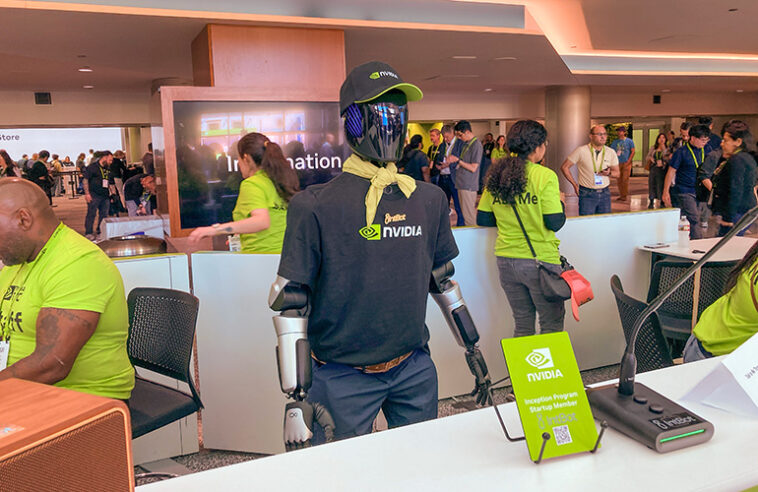
Front Desk Information Concierge assisted GTC 2026 visitors with navigation and event information. | Credit: The Robot Report
In just over a year, IntBot Inc. has gone from concept to full‑body humanoids greeting thousands of guests at NVIDIA’s GTC and in hotel lobbies. The Sunnyvale, Calif.-based startup has used 24/7 interaction footage and sentiment analysis to train a social intelligence engine that sits on top of off‑the‑shelf hardware.

At GTC 2026, CEO Lei Yang announced that the company‘s IntEng “general social intelligence engine” now supports multiple humanoid and service robots from different hardware vendors. He said this marked a significant step toward hardware-agnostic deployment of socially intelligent robots in real-world environments.
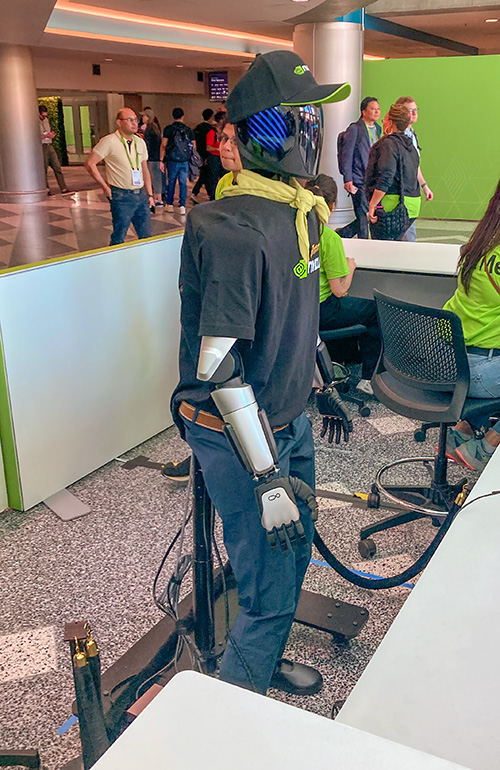
This full-length view of the IntBot humanoid shows its feet, although the robot was stationary and secured to stand for its shift at the GTC26 help desk. | Credit: The Robot Report
IntBot also showcased the first edge deployment of the NVIDIA Cosmos Reason-2 vision-language model (VLM) within its software stack. Running directly on robot edge compute systems, the model enables robots to perform real-time scene understanding, allowing them to interpret complex human environments such as crowded conference spaces.
“The first-generation robot was a pre-programmed kind of action. But for our robot, if you were at CES or watched the videos, all the emotions are generated,” stated Yang. “So even if you are not talking to the robot, the robot would respond with some very natural, very subtle motion, just the very side nodding, to show ‘Okay, I’m listening,’ or even the kind of motion to indicate ‘I’m alive.’ Everything is driven by our social intelligence.”
Running directly on robot edge compute systems, the model enables robots to perform real-time scene understanding, allowing them to interpret complex human environments such as crowded conference spaces.
According to Yang, ItBot’s robots use a form of audio-visual fusion, combining what it hears with what it sees, to better understand who in the scene is talking and what the speakers’ intent might be. This enables the robot to provide a more natural interaction with humans.
IntBot stays platform-neutral
While most humanoid startups chase ever-better locomotion and manipulation, IntBot is deliberately staying “hardware agnostic,” positioning its software as a social intelligence layer that can ride on top of whatever platforms the industry produces next.
Today, that stack powers Nilo, a full-body humanoid that works 24/7 as a multilingual concierge in hotel lobbies from New York to Las Vegas, blending on-device perception and body-language generation with cloud LLMs for deeper queries.
“Right now, we already have three hotels across the U.S.,” said Yang. “(We’re at) The Nap York in New York Cityand a second one is called Autonomous in Las Vegasand the third one is a Marriott Hotel in Tulsa, Okla. And all of these three robots operate 24/7, basically. They work alongside their human staff members, but IntBot offers add-on functions to augment what the human staff, concierge, or (other) people can do.”
By focusing first on noisy, real-world environments like CES and busy hotel lobbies, where earlier kiosk-style systems and robots like Pepper stumbled, Lei Yang is betting that mastering natural, multi-party interaction will be the key to getting humanoids accepted as everyday co-workers, not just trade-show spectacles.

IntEngine coordinates perception, communication in real time
Nylo’s ability to operate autonomously on the GTC show floor is powered by IntEngine, IntBot’s proprietary, multimodal, multi-loop social intelligence system. IntEngine fuses vision, audio, and language in real time to coordinate speech, facial expression, and gesture—enabling robots to perceive social context and respond naturally.
This architecture allows Nylo not just to respond, but to decide when and how to engage, which Yang said is an essential capability for operating in open, public environments.
The post IntBot bets the future of humanoids on social intelligence, not kung fu appeared first on The Robot Report.



GIPHY App Key not set. Please check settings