
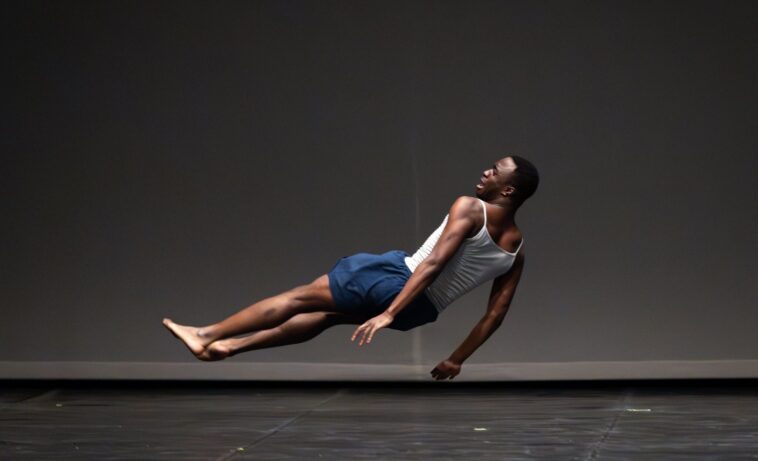
Born in Cecina, Italy, to Nigerian parents, Nnamdi Nwagwu doesn’t remember a time when dance wasn’t part of his life. Dance was always present in his family home, and after a short, unsuccessful stint with basketball, he began formal training at 6.
At 13, he received a scholarship to study at Professione Danza Parma in Parma, Italy, and began rigorous ballet training. Over the next few years, Nwagwu competed in numerous solos. But at 16, he discovered a love for choreography—creating a solo for himself that went on to win first place in the Contemporary Dance category at the 2020 YAGP semifinals.

Winning at YAGP launched Nwagwu’s professional career, leading to gala appearances around the world and a richer exploration of his choreographic voice. It was during this period that Nwagwu began to understand the political nature of his presence onstage. “Even just being in spaces as a Black artist, I am political. Being onstage and working in a company is political for me.”
At 18, he auditioned for Codarts University for the Arts in Rotterdam, the Netherlands, where he was accepted. That same year, he left school for a month to choreograph for Stuttgart Ballet.
Now 22 and graduated, Nwagwu has emerged as part of a new generation of choreographic voices in Europe. As he continues to establish himself, he is defining his artistic priorities while navigating life as a freelancer.
Photo by Nicolò Parsenziani, courtesy Nwagwu.
On Being an Afro-Italian Artist
“When I was 14, I went to study at The Ailey School in New York City. That was the moment I realized some dancers looked like me and had roots like mine.
“And they weren’t the stereotype of ‘Black dancers.’ Sometimes people find out I’m a dancer and assume I only do hip hop or break dancing. But at The Ailey School, I thought: Oh, there are people like me at the ballet barre. And that stereotype didn’t exist anymore. That’s when I realized I could also be a professional dancer.
“I was a huge fan of Misty Copeland, Michaela DePrince, and Carlos Acosta, but they were American or outside of my Italian dance world. That’s why I now feel a responsibility to represent what Black artists can do in Italy and Europe.
“That’s why I always say I am Afro-Italian. Yes, I’m Nigerian—my blood is 100 percent Nigerian. But I’m also Italian. I was born and grew up in Italy, and I speak and think in Italian.
“So I’m a queer, Black, Afro-Italian artist, and I need to be in spaces where there aren’t people who look like me—because I can open doors for others to come after me, in the way doors were opened for me.”
 Nwagwu with dancers Riccardo Ferlito and Edoardo Sartori. Photo by Roman Novitsky, courtesy Nwagwu.
Advice on Freelancing
“I’ve realized networking only works if you’re able to be true to yourself. Go see shows. Talk with directors, choreographers, and programmers.
“Freelancing is about community. I have never heard of a freelancer doing things by themselves. To me, ‘freelance’ means there is a ‘lance’ you are ‘freely’ moving through. Your lance is your community, and it gives you the freedom to take jobs as they come.
“But if you’re free and not putting in the effort to be part of a lance community—if you’re just lancing, or swimming around—then the whole system doesn’t work.
“For me, freelancing is not just about the physical work; it’s also about data analysis. Who is following you on Instagram? Which director is appreciating your work?
“…Networking also means saying, ‘Okay, I’m going to do a side job because I can’t find a project right now.’ I’m going to put that money aside, take a big trip, and go to a choreographer and say, ‘Hey, I want to work with you. I don’t know how, but I’ll be there—even if I’m in the corner, because I want to learn from you.’ ”
 Photo by Alex Avgud, courtesy Nwagwu.
On Choreography and Future Goals
“I think everyone has a mission in life, and I feel mine is to help people know their strength. That’s what I love about coaching: I can use my own taste and point of view to help dancers become not better but to see a different light within themselves. I like making people shine.
“…My honest dream is to be a versatile choreographer with a specific voice. Take someone like Marco Goecke—you can watch a piece by him and, without knowing the choreographer, immediately see that it’s Marco. I want to have my own recognizable movement language, one that can blend ballet companies and contemporary companies.
“…I also love creating characters and storytelling. Even if the world created isn’t explicit, there’s an energetic throughline. For me, it’s really about the energy. I think as a dancer, as a performer, my strength has always been my energy—my presence—and that’s what I really want to translate into my choreography.
“I like to say that in choreography, the brain knows where it’s going in terms of steps and memory, but for the body, it should always be a new experience. That’s what I want dancers to think about when we work and move together.
“Because at the end of the day, steps are steps. But through experiences, we can connect to humanity and bring empathy and honesty onstage.”




GIPHY App Key not set. Please check settings